Gemini 4 Hydrogen Scores Above Argon on Intelligence Index at Lower Cost
- Gate
- Machine Learning
- Departs
- Crew
- Matthias Bastian
- Passengers
- 728
Google's Gemini 4 Hydrogen beats the larger Argon on the Artificial Analysis index at $1.50 per million input tokens, but trails on terminal tasks.

The surprising part of Gemini 4 Hydrogen isn't that it's fast. It's that a model built for everyday work now scores above Google's larger Argon on a widely used independent index, and costs less to run.

Google positions Hydrogen as the successor to Gemini 3.8 Flash, a model for routine coding and agentic tasks. The frontier tier sits elsewhere: Gemini 4 Carbon, which Google introduced just two days earlier, and Gemini 4 Argon, which was built for long, multi-step reasoning on hard problems. Two days ago, Google was recommending Argon for daily coding. Hydrogen makes that advice look dated, less than four weeks after Argon's release.
Where Hydrogen sits in the lineup
Hydrogen's headline number comes from the Artificial Analysis Intelligence Index. At the default "high" thinking level it scores 51, ahead of Argon's 50. At the new top setting, "xhigh," it reaches 54. Argon offers only medium and high, so Hydrogen has more room to trade cost for quality.
The pricing is where the model gets interesting for developers. Hydrogen costs $1.50 per million input tokens and $7.50 per million output tokens, with cache hits at $0.075. It accepts a one-million-token input window and can produce up to one million output tokens. Carbon still leads the index at 59, so Hydrogen is not Google's top model. It is the model that makes the mid-tier choice harder to justify.
Google's numbers against Flash
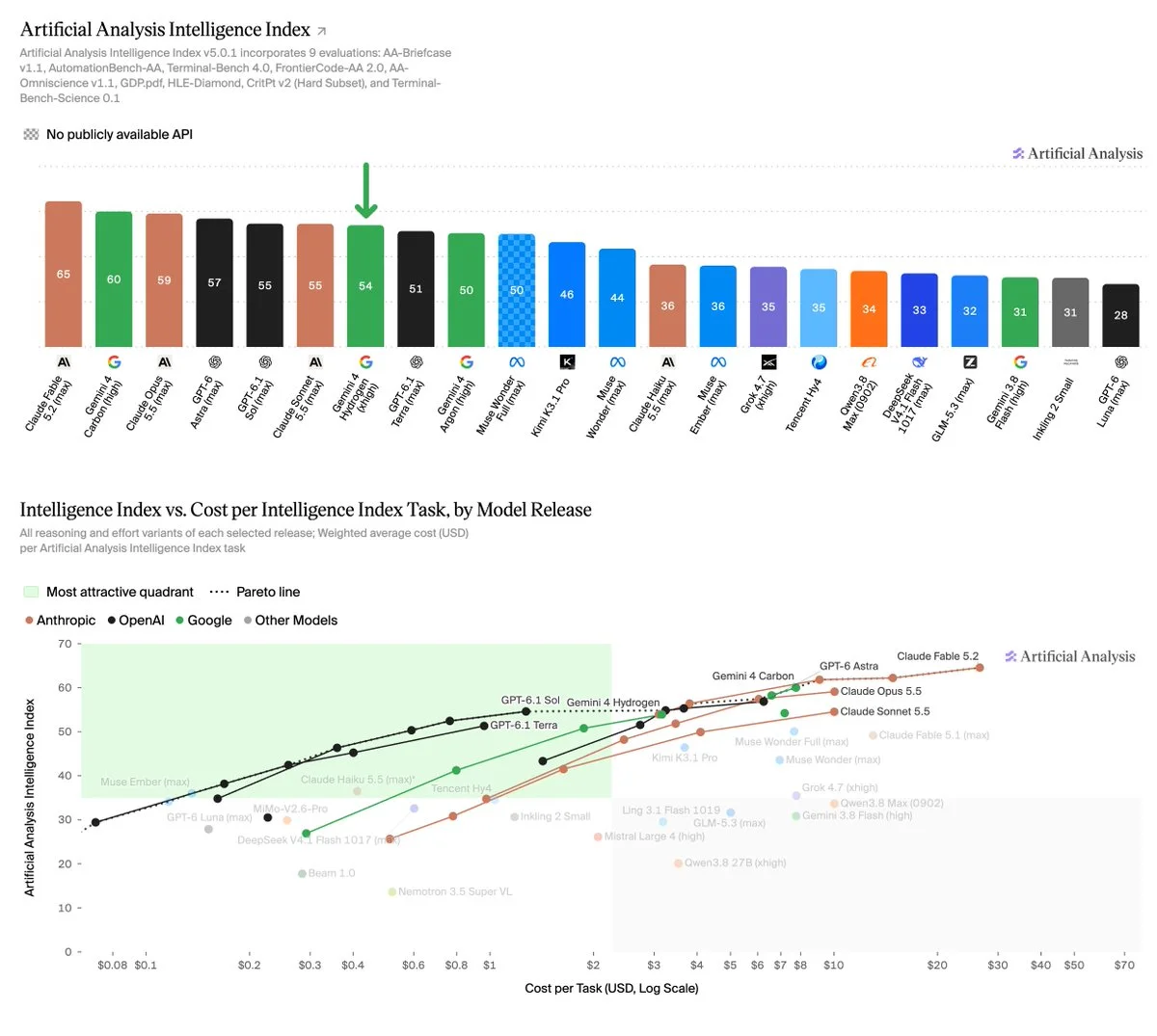
Against its predecessor, Google's claims are large. At the default thinking level, Hydrogen finishes tasks 2.5 times faster. On Terminal-Bench 4.1, the score rises from 18.2 percent for Flash to 57 percent for Hydrogen. Google also says hallucinations fell by a factor of five and that the model recovers better when a tool call fails or a search returns nothing.
Agentic results are more mixed. On open-ended tasks such as research, data analysis and code navigation, Hydrogen ranks fifth on the Agent Arena leaderboard. Google reports first place on the Vals Tax Agent Bench at 52.3 percent and a tie for first on the Vals Legal Research Bench at 55.8 percent.
The benchmark table below pulls the figures Google reported for all three Gemini 4 models. Many cells are empty because Google didn't publish those comparisons, so gaps shouldn't be read as zeros.
| Benchmark | Hydrogen | Carbon | Argon |
|---|---|---|---|
| AA Index v5.0 | 54 (xhigh) | 59 | 50 |
| SWE-sweep | 13.5% | 9.6% | 4.3% |
| Terminal-Bench 4.1 (cheating-adjusted) | 57.0% | — | — |
| Agents' Last Exam v1.1 | 71.6% | 77.4% | 69.0% |
| AutomationBench | 76.1% | — | — |
| OSWorld-2.1 (offline subset) | 77.6% | 81.5% | 74.7% |
| Chartography | 66.6% | 72.5% | 71.6% |
| HLE-Diamond | 58.8% | — | — |
Hydrogen also scores 53.4 percent on Google's new Multimodal Knowledge Agent Benchmark, aimed at summarizing large PDFs, spreadsheets and videos. Carbon leads on most of the other rows, including long-context retrieval, where it reaches 96.2 percent on GraphWalks against Argon's 84.2 percent. Hydrogen isn't meant to beat Carbon, and the table shows it doesn't.
What independent testing shows
Artificial Analysis places Hydrogen roughly level with Claude Sonnet 5.5 at its highest setting. At "high," the model drops to 51, just behind GPT-6.1 Sol and Claude Opus 5.5, which both score 52 at their respective settings.
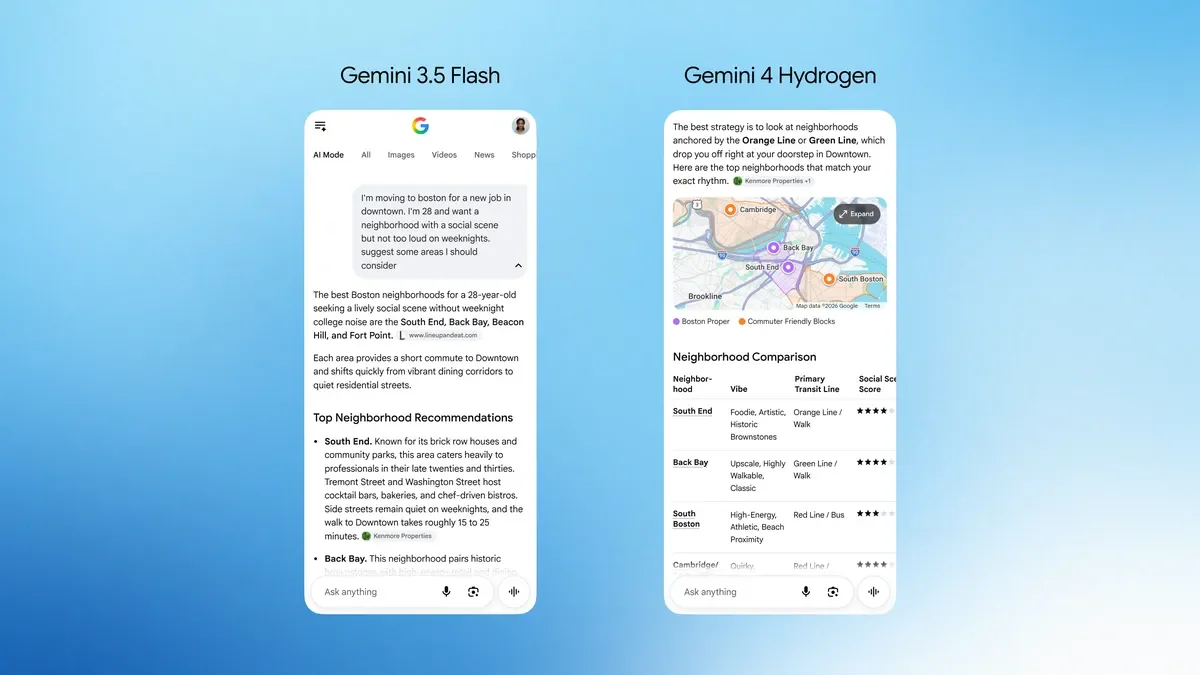
The strongest finding is on hallucination. On AA-Omniscience, Hydrogen makes things up 8 percent of the time. It also beats other Gemini models, Carbon included, on presentation quality in AA-Briefcase, which tests agentic knowledge work.
Terminal work is the weak spot. Hydrogen scores 54 percent on Terminal-Bench 4.0 and 50 percent on Terminal-Bench-Science 0.1. Claude Sonnet 5.5 at maximum effort reaches 64 and 53 percent, and GPT-6.1 Sol at maximum reaches 56 and 58 percent. If your workload is shell-heavy agent work, Hydrogen is not the obvious pick.
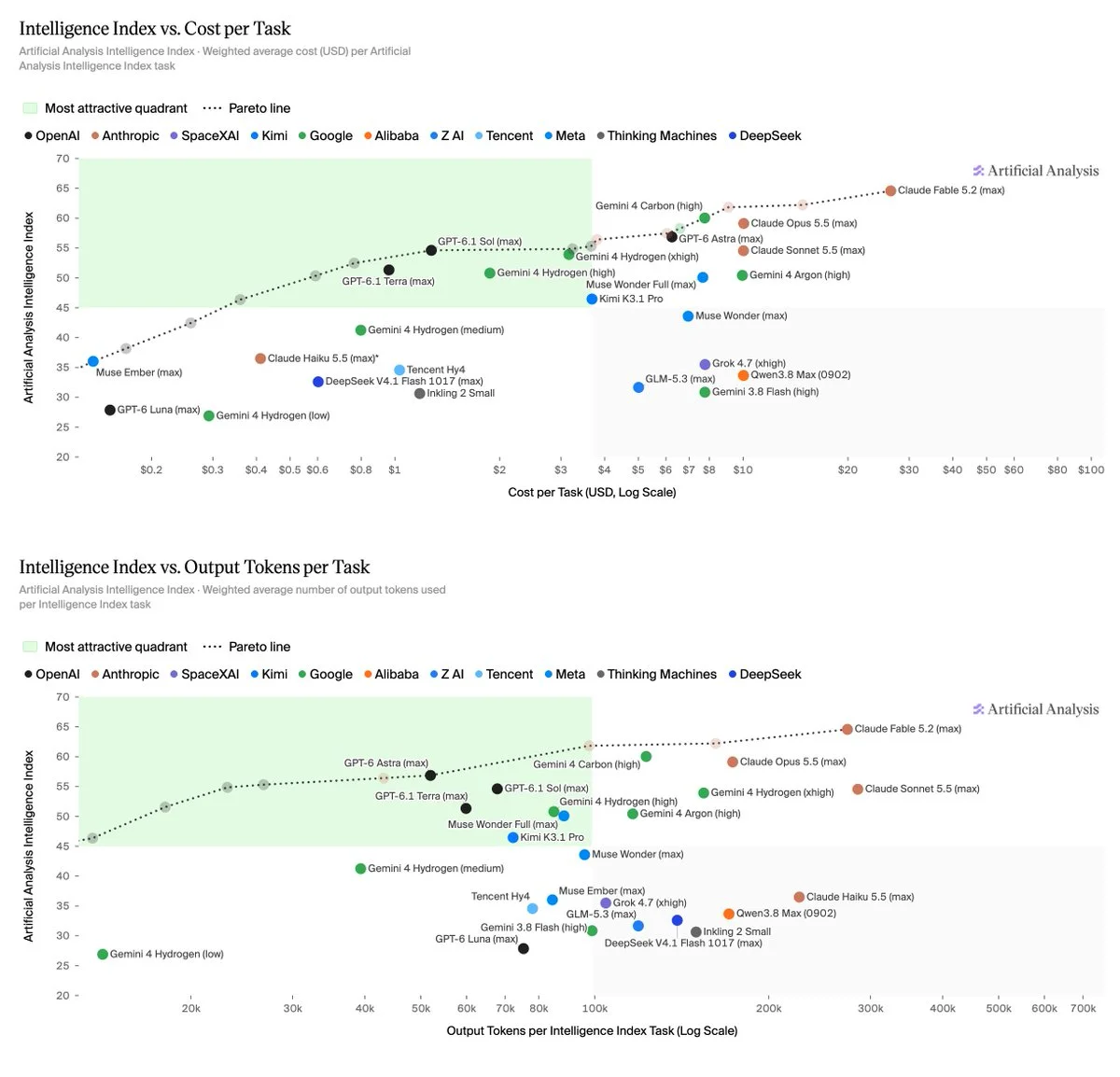
The cost picture depends heavily on the thinking level. Artificial Analysis puts the average cost per task at $3.16 for xhigh, $1.87 for high, $0.80 for medium and $0.29 for low. The xhigh tier burns nearly twice as many output tokens as high, which explains most of the jump. At xhigh, Hydrogen costs roughly a third of Claude Sonnet 5.5 at maximum effort, which scores close to the same, but about 2.5 times GPT-6.1 Sol at maximum.
Here's the thing: at medium and low, scores fall to 41 and 27. The model's value is concentrated in the high tier, where Artificial Analysis says it sits on the Pareto frontier, meaning no other model is both cheaper and smarter at that price.
Where it's available and how Antigravity uses it
Google is rolling Hydrogen out globally. Developers can reach it through the Gemini API in AI Studio and Android Studio. Paying Pro and Ultra subscribers get it in Google Antigravity, and business customers can use it through Gemini for Business. It is also available in the Gemini app and Google Search.
Antigravity adds a new orchestrator that switches between Carbon and Hydrogen within a single session. On Terminal-Bench 4.0, Google says the orchestrator nearly matches Carbon's success rate while using 24 percent fewer resources and cutting processing time by 19 percent. That approach matters more than the single-model score. Teams that route easy steps to a cheaper model and hard steps to a larger one can get most of the quality at a lower bill, if the routing holds up on their own tasks.
The open question is whether Hydrogen's hallucination gains and its weakness on terminal tasks hold outside the benchmarks. Index scores are useful for ranking, but they don't tell you how the model behaves on your codebase. Run your own evaluation before replacing Argon, and check the xhigh token counts before you assume the top tier is worth its price.