Human-Made Games, AI-Assisted Proofs and the Power Bottleneck
- Gate
- Machine Learning
- Departs
- Crew
- Azeem Azhar
- Passengers
- 449
GTA VI’s reported handmade characters highlight a market for human craft, while competing Riemann proofs and grid queues expose AI’s verification and energy constraints.
Handmade work can still scale
Generative AI makes digital content cheaper to produce, but that doesn’t mean audiences will value every output equally. The reported production of Grand Theft Auto VI points to a different source of value: labor-intensive work that carries a clear human imprint. Rockstar’s 5,000 staff built the game without generative AI, and reports say its 30,000 unique characters were made by hand. The game brought in $3.79 billion by the end of its first day, including preorders. Those figures don’t prove that audiences paid a premium for handmade details, but they show that a large, carefully crafted digital product can reach a mass market.

That possibility matters because handmade work has often struggled to compete on price. In the 19th century, William Morris and the British Arts and Crafts movement resisted industrial production. Manual work couldn’t match the cost of mechanized goods, leaving its higher-priced products within reach of the wealthy. Morris described his life’s work as “ministering to the swinish luxury of the rich.”
Digital products change the economics. A game’s characters can be designed by hand once and then distributed to millions of buyers. The cost of the original labor remains, but each additional copy doesn’t require another round of production. That gives human craft a route beyond the small, expensive market that constrained earlier handmade goods.
The demand for a human touch may reach beyond games. In one study, people rated AI-generated paintings more favorably when they were labeled as made by people. The result suggests that a work’s perceived origin can affect how it is judged, even when the work itself is unchanged. As synthetic content becomes easier to produce, labels and provenance may help audiences find work they believe was made by people. Whether that preference can sustain a broad market remains open; for now, the game’s reported scale is a notable example of human labor reaching mass digital audiences.

What formal verification can add to a proof
Two claimed proofs of the Riemann hypothesis surfaced on the same day, putting the question of verification alongside the question of authorship. Levent Alpöge, a mathematician at Anthropic, said he and Claude may have proved the conjecture. Stanford mathematician Ravi Vakil separately announced a proof by Alessandro Masullo, described as “all human, with no AI.” The claims have not been established here as correct.
Alpöge says his proof runs to 17.4 million lines of Lean, a formal language used to express logical arguments in a form that can be checked mechanically. Masullo’s proof was still being examined by a third party, and a team was translating the argument into Lean to make it easier to verify. The two efforts therefore highlight different routes to a result: one developed with AI assistance and expressed in a formal system, the other attributed to a human mathematician and being converted into that system.
Lean can check whether a formal proof follows from its stated premises and rules. That kind of checking can catch gaps that ordinary review may miss, but it depends on translating the mathematical argument correctly and encoding the relevant definitions and assumptions. Formal verification strengthens the case that a proof is internally sound; it doesn’t by itself resolve every question about how the result was found or whether the formalization captures the intended mathematics.
Scott Aaronson has argued that results verified in Lean have not later been retracted. That record gives researchers a reason to use formal tools when checking difficult claims. It also signals a shift in mathematical practice: human and AI-assisted work alike may increasingly need a machine-checkable form before other researchers can assess it with confidence.
Anthropic’s value is still an open question
Anthropic drew attention from financial markets during the week, prompting a practical question: what, exactly, is valuable about the company’s work? One possibility is that it could capture a share of the value AI creates across services built on intangible assets. Other scenarios range from licensing models that run on users’ devices to supplying AI as a utility.
Those possibilities depend on how customers use models and where the economic value accumulates. Licensing access to a model, running it locally, and providing a shared service each imply different costs and relationships with customers. The available scenarios frame a set of business possibilities; they don’t settle which one Anthropic can sustain.
A separate reflection on conversations with people inside the company described a tension in its approach: a belief that a dangerous technology must be built quickly, paired with the belief that its own team is best placed to build it. That tension matters to any assessment of the company’s strategy. A compelling technical product and a durable business model are distinct questions, and both remain central to understanding what the company is selling.
Power access is shaping AI deployment
More than 2,000 gigawatts of new power plants and batteries are waiting to connect to the US grid—more capacity than all the power plants currently running in the country. About 85% of that queue is for solar, wind and storage. The backlog puts a physical constraint alongside the demand for more computing: data centers need electricity, and access to new supply can take time.
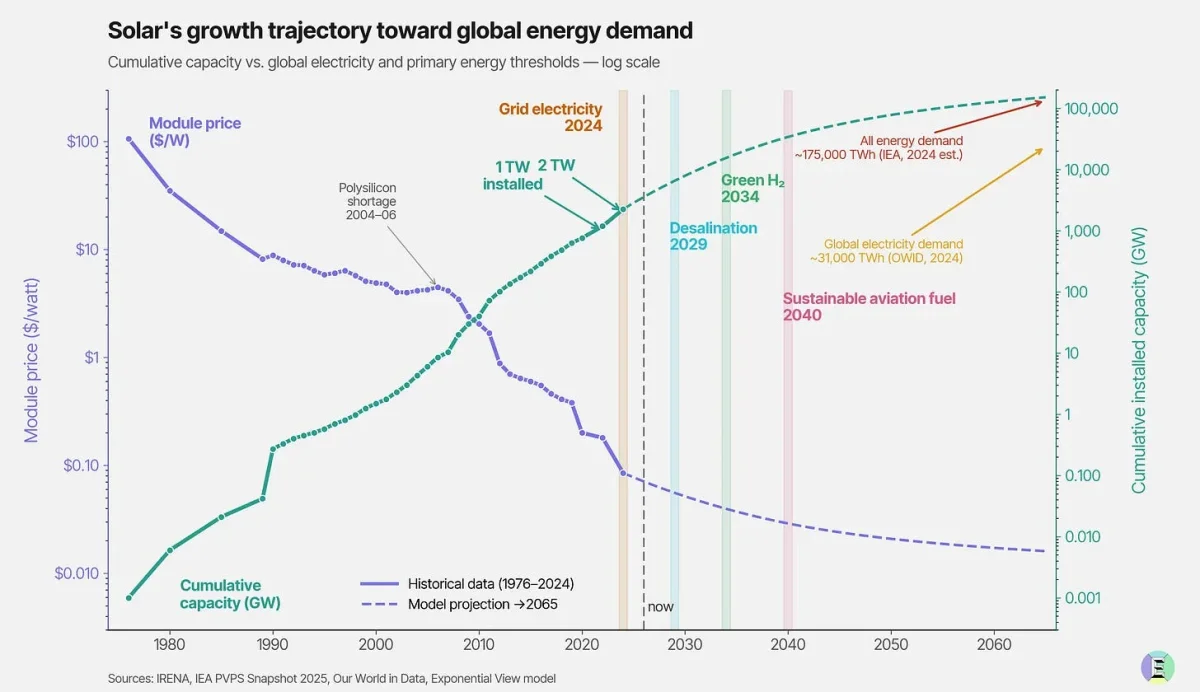
Solar modules have continued to get 24% cheaper with every doubling of capacity, a pattern described by Wright’s law. Falling costs can make solar useful in places where it previously wasn’t practical. But cheaper panels don’t immediately solve the problem of connecting new generation to the grid. When projects wait for interconnection, developers and data center operators have to weigh the value of waiting against the cost of alternative power.
An AI chip rents for about $3 an hour, while a month spent waiting for power can cost more than the electricity itself. That comparison shifts attention from the price of computing hardware to the schedule for getting it online. An underused chip still carries an hourly cost, so a delay in power access can erode the economics of a planned facility.
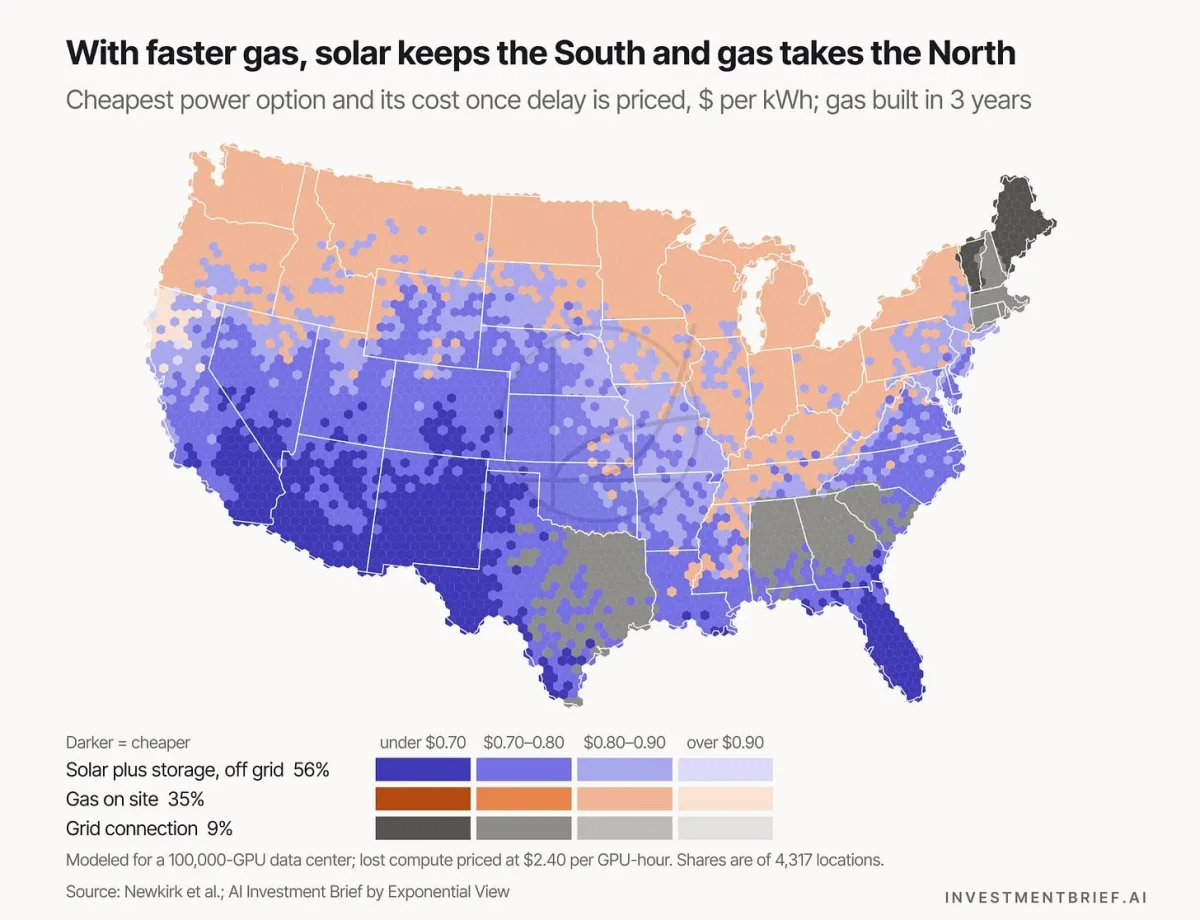
On-site solar and batteries offer one response. A recent analysis said they are the cheapest option for powering data centers in half of the United States. The practical result will depend on local conditions and on whether a site can match its supply with the facility’s demand. For AI developers, the next buildout depends as much on power availability and deployment timing as on advances in chips. Human craft, proof checking and power access each point to the same broader constraint: technical capability only becomes valuable when people can trust it, pay for it and put it to work.