Exploring Flash Attention 4: Architecture and Implementation for Efficient Transformer Processing
- Gate
- Machine Learning
- Departs
- Crew
- Charles Frye
- Passengers
- 523
Flash Attention 4 achieves a ~20% speedup over prior attention kernels through advanced asynchronous architecture and novel techniques in GPU programming.
This blog post made the front page of HackerNews! Discussion here.
This blog post was presented to the GPU MODE Discord! Watch the recording here.
Tri Dao recently showcased preliminary results on Flash Attention 4 (FA4) at the Hot Chips conference. FA4 is the latest in the Flash Attention series, specifically designed to optimize GPU computations for attention layers in Transformer neural networks. As generative AI workloads increasingly rely on these computations, performance improvements become crucial. Billions of dollars are being invested into GPU resources to expedite these operations, making the release of Flash Attention 4 a significant development for achieving faster processing speeds.
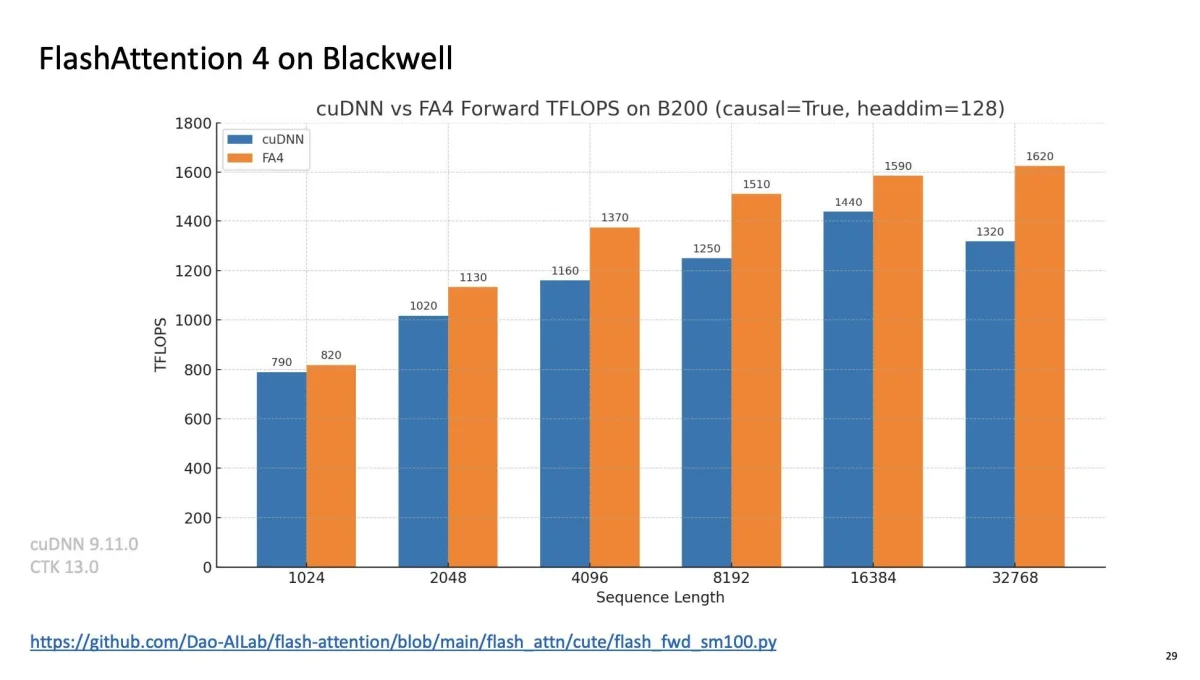
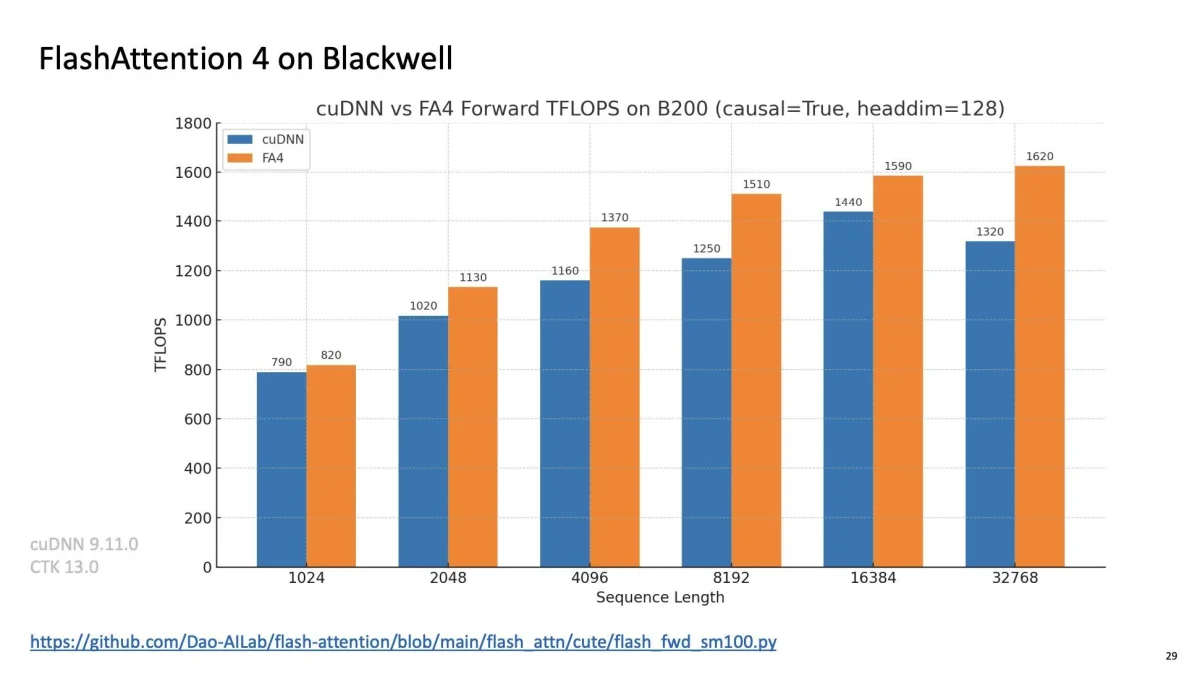
The new kernel leverages Nvidia's cutting-edge Blackwell Streaming Multiprocessor architecture, achieving approximately 20% faster performance than the previous state-of-the-art attention kernels found in Nvidia's cuDNN library. Unlike cuDNN, which remains closed-source, FA4's source code is openly available, allowing for transparency and inspection by the developer community. This write-up details our reverse-engineering efforts of the FA4 kernel, shedding light on its architecture and unique features.
A Quick Overview of Flash Attention 4: Understanding Its Architecture
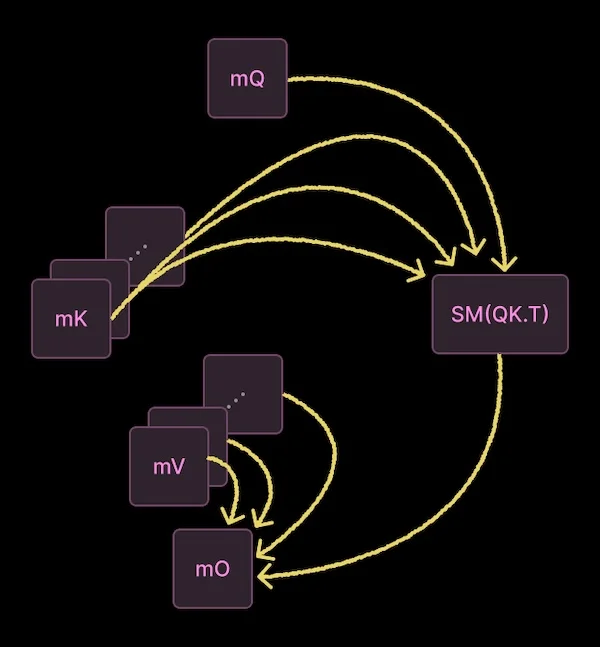
FA4 begins with bf16 tensors containing queries, keys, and values located in global memory (GPU RAM), with the goal of producing corresponding output tensors of weighted values based on similarity scores computed from the queries and keys. This process necessitates matrix multiplication, exponentiation, and normalization, all of which are computationally intensive.
To address this challenge, the problem is deconstructed into smaller manageable tasks. The large input tensor is divided into smaller sections referred to as "tiles," with each tile contributing to the overall output. Specifically, a single execution instance of the kernel generates two tiles of the output tensor using two input query tiles, streaming in the associated key and value tiles as needed. This design can be likened to a vectorized scan against a key-value store.
By executing this tile-level computation concurrently across many instances, FA4 provides a highly efficient model that adheres to the CUDA programming paradigm, utilizing the "single program, multiple data" execution strategy. Flash Attention 4 incorporates two key concepts: enhanced pipeline concurrency and warp specialization, both of which help in maximizing processing speed.
Pipelining and Warps in FA4: A Deeper Look
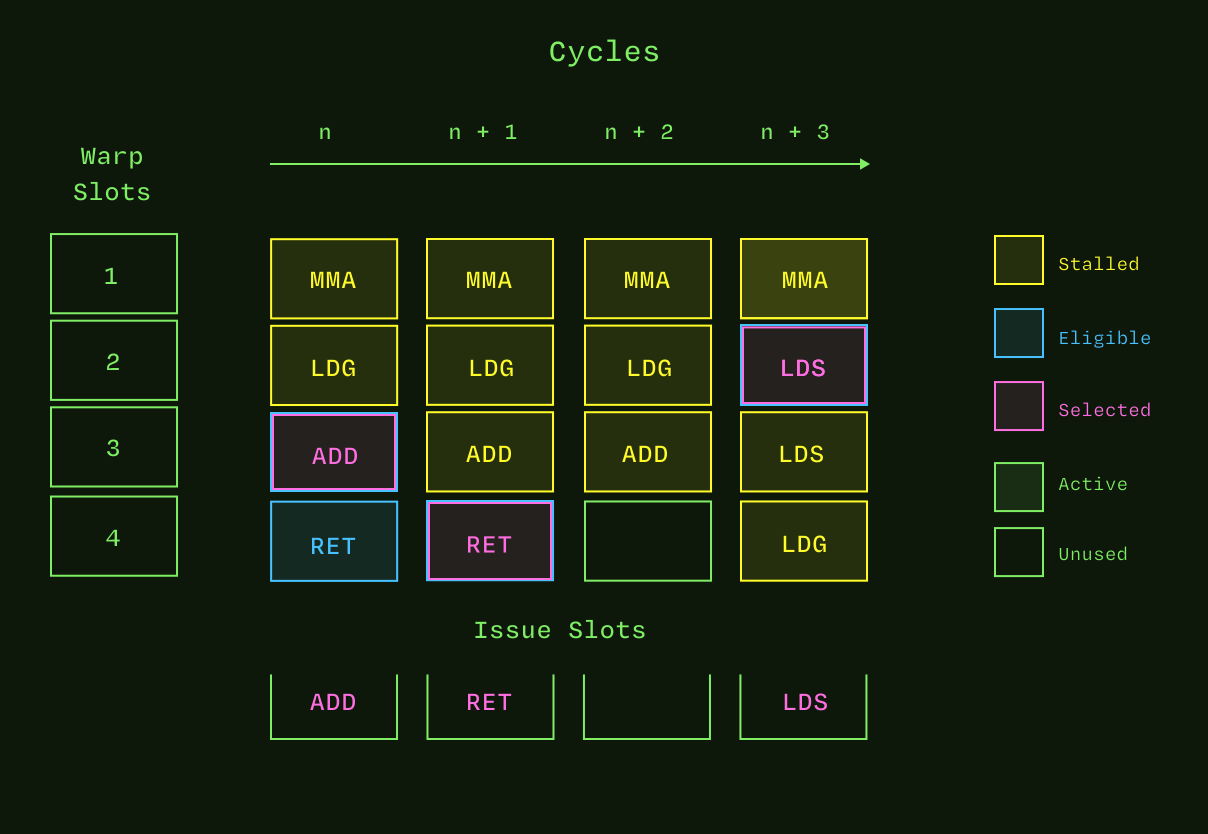
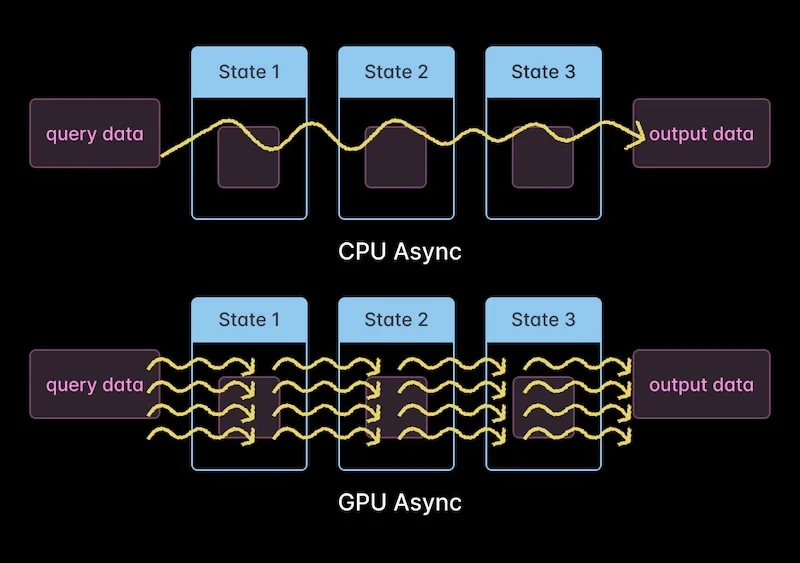
The asynchronous operation pipeline within FA4 significantly enhances the performance of the attention computation. In contrast to traditional CPU asynchronous programming, where a single thread carries data through a linear series of transitions, FA4’s GPU pipeline involves multiple concurrent operations handled by groups of warps. Each warp, formed from 32 threads, executes distinct transformations at different stages of processing, utilizing the GPU's warp scheduling capabilities to efficiently manage execution cycles and stalling.
This scheduling mechanism operates at high speed to maximize the use of available execution slots. The rapid switching of warps allows for maintaining resource utilization across various processing stages, grounds which are typically overlooked in standard CPU-based models.
Understanding the functionality of each tile during its lifecycle in FA4 provides insight into the memory hierarchy of the GPU, encompassing the movement and transformation from queries to outputs through shared and global memory layers. The overall architecture facilitates a high level of concurrency while also allowing for effective memory management throughout the tile lifecycle.
Detailed Breakdown: The Function of Each Warp in FA4
FA4 employs several specialized warps, each responsible for specific tasks within the computation process:
- The Load warp loads tiles from global memory into shared memory.
- The MMA warp computes the unnormalized attention scores and updates the output tiles.
- Eight Softmax warps compute the normalized attention scores while maintaining running statistics.
- Four Correction warps manage normalization adjustments for output values.
- One or two Epilogue warps store the processed output back into global memory.
The Life of a Tile: Step-by-Step Execution in FA4
Within FA4, the initial tile of queries is loaded into shared memory, along with the associated key and value tiles. The Load warp initiates this process, which involves efficiently handling asynchronous copy operations through mechanisms like Tensor Memory Accelerator (TMA) to prevent register overflow caused by accessing multidimensional arrays.
After loading, the MMA warp calculates unnormalized scores using the corresponding keys and queries, and subsequently, the Softmax warps perform normalization on these scores to derive the required probabilities. A pivotal enhancement in FA4 is the new implementation of exponential calculations, which utilizes a polynomial approximation method for efficiency, along with transformations to avoid accuracy issues typical of floating-point operations.
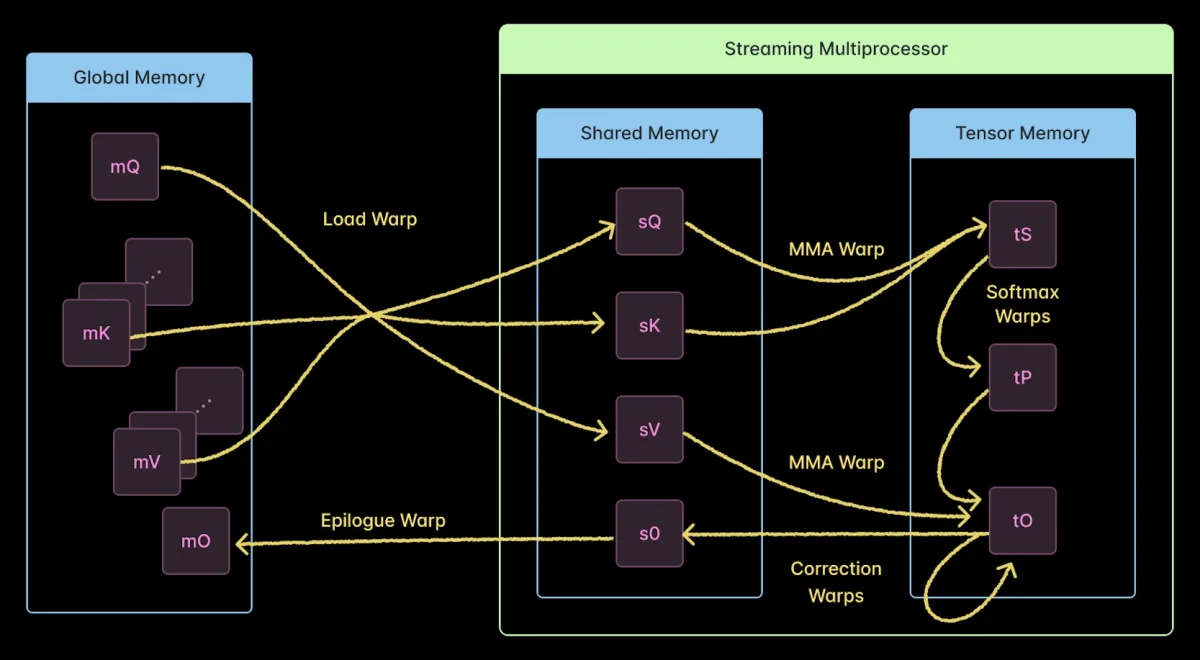
The algorithm avoids the previous method of using Special Function Units for exponentiation, allowing greater flexibility and reduced queueing issues, thus leading to resource optimizations. The Correction warps then adjust the final outputs based on the latest scaling factors, significantly improving the efficiency of the model.
Finally, the Epilogue warps finalize the output processing, ensuring that the computed values are stored and ready for retrieval in global memory, completing the execution of the tile.
Future Directions and Implications of Flash Attention 4
The evolution towards more complex asynchronous programming models in GPU architectures like Blackwell signifies a critical shift in GPU programming. Enabling greater concurrency through structured memory access patterns is paramount for optimizing resource utilization and extending computational capabilities.
Current advancements are indicative of Nvidia's commitment to enhancing the efficiency of numerical computations within AI and machine learning workloads. Future works may involve even more sophisticated memory scheduling techniques and optimizations that could help address the limitations developers face when working with asynchronous GPU architectures.
FA4 serves as a prominent example of these trends, laying the groundwork for improved methodologies in high-performance computing. Research and development teams should consider how these concepts can be applied to future projects, especially within their own GPU-heavy workloads.
To wrap up, the introduction of Flash Attention 4 reflects a noteworthy innovation aimed at pushing the performance envelope for AI workloads, contributing to the broader landscape of optimized GPU programming.


