Meta's Muse Spark Open Competes in the Open-Weight AI Model Arena
- Gate
- Machine Learning
- Departs
- Crew
- Matthias Bastian
- Passengers
- 956
Muse Spark Open from Meta is positioned as a leading open-weight AI model, designed for various tasks and showcasing strong performance against its peers.

Meta’s latest release, Muse Spark Open, marks a significant step into open-weight AI models following the Llama series. With its development, Meta aims to offer an advanced solution tailored for coding and agentic tasks, boasting an impressive architecture of 816 billion parameters, of which 42 billion are active. This model supports an extensive context length of up to one million tokens and is capable of processing text, images, video, and audio.

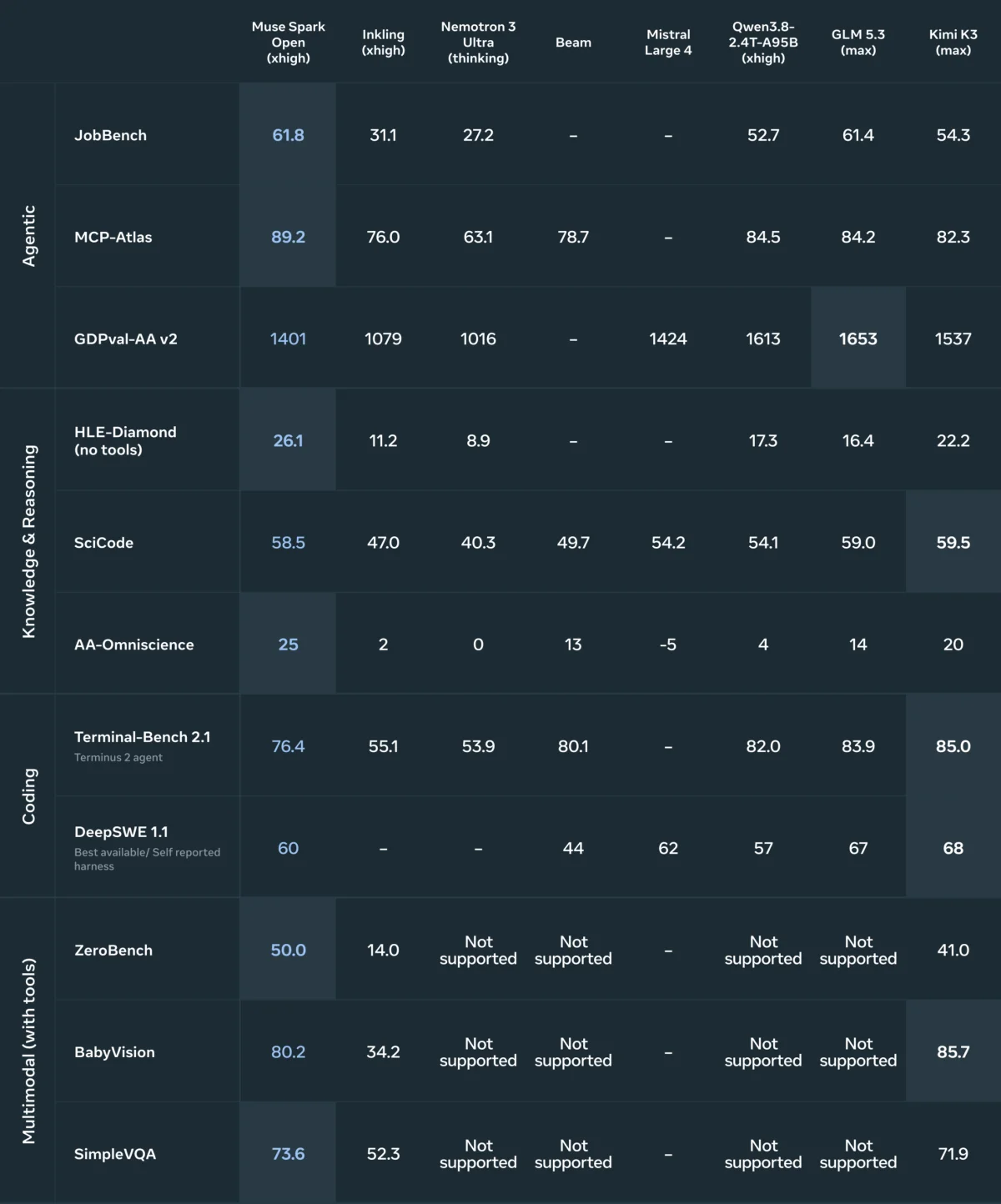
Performance Benchmarks
Meta's claims about Muse Spark Open are reinforced by its performance across several critical benchmarks. It reportedly outperforms competitors including Qwen 3.8, GLM 5.3, and Kimi K3 in categories such as Agentic capabilities, Knowledge and Reasoning ability, and Multimodal processing. However, it’s worth noting that when it comes to coding tasks, Muse Spark Open does not match some competing models.
In tests conducted on platforms like JobBench, MCP-Atlas, HLE-Diamond, and ZeroBench, Muse Spark Open showcases significant advantages in specific areas, although it still trails behind Meta's proprietary Muse Wonder Full models. This raises questions about the intended use cases for Muse Spark Open, suggesting that while it is an ambitious model, developers might need to assess whether it meets their requirements for coding tasks or if a more specialized solution would be necessary.
Technical Specifications and Deployment
The technical architecture of Muse Spark Open includes optimizations tailored for Apple's M5 Ultra hardware, demonstrating a focus on performance efficiency. Meta has confirmed that the model can operate locally on dual Mac Studios, each equipped with 512 GB of unified memory, making it accessible for developers working within this hardware ecosystem. Additionally, the availability of model weights on Hugging Face encourages community engagement and experimentation.
Licensing for Muse Spark Open is primarily structured to foster accessibility. Developers may utilize the model freely under the condition that they label their work as "Built with Muse Spark Open." However, for larger commercial applications—specifically for providers earning more than $20 million annually who aim to offer the model as an API service—a separate agreement with Meta is mandated to clarify usage rights and obligations. This licensing framework indicates Meta's strategy to balance open access with strategic partnerships in the AI space.
Comparative Analysis with Other Models
When assessing Muse Spark Open against peer models like Qwen, GLM, and Kimi, it's essential to consider both performance metrics and application suitability. While Muse Spark Open scores high in Agentic capabilities, knowledge processing, and multimodality, these strengths may not inherently translate to coding efficiency, a critical aspect for many developers. Thus, while it leads in some benchmarks, its overall effectiveness can vary greatly depending on the specific tasks developers aim to tackle.
Muse Spark Open appears to enhance the competitive fabric of open-weight models that are increasingly crucial in various fields including coding, creative applications, and data analysis. The existence of models such as Qwen and GLM 5.3 reveals a diverse landscape, wherein each model may serve different segments within the developer community. Users will likely find it advantageous to experiment with multiple models to pinpoint the best fit for their specific needs.
Implications and Future Directions
The introduction of Muse Spark Open into the market not only signifies Meta’s commitment to advancing open-weight AI models but also raises numerous questions regarding the future landscape of AI development. Considering the increasing complexity and integration of multimodal functionality in AI, models must continue evolving to meet developer needs. Areas such as fine-tuning, data efficiency, and real-time processing will likely become focal points for future enhancements.
Open research questions remain: What specific applications can leverage Muse Spark Open’s strengths effectively? How does this model balance the trade-offs between capability and usability compared to rivals? As developers begin to adopt Muse Spark Open, these considerations will shape the ongoing development and refinement of AI models in the industry.
In conclusion, Muse Spark Open stands as a noteworthy contender among open-weight models, showcasing strong capabilities while also highlighting areas for improvement, particularly in coding tasks, where many developers still seek better solutions.