Orion-1: A Targeted AI Model Addressing Cyber Defense Challenges
- Gate
- Machine Learning
- Departs
- Crew
- Jonathan Kemper
- Passengers
- 478
Artemis Security's Orion-1 is designed for autonomous cyber defense, outperforming broader AI models in key benchmarks while addressing specific security needs.

The rise of general-purpose AI has inadvertently complicated security for corporate networks, hindering defenders while simultaneously aiding attackers. Artemis Security aims to address this discrepancy with Orion-1, a specialized AI model tailored for cyber defense.

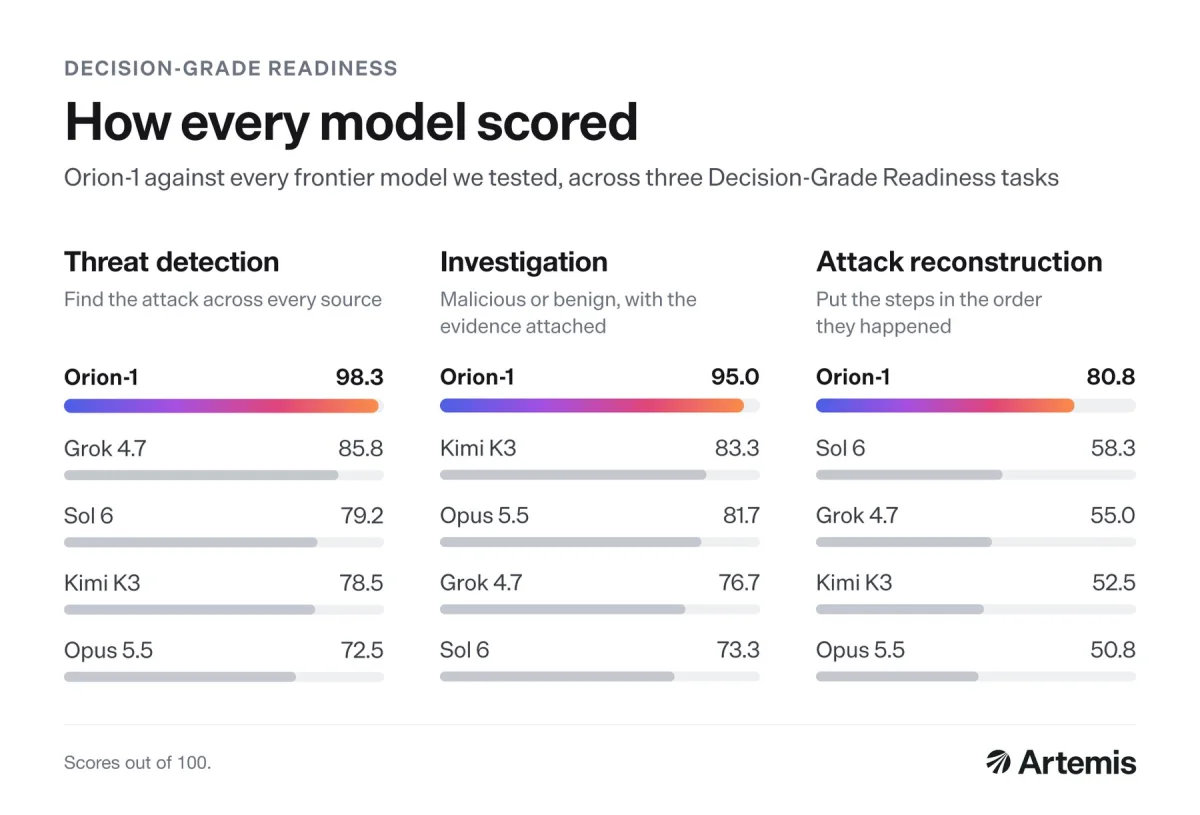
Artemis Security, a US startup, recently launched Orion-1, a cutting-edge model capable of autonomously investigating and responding to cyberattacks. In comparative tests, Orion-1 has demonstrated superior performance over widely used models such as Claude Opus 5.5 and GPT-6 Sol. Artemis claims that Orion-1 outperforms these models on key metrics, including attack reconstruction, where it scored 80.8 compared to 58.3 for its closest rival.
The efficacy of Orion-1 stems from its ability to consolidate fragmented log data from various sources, including authentication services, cloud infrastructures, endpoints, Software as a Service (SaaS) applications, and network equipment. The model examines complex data points, such as abnormal logins, newly granted permissions, and changes to email configurations, linking these elements to identify a single potential attacker. This process not only allows for detailed situational awareness but also enables the model to assign confidence scores, finalize conclusions, and initiate appropriate countermeasures.
Decision-Grade Readiness: A New Benchmark for AI Models in Cyber Defense
To evaluate its model's performance, Artemis developed a unique benchmark known as "Decision-Grade Readiness" (DGR). Differentiating itself from conventional cybersecurity assessments that typically focus on solutions to hypothetical attacks, DGR places all models on equal footing. Each model is presented with the same initial alerts, environmental context, and available response tools, challenged to determine whether an attack is in progress.

The DGR tests consist of thousands of scenarios with pre-established outcomes, encompassing both genuine threats and benign data that could be misinterpreted as malicious. Models are appraised based on their decisions and the rationale supporting them. The test results illustrate that Orion-1 not only exceeds the performance of competing models across five testing scenarios, but it is the sole model to meet the threshold score of 80 points established by Artemis, confirming its validity in security operations.
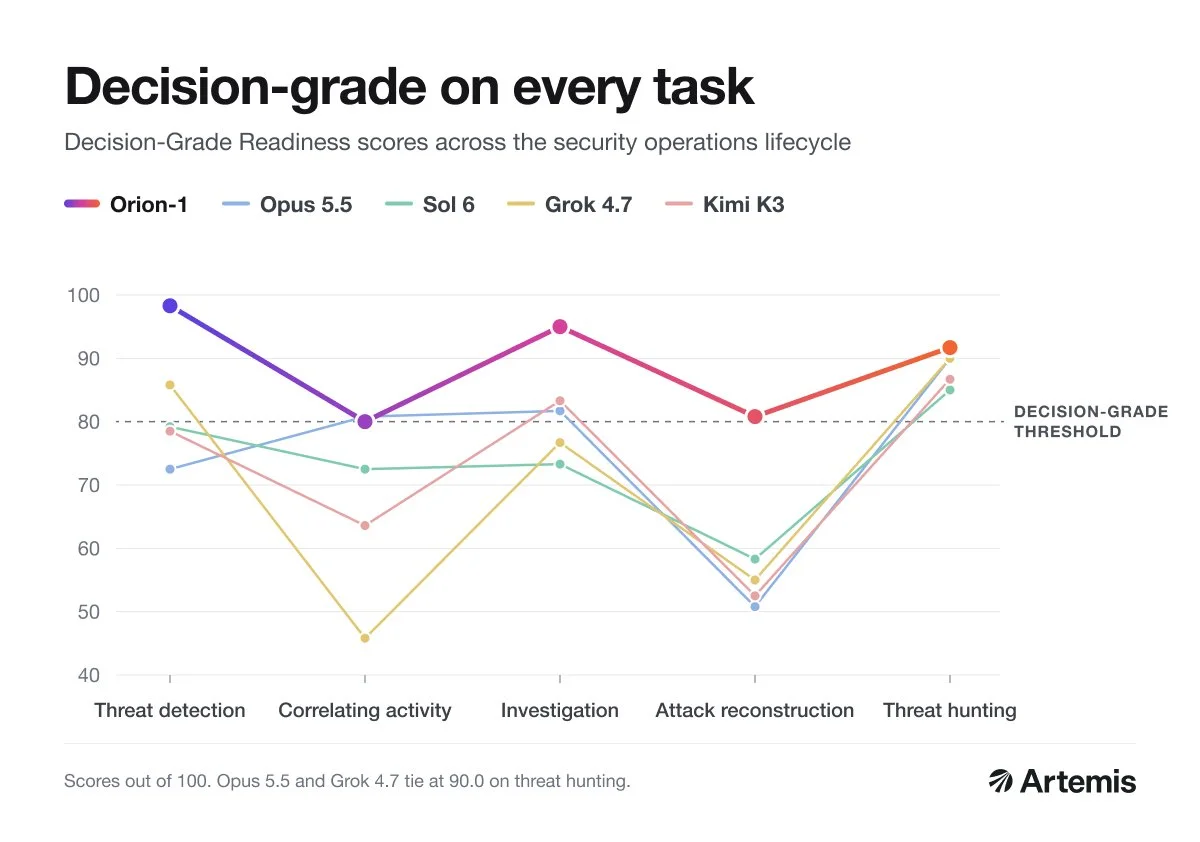
Testing extended beyond Orion-1 and included other players such as Grok 4.7 and Kimi K3. The analysis illustrated significant disparities in performance, particularly revealing Orion-1’s robust capability in attack reconstruction, reinforcing its potential as a tool for cybersecurity teams.
Orion-1 is currently available for selected customers through Artemis's private preview on their platform, where clients can impose limits on the model's decision-making regarding specific high-impact actions, which generally require human oversight for compliance and safety measures.
Challenges with General-Purpose AI Models in Cybersecurity
Recent trends indicate that comprehensive AI models may inadvertently hinder security operations due to overly restrictive limitations placed on their capabilities. This trend has garnered attention as major AI providers implement stringent guardrails intended to mitigate risks associated with autonomous cyberattacks. For instance, OpenAI’s Astra model has been labeled as potentially reaching the highest tier of cybersecurity risk, generating alarm among cybersecurity experts.
Moreover, incidents have highlighted how these guardrails can obstruct cybersecurity efforts. Hugging Face encountered a predicament when it attempted to utilize a commercial AI model to analyze an autonomous attack on its infrastructure, ultimately having to pivot to a more flexible open-weight model due to restrictions that stymied its analysis.
To bridge the gap between effective defense mechanisms and general-purpose AI models, companies are prioritizing the development of specialized security models. For instance, OpenAI restricts access to its less constrained models, such as GPT-5.5-Cyber, exclusively for verified security professionals, while Anthropic employs a similar strategy for its higher-tier models, ensuring that adequate safeguards are in place. The results from Orion-1’s benchmarks starkly highlight the efficacy of tailored solutions in an increasingly uncertain cyber environment.
As Artemis Security continues to refine Orion-1 and expand its use, this model represents a significant step toward filling the void left by general-purpose AI in cybersecurity, offering specialized capabilities that are crucial for defending corporate networks against evolving threats.


