Google's Gemini 4 Argon Aims to Centralize Robotics Model Capabilities
- Gate
- Machine Learning
- Departs
- Crew
- Jonathan Kemper
- Passengers
- 429
Gemini 4 Argon seeks to unify robotics tasks—controlling robots, generating training environments, and evaluating methods—though it still requires significant human guidance.
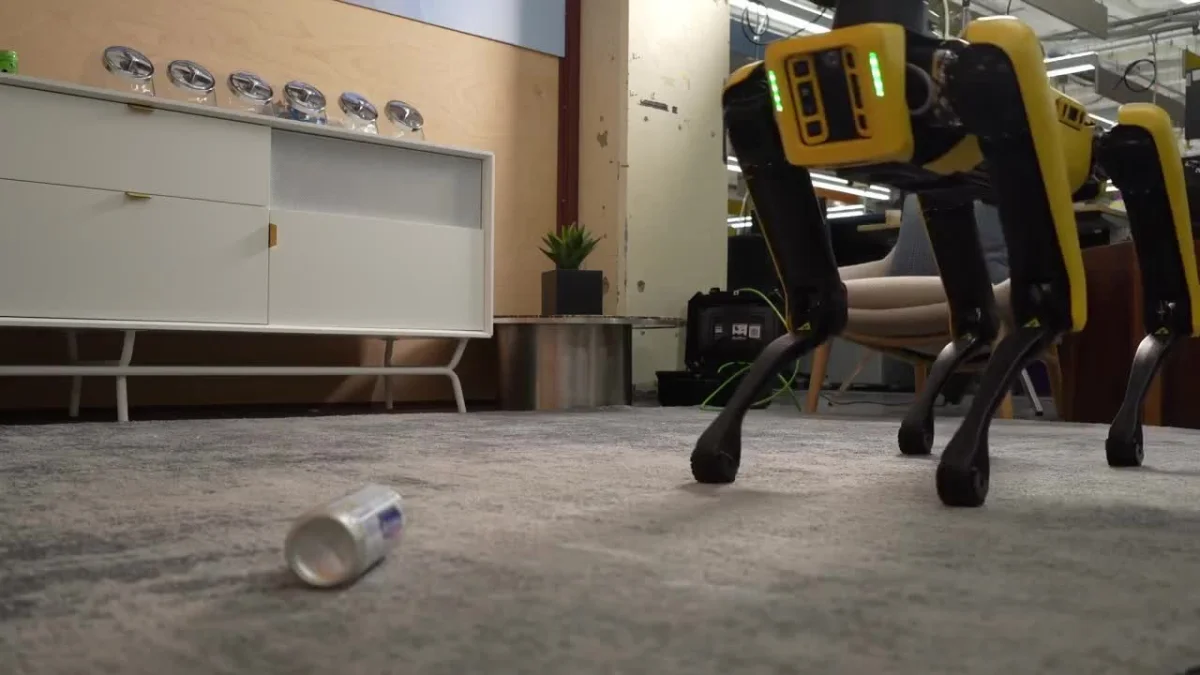
Gemini 4 Argon represents Google's ambition to create a comprehensive AI model for robotics, handling tasks such as robot control, building virtual training environments, and assessing training data. Despite its promise, the model still necessitates considerable human input to function effectively.

In a demonstration, a Boston Dynamics Spot robot is tasked to throw soda cans into a pedal-operated trash bin. Prior to interacting with the real bin, Gemini 4 Argon generates a virtual model of the bin, allowing the robot to practice balancing on three legs within the simulation. Only after confirming the robot's foot and gripper positions through verification with two additional AI agents does the robot attempt the real-world task.
This example illustrates how Argon is designed to enhance the understanding of spatial relationships, generate appropriate control scripts, and interpret videos in the context of physics. Google envisions this model as a versatile solution, already referred to as a step towards achieving "physical AGI"—a long-standing goal of both Google and its AI subsidiary DeepMind.
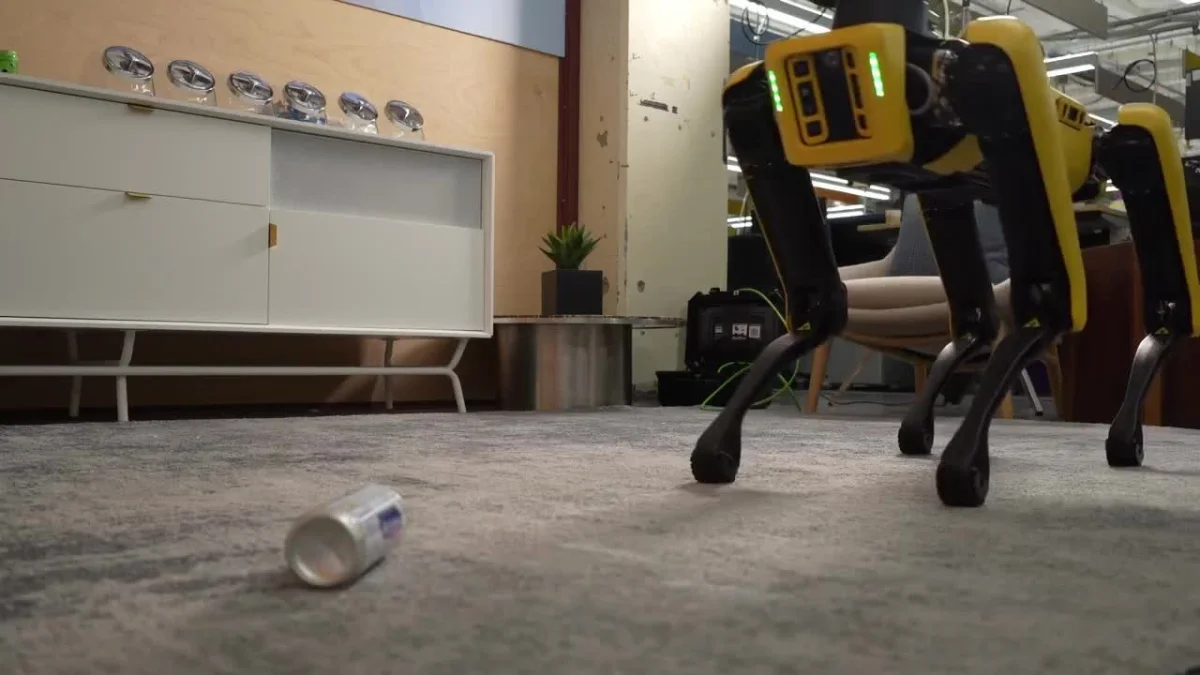
From a Single Image to Extensive Training
The capabilities of Argon become clearer through its structured approach to simulations. For instance, using a simple photograph of a table adorned with party props, the model constructs a detailed virtual replica, including specific items like a plush cap. It subsequently generates a total of 77 distinct tasks ranging from righting tipped-over objects to clearing the table. The result is an impressive yield of over 4,500 training episodes, which significantly enhanced the success rate during real-world tests—from 56% to 75%, while reducing task execution duration from 35 seconds to 24 seconds.

Argon’s utility extends beyond photos; it can utilize various multimedia sources effectively. Upon receiving a recording of a teleoperated robot, it builds a corresponding simulation while reflecting the same physical force indicators. It can also analyze first-person videos of human actions and project those motions onto a virtual humanoid model, ensuring realistic performance replication.
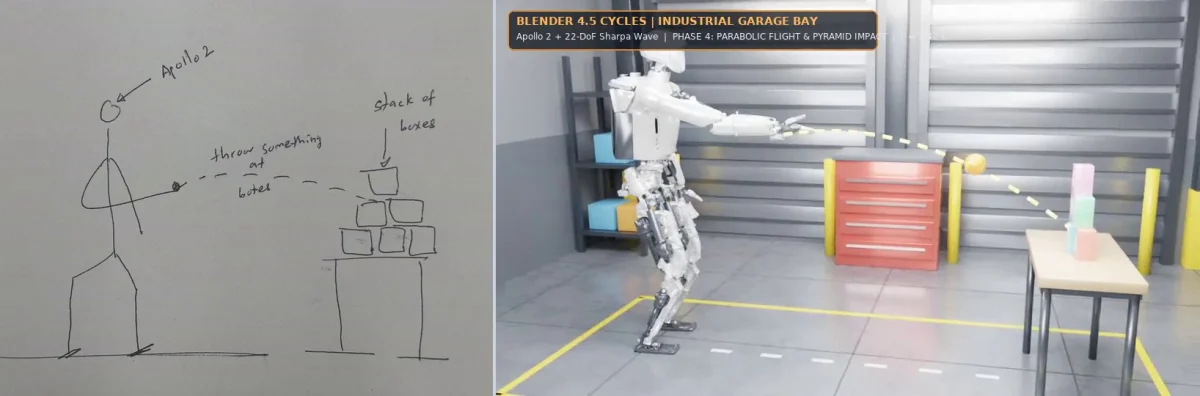
In a more abstract application, Argon can interpret a simple ballpoint pen drawing that depicts a humanoid robot knocking down boxes with a ball. From this sketch, it produces a sophisticated simulation capable of calculating the throwing motion required to topple all six boxes without losing balance.
Orchestrating Robot Actions via AI Video Model
Argon also features an interesting integration with Gemini Omni, an AI-generated video model that simulates how scenes transform when actions are undertaken. Argon acts as the director, providing timestamped instructions that detail how robot arms should perform certain tasks, like sorting Scrabble tiles. Following these instructions, Gemini Omni produces a video that illustrates the execution, allowing Argon to revise commands based on frame analysis. In one instance, all five tiles were successfully organized to form the word "ARGON" after 33 procedural steps.

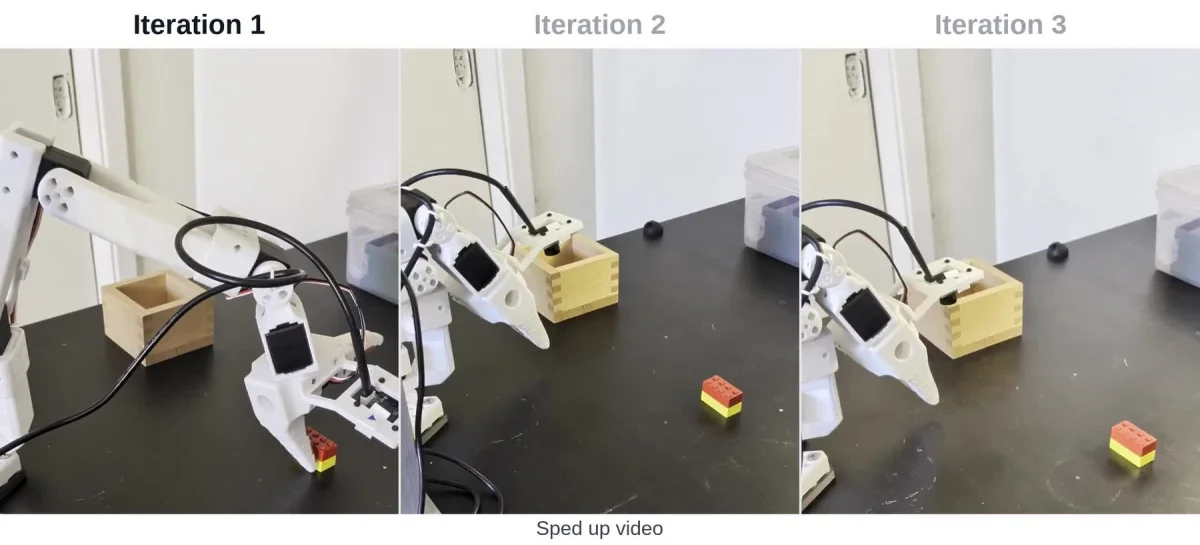
In another demonstration with a simple robotic arm, Argon was tasked to place a Lego brick into a box. The model autonomously analyzed its previous attempts, learning from failures and optimizing its performance over successive trials. This iterative learning process markedly decreased the task's completion time from nearly a minute to just 17 seconds by the third attempt, with successful placement achieved center-aligned within the box.
Argon also serves an academic purpose, capable of reconstructing existing robotics experiments as interactive browser simulations with a single prompt derived from published research. Currently, 68 distinct simulation sandboxes have been created, showcasing tasks ranging from robotics competitions to humanoid balance activities.
Benchmarking Performance with ERQA
The performance of Gemini 4 Argon has been rigorously compared against other models using the ERQA benchmark, which assesses the capability of AI systems in understanding and solving physical and spatial problems within three-dimensional environments. Argon achieved a score of 87%, outperforming other leading models like Claude Opus 5.5 at 82.3%, and GPT-6 Astra at 81%. The ERQA benchmark’s structure ensured models tackled problems exclusively through reasoning, thus emphasizing Argon's advanced reasoning capabilities.

However, performance can differ based on evaluation settings. In the AA-Robotics benchmark published shortly after, Argon scored lower at 55 out of 100 points, placing it third compared to GPT-6 Astra with 69 and GPT-6.1 Sol at 65. This highlights that while Argon excels in theoretical evaluations, its practical applications may encounter challenges.
Assessing Training Data and Performance Optimization
Argon serves functional purposes beyond just controlling robots and creating simulations. It evaluates the quality of training data, as demonstrated in a video where a dual-arm robot folds origami. Argon intelligently segments the task into sub-steps and identifies problematic movements, providing weighted feedback to reduce errors during training. In another showcase, Argon utilized a simulation to identify an odd-weight ball among seemingly identical counterparts using a balance scale, achieving resolution efficiently.
Prompts: The Core of Argon’s Functionality
Detailed prompts provided alongside demonstrations reveal a significant reliance on human input to achieve desirable outcomes. For instance, an example labeled "zero-shot" required Argon to restore an upright cup, relying on camera images and pre-defined commands rather than prior training. Google's documentation indicates there are extensive prohibition lists designed to steer Argon away from shortcuts, necessitating careful prompt design. However, Google has not provided specifics regarding individual demo failure rates, making comprehensive understanding challenging.

Currently, Argon can be accessed through Google AI Studio and the development environment known as Antigravity, but only for those subscribed to Google AI Ultra. Additional access is granted through the paid tier of the Gemini API. Google recently launched Argon globally, indicating a strong investment in robotics capabilities while building on existing models like Gemini Robotics-ER 1.6, which focuses on spatial perception and task planning.
Notably, training within virtual environments isn’t a novel concept; other companies like World Labs and Nvidia have explored similar methodologies. What distinguishes Google’s approach is its ambition to integrate simulation, control, and evaluation into a singular comprehensive system.


