Cities Apply AI Agents and Digital Twins to Services, Traffic and Urban Planning
- Gate
- Machine Learning
- Departs
- Crew
- Esther Lee
- Passengers
- 487
Examples from Spain, Poland, Malaysia and Taiwan show how cities are applying AI agents, camera analytics and digital twins to operational tasks.
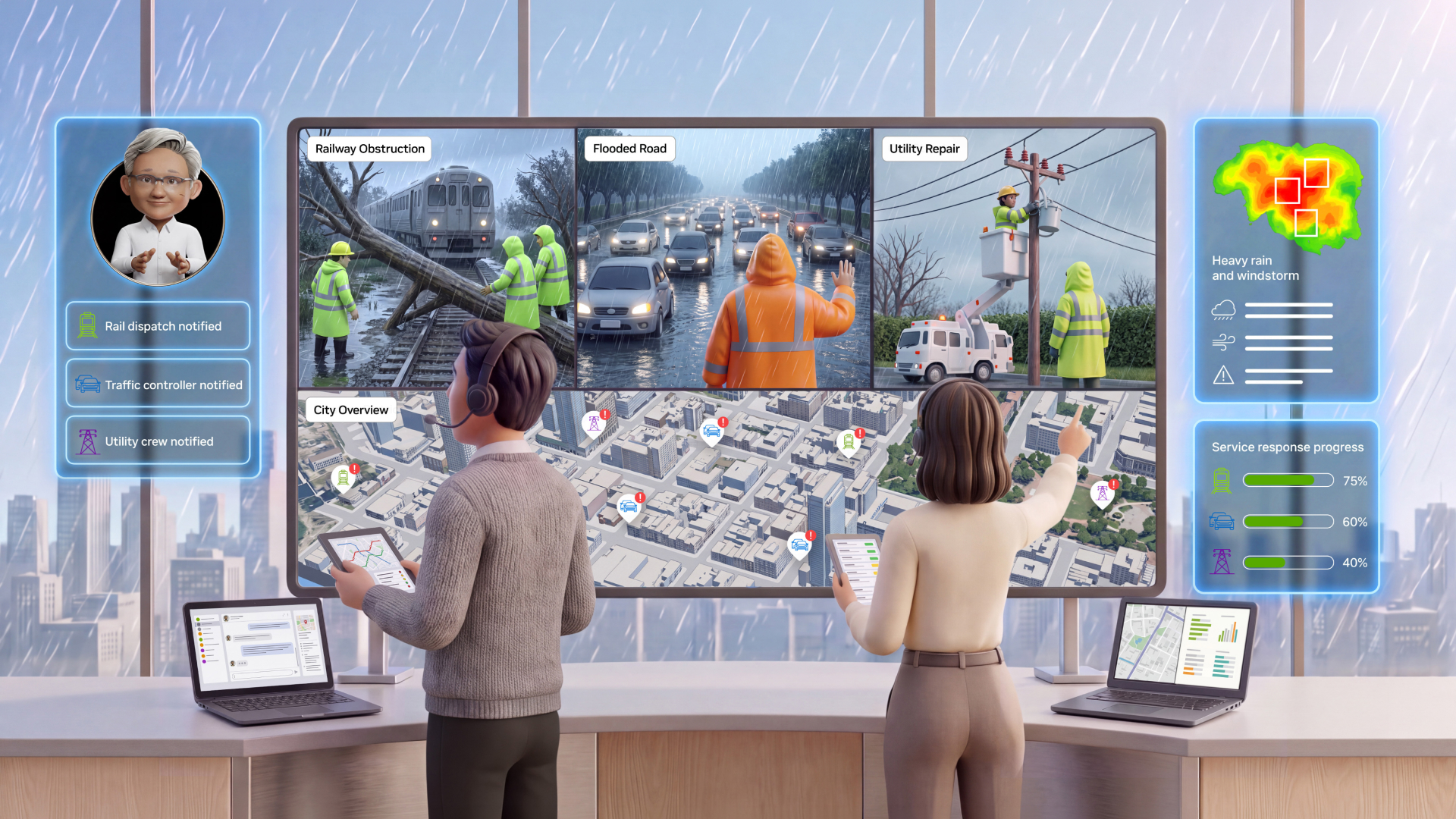
City AI projects are moving from isolated demonstrations toward shared infrastructure that can support several operational tasks. Examples described by NVIDIA and its partners range from resident service agents and camera analysis to traffic simulation and digital twins for urban planning. The deployments also show different ways to build capacity: use existing camera feeds, share computing across organizations, or access systems through managed services.
The practical question is what these systems can do with the data cities already collect. A language agent can handle service inquiries; a vision system can search camera footage; a simulation can compare design options before construction. Each use case has distinct requirements for data access, computing and human review, so the examples are best read as a set of approaches rather than one standard city platform.
Agents handle service requests and interpret camera feeds
In Spain, 1MillionBot combines open source ALIA models trained at the Barcelona Supercomputing Center with NVIDIA Nemotron and other models. Its resident service agents are used by Madrid Digital (Comunidad de Madrid), Administració Oberta de Catalunya and more than 150 deployments across Spain. The stated tasks include explaining municipal procedures, handling appointment requests, receiving urban planning incidents and answering service inquiries. That scope points to a practical role for agents: managing routine interactions across multiple services, with the underlying systems assembled from more than one model.
LiveX is developing its AI City concept in the San Francisco Bay Area with NVIDIA Cosmos world models, Nemotron open models, and Omniverse and Metropolis libraries on NVIDIA RTX PRO GPUs. Its conversational AI hosts are designed to answer questions and take actions in places such as airports, hospitals and local events. They can also be tailored to local languages and service needs. The description does not specify how those actions are reviewed or which services the hosts can access, details that will matter when assessing deployments in busy public spaces.
Camera analysis takes a different route: vision agents process existing video feeds to surface information for operational teams. In Wrocław, Poland, K2K is building shared AI infrastructure with NVIDIA accelerated computing, Cosmos world reasoning models and the Metropolis Blueprint for video search and summarization (VSS). The system is intended to turn camera streams into information that teams can use for mobility, safety and event response. Using one infrastructure across several city functions could spread computing costs, though the source gives no figures for the system’s operating cost or performance.
Malaysia’s ITMAX is packaging infrastructure and AI applications as long-term managed services, including traffic management. Its SamurAI V2 vision agents, built with reference to Cosmos, Nemotron and the Metropolis VSS blueprint, are scaling on NVIDIA RTX PRO 6000 GPUs to support more than 17,000 cameras by 2027. ITMAX also integrates TeraSim, an open source traffic simulation platform from Laplace Intelligence. The company reports that testing signal timing with TeraSim reduced peak-hour corridor travel times by up to 26%. That figure is specific to the reported use case; the source does not provide a test design or comparison conditions for evaluating how broadly it applies.
Digital twins put planning scenarios into simulation
Digital twins can represent infrastructure and its processes in a simulated environment, giving operators a way to examine scenarios before changing physical systems. At Dangote’s Lekki refinery in Nigeria, Honeywell Technologies’ Forge Plant Cognition uses Nemotron-powered agents to interpret operational data. A digital twin of the plant and its processes, built with Omniverse libraries, is planned to support simulation and training. Running on Dell PowerEdge servers with NVIDIA RTX PRO accelerators, the platform is intended to help operators find bottlenecks, anticipate equipment and process issues, and improve plant performance. The twin is described as planned, so the article does not report results from its simulation or training use.
In Taiwan, Linker Vision and Dutch architecture firm MVRDV are using Omniverse and Nemotron to build agents that assess environmental, social and governance effects of urban planning scenarios. The partners report that the system simulates 15-year outcomes for an urban forest canopy in 10 minutes, reducing design iteration time from two weeks to less than an hour. Faster iteration can let planners compare more options within a given schedule, while the usefulness of the results still depends on the data and assumptions used to model each scenario.
Shared capacity shapes local AI ecosystems
These projects rely on different operating models. Some use workstations or small GPU systems for initial agent workloads; others depend on accelerated servers, large camera networks or shared computing. Managed services and shared infrastructure may let departments or neighboring municipalities draw on common capacity instead of acquiring and maintaining separate systems. The source does not give comparative cost or staffing figures, so it remains difficult to judge which model is most practical for a particular city.
At Morocco’s Tanger Med port, Cires Technologies is expanding a sovereign AI factory for planned applications in worker safety, congestion analysis, cargo routing and port operations. The company is also building an ecosystem of application providers to develop local models and software for ports and cities. The range of proposed tasks suggests the facility is meant to serve multiple operators, but the article does not report deployment outcomes for those applications.
The Barcelona Supercomputing Center’s AI Factory Accelerator Programme gives startups access to sovereign computing, technical support and training. BSC AI Factory also supports research and startup development in areas including agriculture, medical imaging, knowledge access and speech services. Such programs extend the local pool of technical capacity beyond city departments, while leaving teams to determine how models fit their data, workflows and service requirements.
Together, the examples show AI being applied to defined operational jobs, from answering routine questions to testing traffic signals and comparing long-range planning scenarios. The next useful evidence will be deployment results: how reliably systems handle real requests, how camera analysis performs in varied conditions, and what it costs to maintain the computing and data pipelines. Those details will help cities distinguish promising demonstrations from services that can be sustained across departments and locations.