Open NVIDIA Tools Put 6G Research to Work on Robotics, Receivers and Network Power
- Gate
- Machine Learning
- Departs
- Crew
- Soma Velayutham
- Passengers
- 807
Researchers report faster robot tasks, stronger signal reception, lower network power use and 5G simulations that run in minutes.
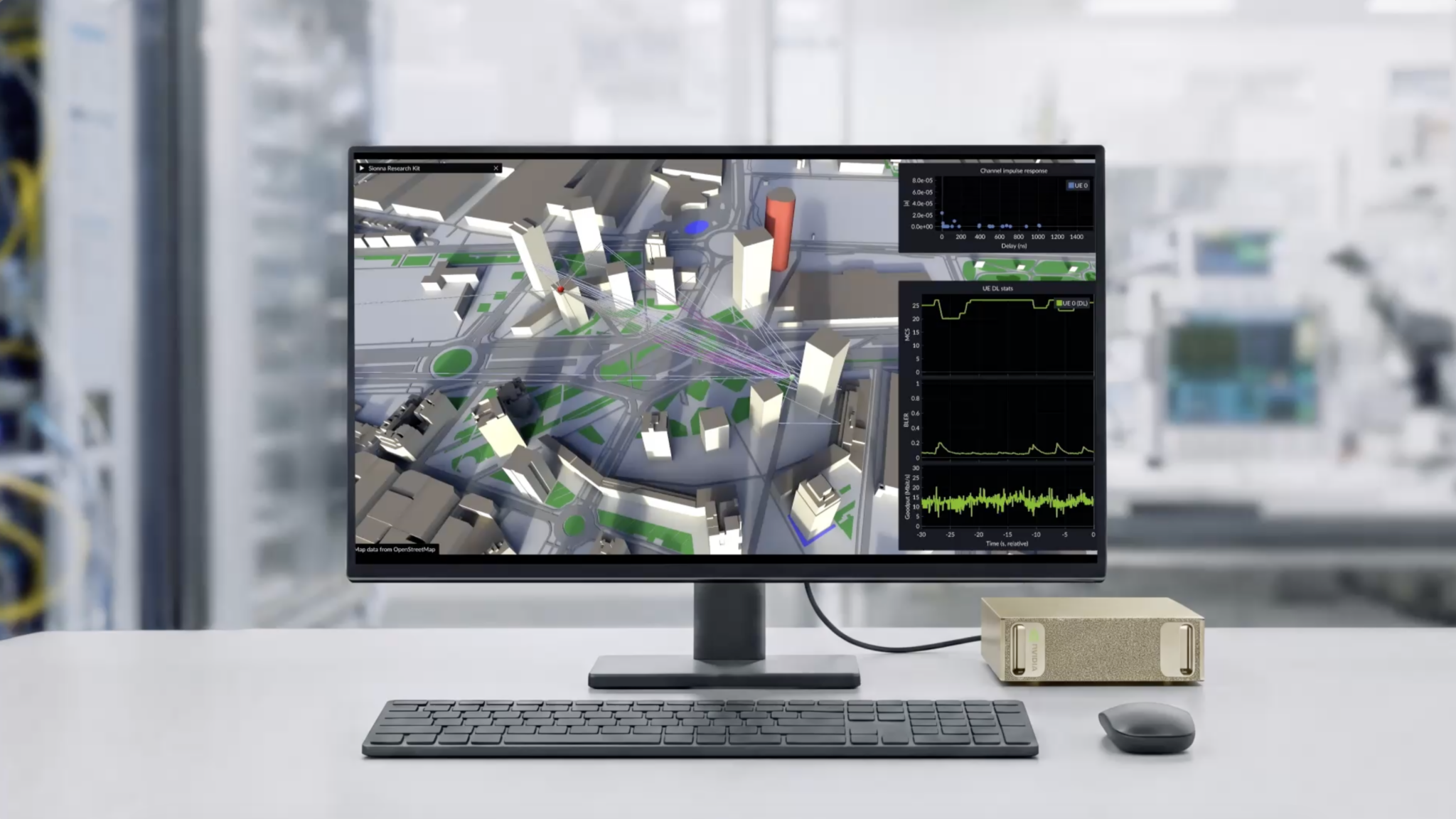
Open software is helping researchers test 5G and 6G network ideas across simulation and real wireless equipment. Results from projects using NVIDIA Aerial and Sionna point to practical gains in robot response time, signal reception, energy use and simulation speed. The work also shows how researchers can connect AI training and network development with experiments over the air.
Adoption of NVIDIA AI Aerial and NVIDIA Sionna grew tenfold over the past year, according to NVIDIA, and its open 5G and 6G tools have passed 1 million downloads. More than 8,000 research and academic institutions worldwide use the platforms. Those figures describe the reach of the tools; the individual studies offer a closer look at what teams are building with them.
Sending robots the information they need
A robot that depends on a remote AI system has to send information across a wireless link and wait for a response. Transmitting periodic images can add delay and processing work, especially when the robot needs to react to a changing scene. Researchers are exploring semantic communications as a way to reduce that load: the robot sends compact descriptions of objects, positions and relationships instead of complete images.
At King’s College London, researchers linked a camera-equipped robot arm to an NVIDIA Jetson AGX Orin running NVIDIA Sionna. Their setup supported a software-defined 5G network and edge AI processing. In fruit-packing and cube-stacking experiments that included deliberately introduced faults, the approach reduced task completion time by up to 52.6% and improved task success compared with sending periodic images.
The system also handled errors such as dropped objects and unsuccessful actions, recovering so the robot could continue. In versions that used a digital twin, it could check planned movements for possible collisions before carrying them out. These results make the communication method relevant to tasks where a remote system needs concise, timely information. The reported gains come from the tested setup, so how they translate to other robots and working conditions remains an open question.
Adapting signal reception to radio conditions
Wireless links can become less reliable when interference or changing radio conditions make signals harder to decode. Errors and retransmissions can then delay the information a device is sending. Neural receivers use AI to interpret incoming signals, with the aim of recovering data more effectively under difficult conditions.
SoftBank integrated a neural receiver into NVIDIA Aerial CUDA-Accelerated RAN (ACAR) and tested it with a commercial 5G smartphone. In controlled tests with interference, the receiver delivered higher uplink throughput than a conventional receiver at all 15 tested settings. The maximum gain was roughly 60%.
A separate study points to the value of adapting a receiver to its operating environment. Using the NVIDIA Aerial Testbed, ETH Zurich researchers tuned neural receivers with local measurements. Their approach reduced block error rates by more than one-third compared with selected pretrained versions. Together, the studies suggest that receiver performance depends both on the model and on how well it is matched to real radio conditions.
Matching network capacity to demand
Network operators need capacity to meet demand, but that demand can change over time. A system that predicts traffic could help identify when some base stations can sleep and when they need to resume operation, while keeping devices connected through neighboring stations.
Researchers at the University of Leeds developed a system that forecasts network demand ten minutes ahead to guide base station sleep decisions. Before a station powers down, the system checks whether active neighbors can serve the affected devices. It also monitors for changes that call for capacity to return.
The team evaluated the approach with a portable 5G “network-in-a-box” powered by an NVIDIA DGX Spark, alongside a digital twin used to validate decisions against real wireless equipment. Researchers reported a 45.6% reduction in radio access network power consumption compared with a full-power baseline, while maintaining device connectivity. The finding is tied to the tested configuration; applying the method elsewhere will depend on demand patterns and the network’s ability to maintain service as stations sleep.
Shortening the simulation cycle
Network simulations let researchers explore how designs behave when many devices compete for connections or signals encounter interference. More realistic simulations can take hours, however, limiting how many scenarios teams can assess. GPU-accelerated channel models offer one way to reduce that bottleneck by calculating how radio signals travel between antennas and devices more quickly.
The Centre Tecnològic de Telecomunicacions de Catalunya (CTTC) integrated GPU-accelerated radio channel models running on ACAR into its open source 5G-LENA network simulator. In an early evaluation, simulation runtime fell from about three hours to 10–20 minutes, depending on the integration. The team reported that the faster runs preserved expected statistical behavior and network performance.
Shorter runs give researchers room to compare more network designs and examine more demanding scenarios. That can help teams identify weaknesses earlier, before committing to field trials or equipment. The reported timing is an early evaluation, so it should be read in the context of the specific integrations tested.
Across these projects, the common thread is a development workflow that joins AI, software-defined networks, simulation and wireless experiments. NVIDIA says Aerial and Sionna are available through GitHub and GitHub, respectively. The next practical measure will be whether results from these research setups hold across more devices, environments and network configurations.