Korea’s Physical AI Push Targets Chip Design, Autonomous Driving and Factory Robotics
- Gate
- Machine Learning
- Departs
- Crew
- NVIDIA Writers
- Passengers
- 681
Samsung, Kakao Mobility and LG are applying NVIDIA computing and simulation tools to chip engineering, driving systems and robot training.
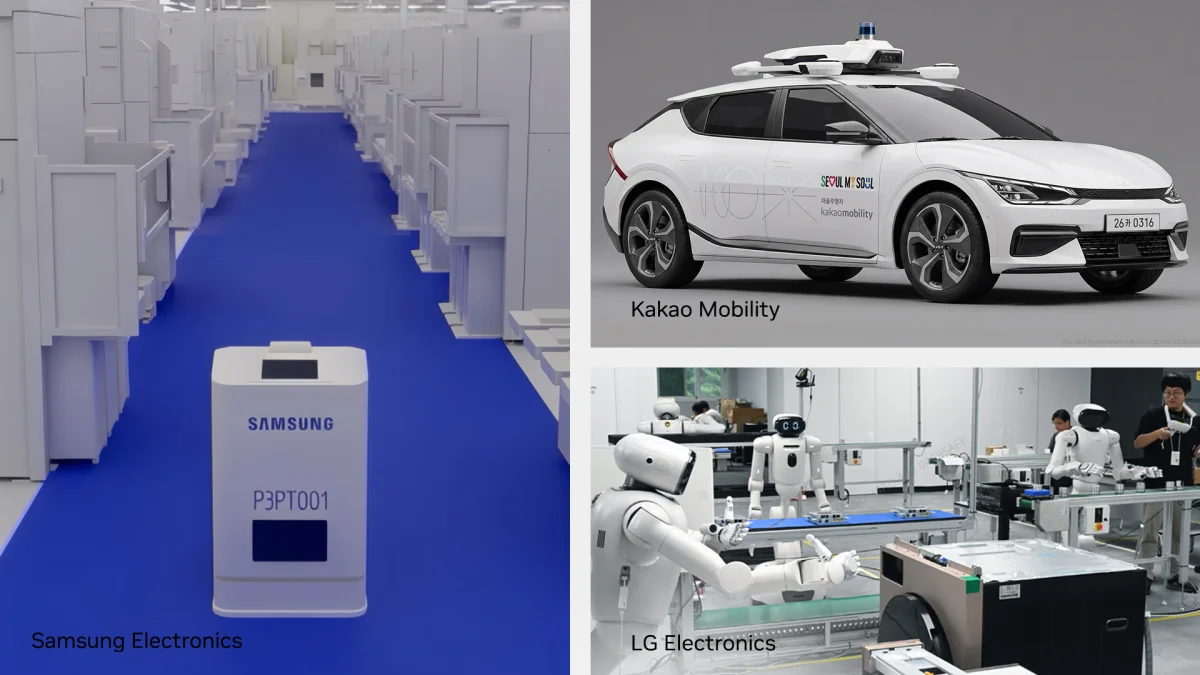
Korea’s physical AI work is taking shape in three settings where software must interact with complex physical systems: semiconductor engineering, autonomous driving and factory robotics. NVIDIA’s role spans accelerated computing, simulation, vehicle platforms and robot training tools. The projects show how companies are trying to connect AI development with engineering workflows and real operating environments, while also revealing how much of the work remains focused on building and validating systems.
The examples are not all at the same stage. Samsung reports specific performance results for selected computing tasks. Kakao Mobility describes a planned development effort for a level 4 driving system. LG Electronics and NVIDIA have demonstrated robotic manipulation and manufacturing tasks with a CLOiD robot. Together, they illustrate several routes for bringing physical AI into industrial use, rather than a single recipe that applies across sectors.
Samsung speeds selected semiconductor calculations
Samsung Electronics is expanding work with NVIDIA across materials research, process development and device engineering. A central target is the heavy computation involved in technology computer-aided design, where simulations help engineers evaluate materials and device behavior. Samsung is applying NVIDIA cuISS and cuDSS to sparse linear systems, and is also using GPU acceleration for process and optical simulations.
For materials research, Samsung’s sMOL platform has run selected quantum chemical calculations up to five times faster end to end with NVIDIA cuEST. That figure applies to the reported calculations; it does not establish the same acceleration across every materials workflow. Samsung is also exploring cuEquivariance to speed tensor operations used in training and inference for atomistic AI models. Those models can represent interactions at the atomic scale, making computation speed relevant to both model development and use.
A separate effort applies NVIDIA PhysicsNeMo to chip-scale thermal and mechanical analysis. In one AI homogenization case, Samsung combined AI-predicted effective material properties with coarser grids and GPU acceleration. The resulting solve took 41 seconds, compared with about 18 hours for a fine-grid run on a 32-core CPU, a reported speedup of roughly 1,600 times.
That comparison reflects a workflow change as well as a hardware change: the accelerated run used a coarser grid and AI-based estimates of material properties. The result is striking for this particular case, but the source does not establish that the same speedup applies to other chip analyses or that the faster result has identical error characteristics. For engineering teams, the practical question is how much time can be saved while keeping predictions useful for design decisions.
NVIDIA Agent Toolkit could eventually connect simulation tools and AI models so engineering agents can run analyses and compare design options. That remains a forward-looking possibility in the source, rather than a reported deployed capability. The value would depend on how reliably such systems can select appropriate analyses, interpret their outputs and keep engineers in control of consequential choices.
Kakao Mobility develops a level 4 driving system
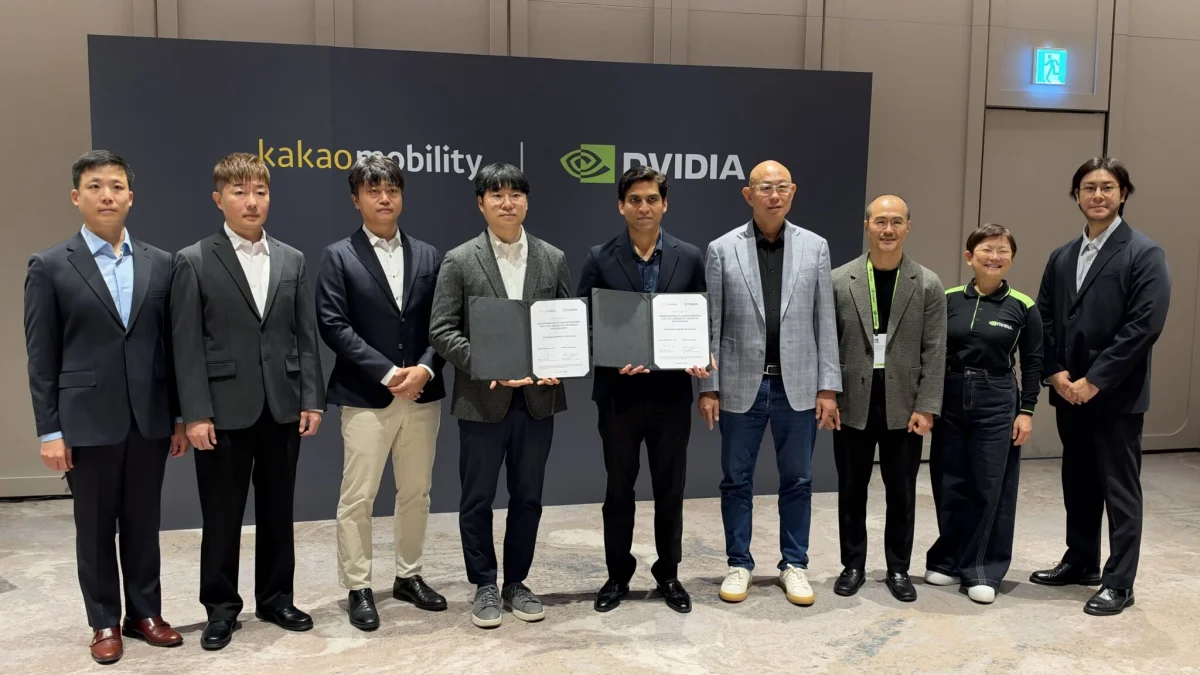
Kakao Mobility plans to combine its driving software and operating experience in Seoul’s Gangnam district with NVIDIA’s vehicle computing platform to advance development of a level 4 autonomous driving system. The stated plan is to build on NVIDIA’s vehicle computing and safety technologies; the source does not report a completed system or a deployment timetable.
The proposed setup uses NVIDIA Hyperion, a reference platform for vehicle sensors and computing, powered by NVIDIA DRIVE AGX Thor. Kakao Mobility also plans to use NVIDIA Halos to support safety work across development and validation. Initial development is planned around Kia purpose-built vehicles, with Kakao Mobility’s software integrated with NVIDIA technologies. The effort is intended to support future level 4 mobility services in Korea.
For autonomous driving, a computing platform is only one part of the development challenge. The system also needs to be exercised and validated across the conditions it may encounter. Kakao Mobility’s experience operating in Gangnam gives the project a local operating context, while the planned use of Hyperion and Halos supplies vehicle computing and development support. The source does not specify the system’s performance results, the scope of its validation, or when services might begin.
LG builds a repeatable robot training workflow
LG Electronics and NVIDIA have demonstrated robotic manipulation and manufacturing tasks with LG’s CLOiD robot in an actual manufacturing environment. The work uses NVIDIA Isaac GR00T, a foundation model for robot capabilities, and links data collection, model training, onboard computing and simulation-based evaluation.
The teams describe this loop as a physical AI data flywheel. Real-world data collection feeds into data augmentation with NVIDIA Cosmos; that material supports GR00T model training. NVIDIA Jetson AGX Thor provides onboard computing, while simulation helps evaluate the resulting robot behavior. The goal is a reusable workflow for continued development and validation of CLOiD’s capabilities.
Repeatedly collecting data, training models and evaluating behavior can help teams refine robots for specific manufacturing tasks. The demonstration establishes that the workflow has been applied in a real manufacturing environment, but the source gives no task success rates, production throughput figures or details about how performance changes after training. Those measures will matter for assessing how well the process transfers to routine factory work.
Across the three efforts, the common thread is the use of computing and simulation to shorten or structure development cycles. Samsung offers a quantified result for one analysis case; Kakao Mobility outlines a vehicle development plan; LG and NVIDIA show a robot training and evaluation loop. The next useful evidence will be results across broader engineering workloads, driving validation and repeatable factory tasks.