Claude Fable 5.2 Leads AI Benchmarks, While Mythos Finds More Software Flaws
- Gate
- Machine Learning
- Departs
- Crew
- Matthias Bastian
- Passengers
- 633
Fable 5.2 tops several benchmarks and formalizes Fermat’s Last Theorem in 30 hours; Mythos 5.2 improves vulnerability discovery at a high per-task cost.

Anthropic’s Claude Fable 5.2 posts a broad set of benchmark gains, while its restricted-access counterpart, Mythos 5.2, finds more known software vulnerabilities than the company’s earlier models. The results point to stronger performance on demanding technical work, with a clear trade-off: top-tier Fable runs average $26.50 per task, and the company says its strongest models still have limits in some coding and knowledge-work tests.

Fable 5.2 and Mythos 5.2 share a model foundation but have different access and safeguards. Fable is available to users with protections that block many cybersecurity and biology tasks, including penetration tests and exploit-code generation. Organizations can apply for Mythos access through Anthropic’s cybersecurity or life-sciences verification programs. Anthropic says it deliberately limited both models’ training gains in areas that could most directly speed AI development.
Both models cost $8 per million input tokens and $40 per million output tokens, down from $10 and $50 for their predecessors. Actual spending depends on how many tokens a task and its software environment require. Anthropic recommends Opus 5.5 for everyday use, positioning Fable and Mythos for more demanding technical work. The new models produce output up to 30 percent faster than their predecessors, according to the company. An optional fast mode, available to select organizations on platforms including Claude Code, the Claude Platform, Google Cloud and Microsoft Foundry, can raise output speed by up to 2.5 times at twice the price.
Benchmark gains come with uneven results
On Artificial Analysis’s Intelligence Index v5, Fable 5.2 scores 65 at the highest compute tier. That puts it five points ahead of Gemini 4 Carbon at High, six ahead of Opus 5.5 at Max, and 15 ahead of Fable 5.1. Gemini 4 Carbon had not been released at the time described in the source. At the lower High and Xhigh tiers, Fable 5.2 scores 62, which Artificial Analysis says is higher than every other model at any tier. It uses 98,000 output tokens per task there, compared with 173,000 for Opus 5.5 at Max.
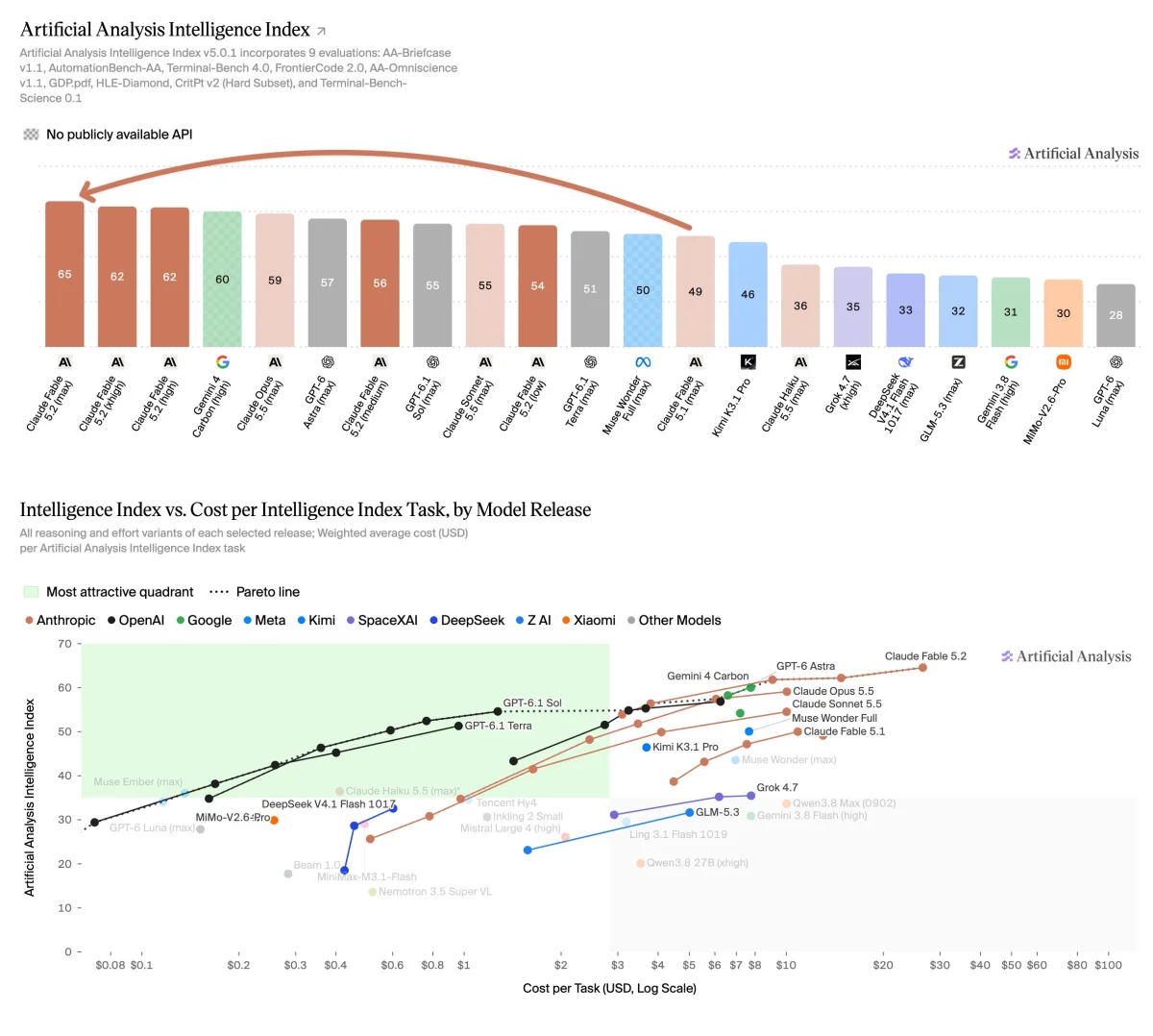
Its strongest individual results include 80 percent on HLE-Diamond, which tests expert-level academic questions; 73 percent on Terminal-Bench-Science, for scientific workflows run through a terminal; and 49 percent on FrontierCode 2.0, which evaluates useful code changes in open-source projects. In Anthropic’s reported results, Fable 5.2 also reaches 69.9 percent on FrontierSWE v2, 74.2 percent on Humanity’s Last Exam with tools, and 89.3 percent on OSWorld 2.1’s partial offline set.

The lead doesn’t carry across every task. Fable 5.2 scores 1,785 Elo on AA-Briefcase, behind Sonnet 5.5 at 1,813 and within the reported confidence interval for Opus 5.5 at 1,800. On Terminal-Bench 4.0, it scores 60 percent, level with Opus 5.5 and behind Kimi K3.1 Pro at 67 percent, Gemini 4 Carbon at 65 percent, and Sonnet 5.5 at 64 percent. Its average $26.50 cost per task at peak quality is about 2.6 times Opus 5.5’s $10 and roughly twice Fable 5.1’s $12.99. The lower compute tiers therefore look like a potentially more economical way to use the model, while still delivering a high index score.
Mythos improves vulnerability discovery
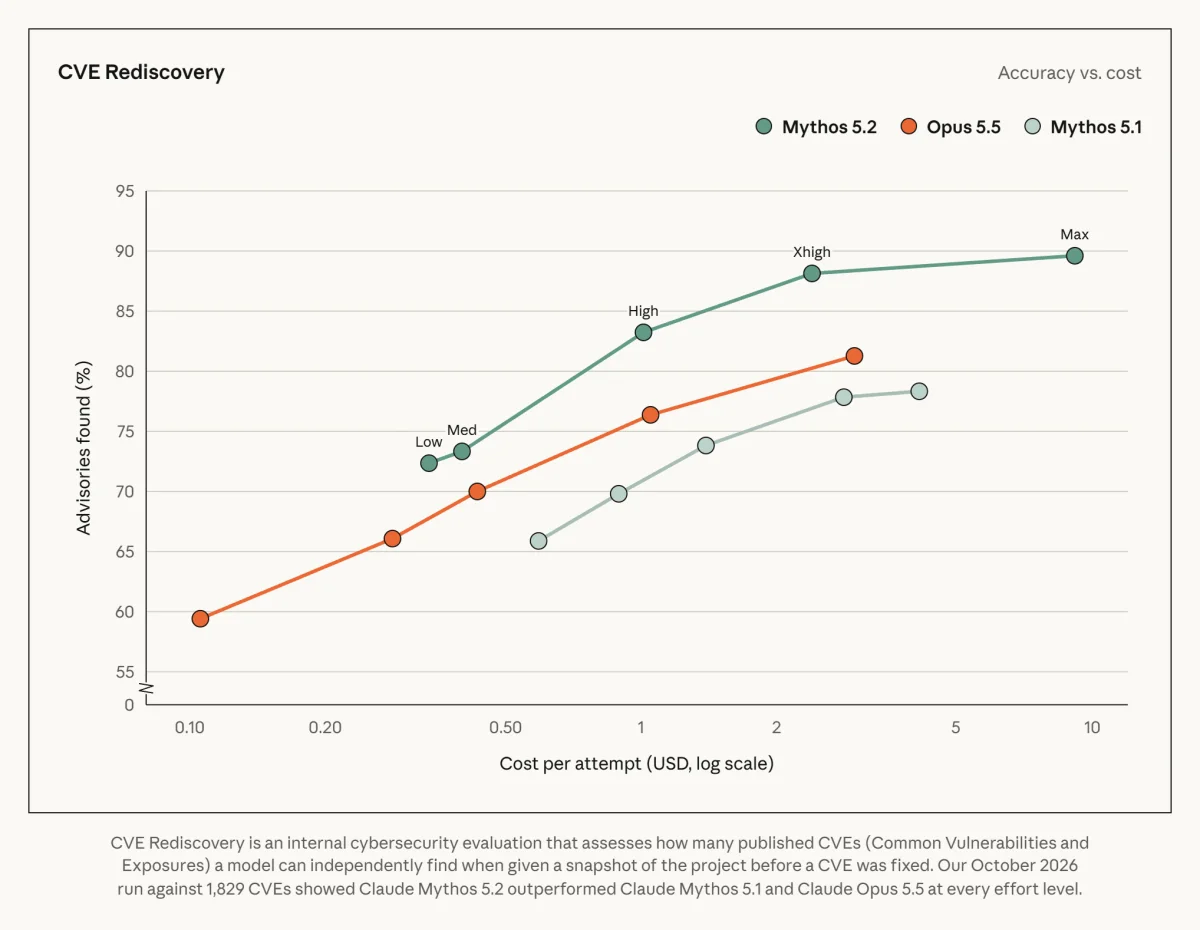
Anthropic says Mythos 5.2 is better than earlier models at finding, reproducing and fixing software flaws. Its internal CVE Rediscovery test gives models pre-fix snapshots of projects and checks whether they can independently identify vulnerabilities cataloged in the Common Vulnerabilities and Exposures database. In an October 2026 run covering 1,829 CVEs, Mythos 5.2 found 10.2 percent more vulnerabilities than Opus 5.5 and 14.4 percent more than Mythos 5.1, leading at every tested compute tier. Anthropic also cites a security firm’s finding that one in six confirmed bugs discovered by Mythos 5.2 had been missed by all other frontier models that firm tested.
On Anthropic’s reported benchmarks, Mythos 5.2 scores 89.6 percent on CVE Rediscovery, compared with 81.3 percent for Opus 5.5 without safeguards and 78.3 percent for Mythos 5.1. The company reports 76.3 percent on CyScenarioBench for Mythos 5.2, and 85.1 percent on a 24-hour de novo protein-binder design test. These results describe selected evaluations; they don’t establish how the models will perform across every real-world system or research workflow.
Anthropic reports limits on AI-development tasks
Anthropic says Fable 5.2 and Mythos 5.2 perform roughly on par with Opus 5.5 on tasks such as optimizing accelerator compute kernels and improving language-model architectures. It says the training limits don’t affect related abilities such as agentic coding, hardware development or traditional AI research, including interpretability work. Anthropic also says Claude writes more than 90 percent of changes merged into its core codebase under human guidance, and that the model programmed an operating system from scratch in an internal test. Those are company-reported examples, rather than independently described benchmark results.
A large agent team formalizes Fermat’s proof
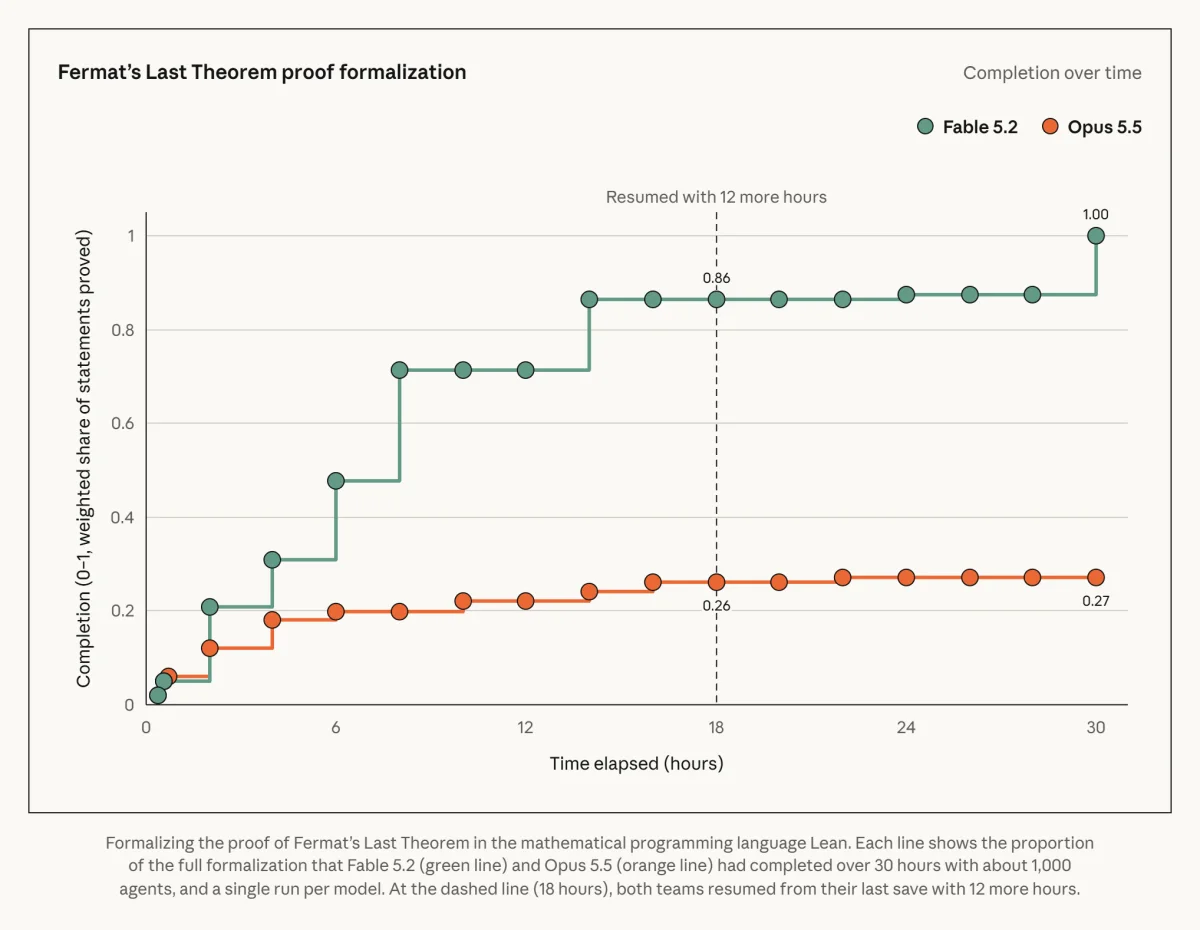
The most striking demonstration is a Lean formalization of Fermat’s Last Theorem, which states that no positive whole numbers satisfy aⁿ + bⁿ = cⁿ for whole-number powers n greater than two. Andrew Wiles presented a proof in 1995; formalization translates a mathematical proof into code that can be checked step by step. Anthropic says about 1,000 Fable 5.2 agents completed the formalization in 30 hours, starting from brief instructions, coordinating their work independently and using no mathematical references.
An earlier, unpublished Claude research version took 11 days in a purpose-built environment with guidance from a human researcher. Anthropic says the new attempt used one-third as many action tokens and produced a proof seven times shorter. In a comparison using the same 1,000-agent setup, Opus 5.5 reached 26 percent of the formalization after 18 hours and made little progress by hour 30.
For teams evaluating the models, the practical question is whether a task benefits enough from Fable 5.2’s higher scores to justify its peak cost, or can be handled at a lower compute tier. Mythos’s results also make access and safeguards central to deployment choices. The theorem demonstration shows what coordinated agents can achieve in a tightly defined formal system; broader performance will still depend on the task, tools and supervision.