Richard Sutton Says AI Progress Needs New Learning Algorithms Beyond LLM Scaling
- Gate
- Machine Learning
- Departs
- Crew
- Matthias Bastian
- Passengers
- 594
Sutton argues that more compute alone won’t deliver lasting progress. Researchers are debating whether new learning methods can complement language model scaling.

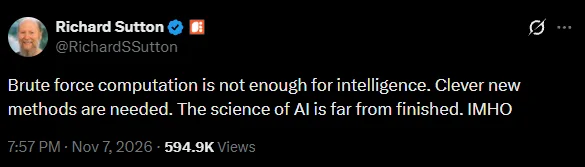
Richard Sutton’s latest argument is that AI progress depends on finding learning methods that keep improving with compute, not simply feeding more resources into today’s language models. The claim fits the central idea of his 2019 essay, “The Bitter Lesson,” but adds a warning: the field still has important algorithmic work ahead.

Sutton, a Turing Award recipient, made the case in a recent post that drew discussion among AI researchers. His point is not that computation has stopped mattering. It’s that compute only pays off when paired with methods that can use it effectively.
The algorithm still sets the terms
In “The Bitter Lesson,” Sutton argued that general methods able to benefit from increasing computation tend to outlast systems built around detailed human assumptions. The lesson is often read as a case for scaling. Sutton’s newer point sharpens the distinction: compute can amplify an approach, but it can’t make every approach scale well.
Jerry Tworek, an AI researcher who left OpenAI after seven years, makes a related argument. The bitter lesson still applies, he writes, but the algorithm matters more as training uses more compute. Some methods can keep improving; others reach limits. And several dimensions of scaling have barely been explored.
That reading challenges the idea that transformer performance settles the broader question of how to build more capable systems. Tworek says the success of scaling transformers has encouraged researchers to treat one productive approach as if it were the whole lesson. His criticism is that this narrows the search for methods that could use computation differently.
Jayden Teoh raises a complementary concern. In a post of his own, he says the bitter lesson has sometimes been used to dismiss academic work that does not appear to follow its principle. Teoh argues that the problem lies in how researchers interpret Sutton’s essay, rather than in the essay itself.
Some ideas, Teoh says, later give way to cleaner or more general methods. That doesn’t mean they were unproductive: an approach can help move research forward even if it doesn’t remain the best way to scale. As he puts it, “An idea doesn’t necessarily have to survive scaling forever to be an important contribution to AI progress.”
Why Sutton questions text and synthetic data
Sutton has previously questioned whether simply scaling large language models can deliver the kind of ongoing learning he wants. He has called synthetic data a “big mistake,” arguing that the real world is vastly more complex than any simulation built by people. A constructed data source reflects the assumptions and knowledge its makers put into it; that makes it hard to treat as a substitute for experience in the world.
His proposed direction is to build agents with world models that learn continuously from their own experience. In this view, internet text offers only a partial record of reality, and current language models don’t keep learning once training ends. A capable agent would need to incorporate new experience while retaining what it learned before, without erasing older knowledge.
That ambition leaves open difficult research questions. What counts as useful experience, and how should an agent update its knowledge without damaging what it already knows? Sutton’s argument points to these problems but does not supply a complete answer. The practical challenge is to design learning methods that improve through experience and keep their earlier capabilities.
Research groups are looking beyond pretraining
The disagreement is already shaping new research efforts. A Frontier Radar report counted 45 new AI labs pursuing approaches that target perceived gaps in current systems. Among them is Core Automation, founded by Tworek, which is searching for learning algorithms beyond pretraining and reinforcement learning. Sutton has also founded Oak Lab, focused on agents that learn on their own.
The shared premise is measured: these researchers see room for more capable AI, but question whether the current training recipe will be enough. Their bet is that progress may require changes in how systems learn, not just more training with familiar methods.
The case for continued language model scaling
OpenAI CEO Sam Altman takes a more optimistic view of language model scaling. He has argued that scaling has more room to run and that skepticism about its limits can hold research back. He has pointed to an OpenAI model that disproved a mathematical conjecture that had long resisted proof as evidence of what the approach can achieve. Altman sees world models as useful in areas such as robotics, while maintaining that the evidence supports further language model scaling.
Anthropic CEO Dario Amodei also expects scaling to continue producing progress. Both leaders run companies whose technical strategies rely heavily on that path, a relevant context when weighing their predictions.
The core dispute is about how to interpret strong results from language models. They show that scaling can work, but don’t establish that every important capability will emerge from scaling the same training approach. Sutton’s challenge is to keep searching for algorithms that learn from experience and benefit from computation. For the field, the useful test is whether new methods deliver measurable gains that today’s systems struggle to reach.