Reading Years of Patient Charts Inside the Hospital Firewall
- Gate
- Machine Learning
- Departs
- Crew
- NVIDIA Writers
- Passengers
- 743
Dyania Health's Synapsis AI reviews years of free-text patient records on hospital servers, surfacing traceable signals for clinicians to confirm.
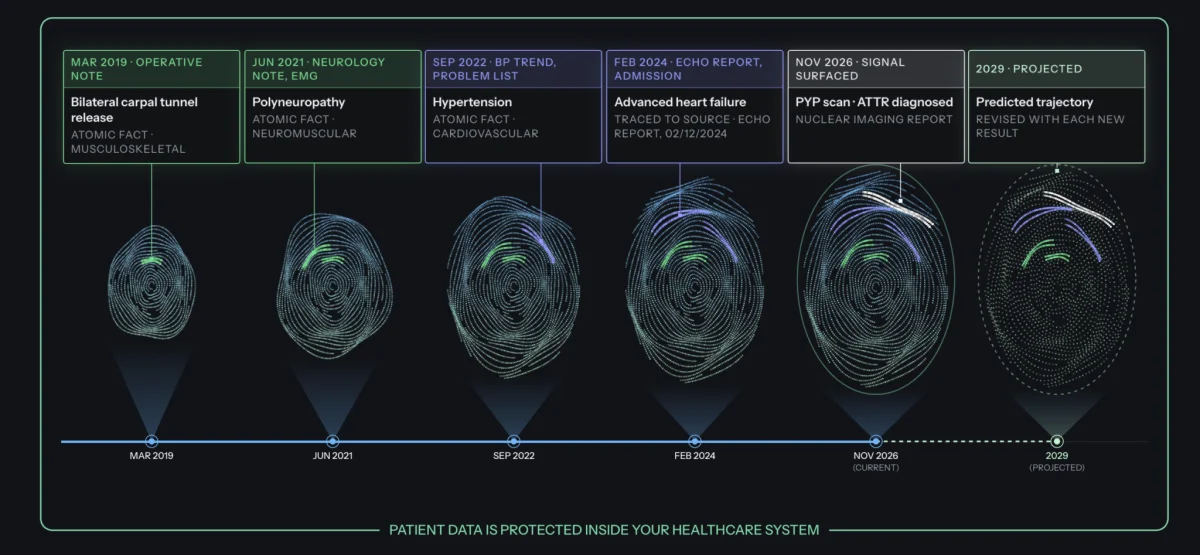
The bottleneck in many hospitals isn't a shortage of data. It's that the data is buried in prose. A patient's history can span decades of physician notes, operative reports, imaging and pathology reads, and discharge summaries, and most of it is free text. Turning that archive into something a care team can act on has always been slow, manual work. That's the problem Dyania Health is aiming at with Synapsis AI, and the approach is more specific than a generic summarization tool.

What Synapsis AI actually does
Dyania Health, a New Jersey-based clinical AI company, describes Synapsis AI as a clinical reasoning engine. The distinction matters. A summarizer compresses a chart. A reasoning engine works across every note, report and lab result in a record and connects findings that may sit years apart, answering clinical questions the way a specialist reviewing the chart would.
The output isn't a narrative paragraph. It's a set of clinical signals, and each one links back to its source in the record. That traceability is the design choice I'd focus on. A flag that says "this patient needs attention" is only useful to a clinician if they can see which echocardiogram, which pathology report or which lab value produced it. Synapsis AI keeps that chain visible, and clinicians review the evidence and make every decision.
Where the data stays
Deployment is where many health AI projects stall, and Dyania's architecture is built around that constraint. Synapsis AI runs on NVIDIA-accelerated computing inside a health system's own firewall. A system can process its entire patient record set onsite, which means patient data is never shared and never leaves the hospital.
For teams that have spent months negotiating data-sharing terms before any model gets a look at a chart, an on-premises design removes a large piece of friction. It doesn't remove the need for clinical validation, but it changes the conversation from "where does the data go" to "how well does the output hold up."
On the software side, Dyania builds and trains its clinical models with NVIDIA NeMo open libraries. It then applies NVIDIA TensorRT and TensorRT-LLM to optimize those models so they run faster and more efficiently on the hospital's own GPU servers. Optimization of this kind is less glamorous than the model itself, but it determines whether a system can process a large archive in a reasonable window on hardware the hospital already runs.
The Cleveland Clinic cohort
The clearest test so far is a study at Cleveland Clinic. Researchers used Synapsis AI to support work on more than 7,800 aortic valve replacement patients treated between 2005 and 2021.
The system reasoned across each patient's record, including every echocardiogram added in the years after surgery. It used that longitudinal information to build a predictive model of valve deterioration and reintervention risk at three, five and ten years after the procedure. The company says the platform completed chart review across the full cohort, work that would have taken clinicians years to finish by hand.
Dr. Lars Svensson, chief of the Heart, Vascular & Thoracic Institute at Cleveland Clinic, put the value in terms of patient outcomes: "Using technology to bring together and analyze information that can help us predict the duration of implanted heart valves is a promising step towards enhanced outcomes and more personalized care for patients."
That quote is measured, and it should be read that way. It describes a promising step, not a finished clinical tool. The more useful takeaway for developers and health IT leaders is the workflow: a question that depends on years of heterogeneous documentation became tractable because the reading was automated and the results stayed tied to their sources.
Where the same pattern applies
Dyania's framing extends the approach beyond one cohort study. Any problem where the answer sits inside the medical record fits the same pattern. The examples given include identifying patients eligible for clinical trials, closing care gaps in cardiology and oncology, and populating clinical registries.
Trial matching and registry abstraction are particularly interesting because both are chronic labor sinks. Teams in these roles typically spend large amounts of time reading charts to confirm eligibility criteria or extract fields, and errors in either step are costly. A system that cites its evidence gives coordinators something to verify rather than something to redo.
What to watch
A few questions remain open. Clinical reasoning over free text depends heavily on documentation quality, and records written differently across departments or over long time spans will test any system. The traceability feature helps a clinician audit a signal, but it doesn't tell you how often the system misses something that isn't written down. And a retrospective cohort study answers a different question than a prospective deployment that changes care in real time.
Still, the architecture is the detail I'd track. Keeping inference on hospital hardware, linking every output to its source, and keeping the clinician as the decision-maker are the parts that determine whether this kind of tool gets past pilot status. If Dyania and its health system partners publish validation results across more sites and more question types, that will say more about the approach than any single case study can.