AI's Early Labour Market Footprint Shows Up First in Young Software and Support Roles
- Gate
- Machine Learning
- Departs
- Crew
- Manuel Uth
- Passengers
- 817
Australia's central bank finds job postings and young-worker employment slipping in AI-exposed roles, though the study can't yet prove AI is the cause.

Most of Australia's labour market hasn't felt AI yet. The clearer signal sits in a narrow slice: people starting their careers in jobs where generative tools map closely onto daily tasks. That's the finding that stands out in a new monitoring analysis from the Reserve Bank of Australia, and it deserves a close read because the pressure is heaviest where entry-level hiring is already thinnest.

What the RBA is actually measuring
Mike Major's work doesn't try to size AI's total effect on jobs. It builds a monitoring system aimed at the places where effects should surface first: entry-level workers and occupations rated highly exposed to AI, including programming, clerical work and customer service. That's a sensible design. Aggregate unemployment moves for many reasons and tends to lag, while a slowdown in graduate hiring shows up in job postings within months.
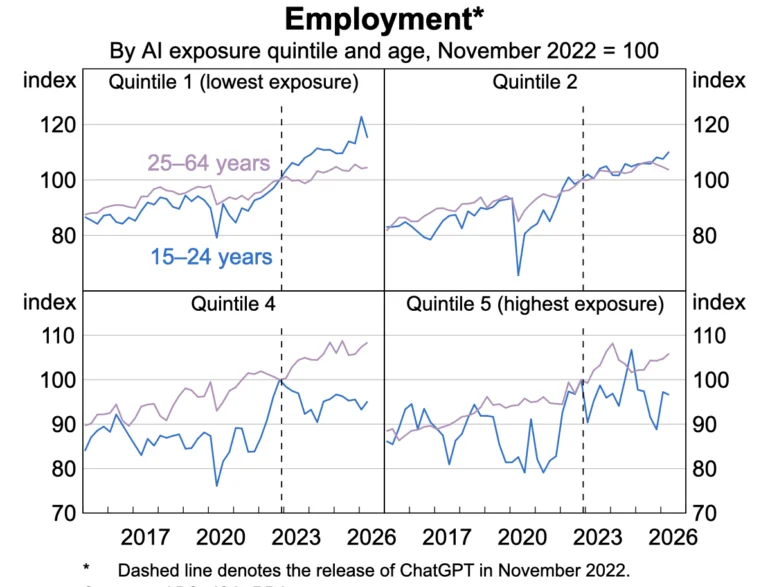
On that measure, postings have fallen across all groups since ChatGPT launched in late 2022. The steepest drop is in the highest-exposure group. Inside it, workers aged 15 to 24 and young college graduates show weaker employment rates and higher unemployment than older workers. The analysis includes a chart that makes the split visible: in the top exposure quintile, employment among young people has declined since late 2022, while employment among older workers has risen.
Where the pattern is strongest
Software development stands out. Junior developers are the group that typically handles the routine coding, testing and documentation work that AI tools now do well, so a shrinking entry tier there is plausible. Customer service and clerical roles show the same logic: the tasks that once justified hiring a new person to learn the job are the ones most easily automated.
The trouble is that these roles have long served as training grounds. If the first rung disappears, the people who would have become senior engineers or experienced account managers in five years never get started. That's the part of the story that matters most for decision-makers, and it's easy to miss when headline employment figures look stable.
Other studies point the same way, with caveats
An August 2025 Stanford study based on millions of US payroll records found a similar shape. Employment among 22- to 25-year-olds in AI-exposed occupations fell 13 percent in relative terms since late 2022, and the drop was nearly 20 percent among young software developers. More experienced workers in the same occupations held steady or gained ground.
A March 2026 Anthropic study also found declining hiring among 22- to 25-year-olds in exposed occupations, with job-finding rates down about 14 percent. It found no systematic rise in overall unemployment, though. The gap between theoretical automation potential and actual AI use remains wide, and that gap is where much of the debate lives.
Anthropic's own workforce offers a company-level view. According to an internal review, the share of junior hires in technical roles fell from 27 percent to 9 percent since early 2025. By August 2026, AI agents across the company were logging six times as many hours as human employees. Anthropic acknowledges it's an extremely AI-intensive software company and therefore a special case. Even so, researchers warn of a "tragedy of the cognitive commons": if junior roles keep vanishing, the pipeline of experienced professionals thins out, assuming those professionals are still needed when they're eventually required.
Causation is the open question
Major is careful on this point, and it's the right instinct. The RBA study doesn't establish direct causation. It measures theoretical exposure rather than what companies actually deploy. Post-pandemic shifts in the business cycle and changes in remote work could also be driving the numbers. SEEK data, meanwhile, suggests AI is complementing existing work while creating new demand for AI skills.
A January 2026 analysis of 10.6 million LinkedIn profiles alongside US unemployment data pushes harder against a simple AI story. The team led by Morgan Frank at the University of Pittsburgh found that problems in exposed occupations started in early 2022, months before ChatGPT launched. Macroeconomic factors, such as the Federal Reserve's interest rate shift or a correction after pandemic-era hiring surges, may matter more than previously assumed.
Denmark offers a useful counterweight. A large study of 25,000 workers found no measurable changes in wages or hours worked despite a 64 percent AI adoption rate. Workers saved an average of just 2.8 percent of their working time. Broad adoption doesn't automatically translate into broad economic change, at least not yet.
Demand is shifting, not only shrinking
The job market story isn't just subtraction. According to the World Economic Forum's "Future of Jobs Report 2025", 77 percent of surveyed companies prioritize upskilling over job cuts. The WEF projects a net gain of 78 million jobs by 2030. LinkedIn data shows AI-related job postings growing sixfold in one year.
My read is that the Australian findings describe a hiring problem more than a layoff problem. Existing workers in exposed roles are mostly holding on. What's shrinking is the number of openings for people without experience, and that's a slower, less visible form of disruption. The question to watch is whether junior hiring recovers as firms learn to use AI tools in ways that still need human trainees, or whether the entry tier keeps eroding. The next round of RBA monitoring data, and whether the 2026 patterns hold beyond a few sectors, will show which way it's heading.