Agents Handle the Fiddly Shopping, Britain Warms to Claude, and Solar Needs Its Financing Fixed
- Gate
- Machine Learning
- Departs
- Crew
- Azeem Azhar
- Passengers
- 578
Agents win on fiddly purchases but still lose to the app for simple ones. Meanwhile, UK AI payers are growing fast, and cheaper renewables need better financing.
An AI agent that buys a phone for you is a useful test of where delegation actually pays off. A chore that means refreshing a retailer's site every few minutes from 7 am is a good fit. Ordering a car you can book in two taps isn't. That split is more informative than any headline about agents "taking over" commerce, and it's where I'd start.
Where agents earn their keep
Agent-based shopping is still early. One figure makes the point: Uber says four rides out of 320 million taken during Halloween week were booked by agents. Nobody should read that as a verdict on agents. It mostly shows that a well-designed app already removes most of the friction, so an agent adds little. I wouldn't hand over a ride booking yet either.
The picture changes with products that are hard to pin down. A limited-stock iPhone release is a clear example: it rewards persistence, speed and patience, none of which a person does well at 7 am. Finicky items like surge-protected power extensions, medicine pouches and woolly jumpers follow the same logic. They involve many variants, unclear specifications and a lot of comparison. Agents can do that legwork tirelessly, and the buyer only has to confirm the final choice.
The early uses are modest but telling. People are testing agents on small errands, such as one buying winter sweaters and another booking a squash court. Those are low-stakes tasks where a wrong result costs little. The open question is how well agents hold up when money, returns and personal data are involved, and that's a more demanding test than anything in these anecdotes.
Britain's quiet shift toward Claude
The UK numbers are worth reading slowly. Roughly one in twenty British adults now pays for an AI product, with spending above $1.3 billion a year. Two years ago that share was 1%, and a year ago it was 2.5%. Five percent is still a minority, but the curve is steep, and steep curves in consumer software usually reflect habit forming rather than novelty fading.
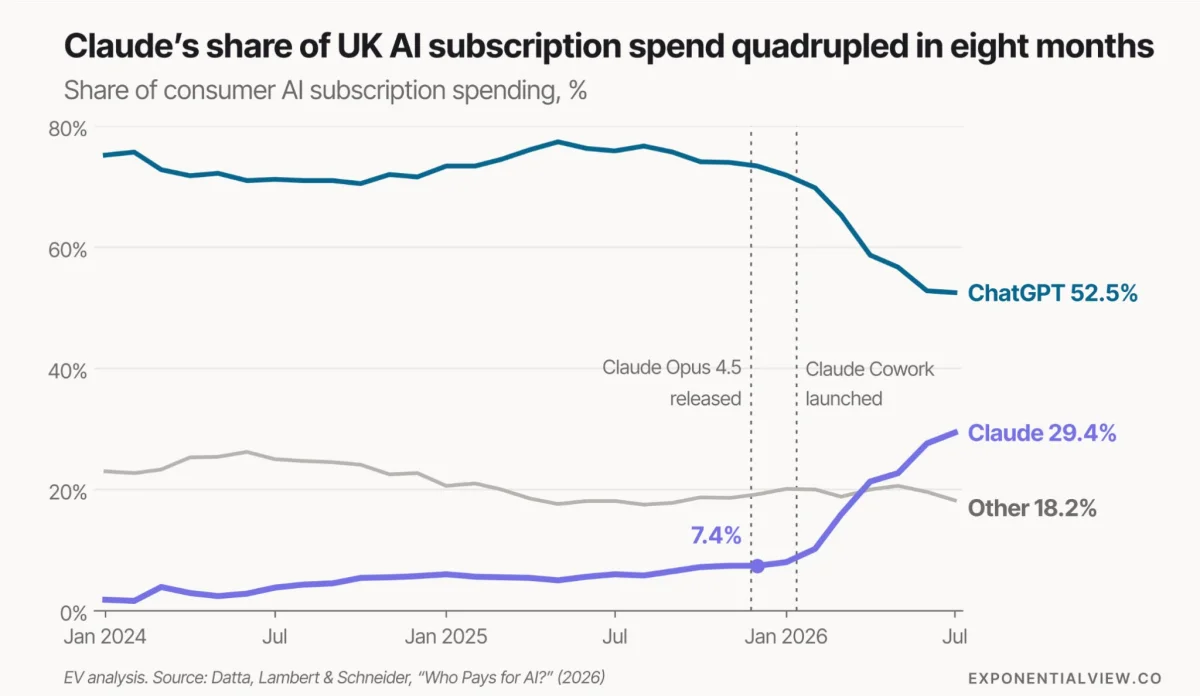
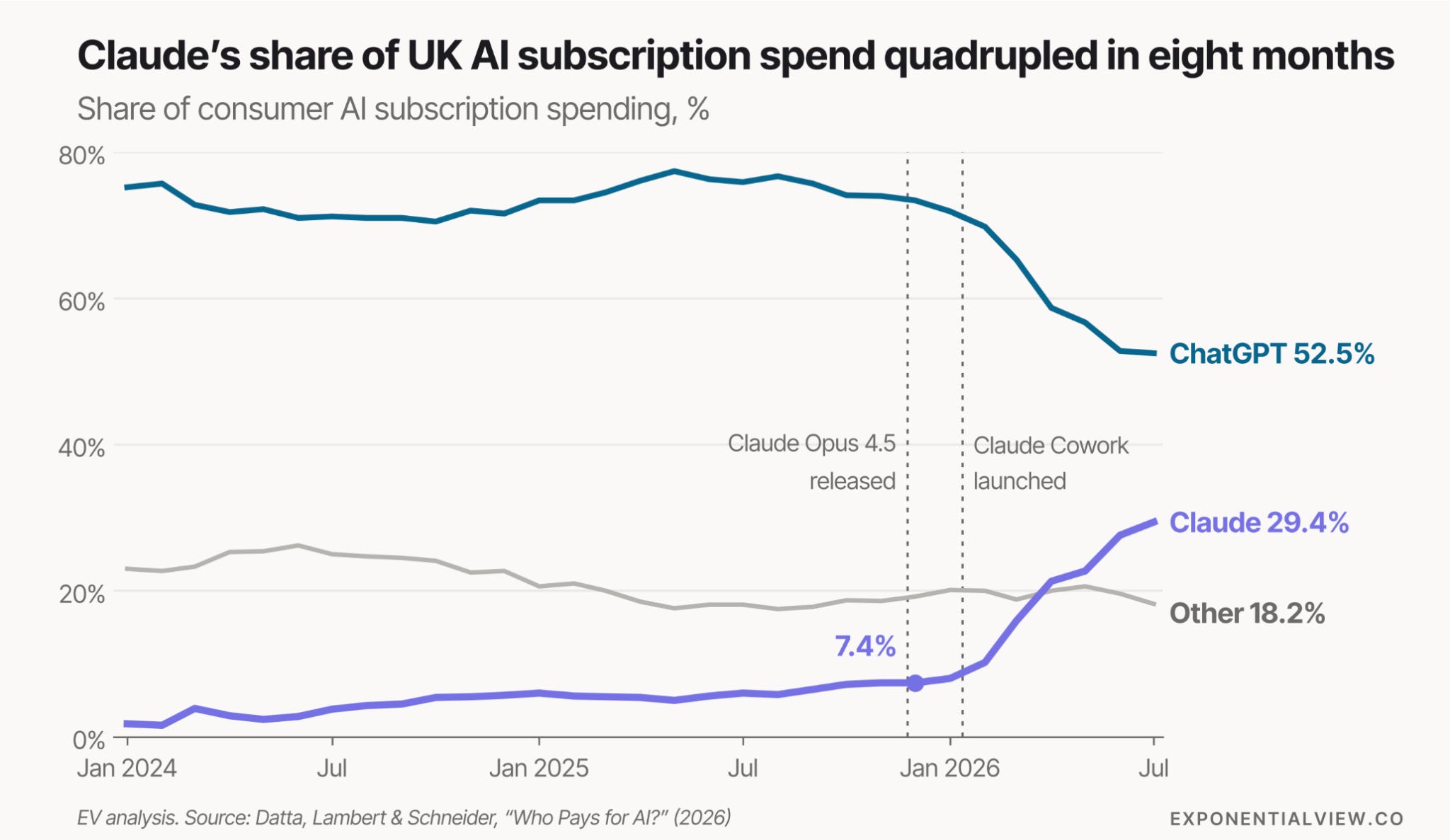
The adoption is concentrated. London leads, and paying users skew toward tech, finance, education and PR. Those are professions where people write, summarise and research all day, so the value of a paid tool is easy to justify. The more interesting detail is the brand split. Claude's share of paying UK users has quadrupled in a year. Something specific seems to be driving that, and one candidate is the improved harness around Claude Cowork. That's a plausible explanation, but the data alone doesn't prove it. Switching patterns in a market this size usually come from several changes landing together: product quality, word of mouth in particular professions, and pricing.
Renewables: the cost maths has shifted
On the energy side, the cost story is getting more favourable for renewables, though not in the simple way people often assume. Adding wind to solar and batteries lowers the median cost from $105 to $86 per MWh. In the harder case of locations north of Milan and Montreal, which sit at roughly the same latitude, the figure falls from $164 to $99. Those gains matter most where sunshine is weaker and seasonal swings are larger.
The reason they work is complementarity. Hourly modelling over ten years suggests sun and wind mostly cover for each other. The exception is a difficult combined lull, lasting about a week every four, when both are weak at once. That's the gap batteries alone can't close, and it's why the combined cost depends so heavily on how the system handles those stretches. Gas backup, or long-duration storage where it's available, fills that role.
Ember's analysis puts the stakes in context. About 83% of the 750 GW of fossil plants in the pipeline sit in places where reliable renewables, with some gas backup, would cost under $100/MWh. That figure implies a particular fuel price environment, roughly where oil sits at $60 a barrel. If fuel prices move, the comparison moves with them. Still, the point stands that many planned fossil projects face competition from cheaper alternatives in their own locations.
The financing problem nobody can wish away
Cheaper hardware doesn't finish the job. Panel and battery costs have fallen, and the next gain may come from robotics that cut installation labour, which is where costs haven't yet dropped as far. But rebuilding a grid around renewables depends on two things that technology can't fix on its own.
The first is cost of capital. Gas plants still borrow more cheaply than solar, even when solar's operating costs are lower. That gap penalises the cleaner option before it earns any revenue. The second is risk. Renewable output varies with weather, and prices swing with it. Financial instruments that match energy prices to that volatility, such as long-term contracts and hedging products that cover intermittent supply, would let developers and buyers share the risk more evenly. Without them, the cheap energy on paper stays expensive in practice.
Here's the thing: the two stories in this piece rhyme. In both, the technical capability arrived first, and the bottleneck moved to the surrounding layer. For agents, that layer is trust, payment and verification. For grids, it's finance and market design. My read is that the next year's progress will be decided less by model benchmarks or panel efficiency and more by whether those surrounding systems get built.