Claude Opus 5.5 Rewards Fewer Prompt Tricks, Anthropic Says
- Gate
- Machine Learning
- Departs
- Crew
- Matthias Bastian
- Passengers
- 485
Anthropic says Claude Opus 5.5 works better when users drop old prompt tricks, start at Medium effort, and describe the end goal in one message.

If you're still prompting Claude Opus 5.5 the way you prompted older models, Anthropic says you're probably holding it back. The company's guidance amounts to a short list of habits to drop and a few new defaults to adopt. Taken together, it's a useful signal that the best way to use a stronger model isn't always the most elaborate prompt.

Opus 5.5 is now the default on Pro, Max, Ultra, and Team plans. Anthropic says it behaves differently from earlier Opus releases, and that many users carry over instructions that made sense a generation ago. Here's the thing: those instructions were built for models that needed a nudge, and this one doesn't.
Why "think hard" has become dead weight
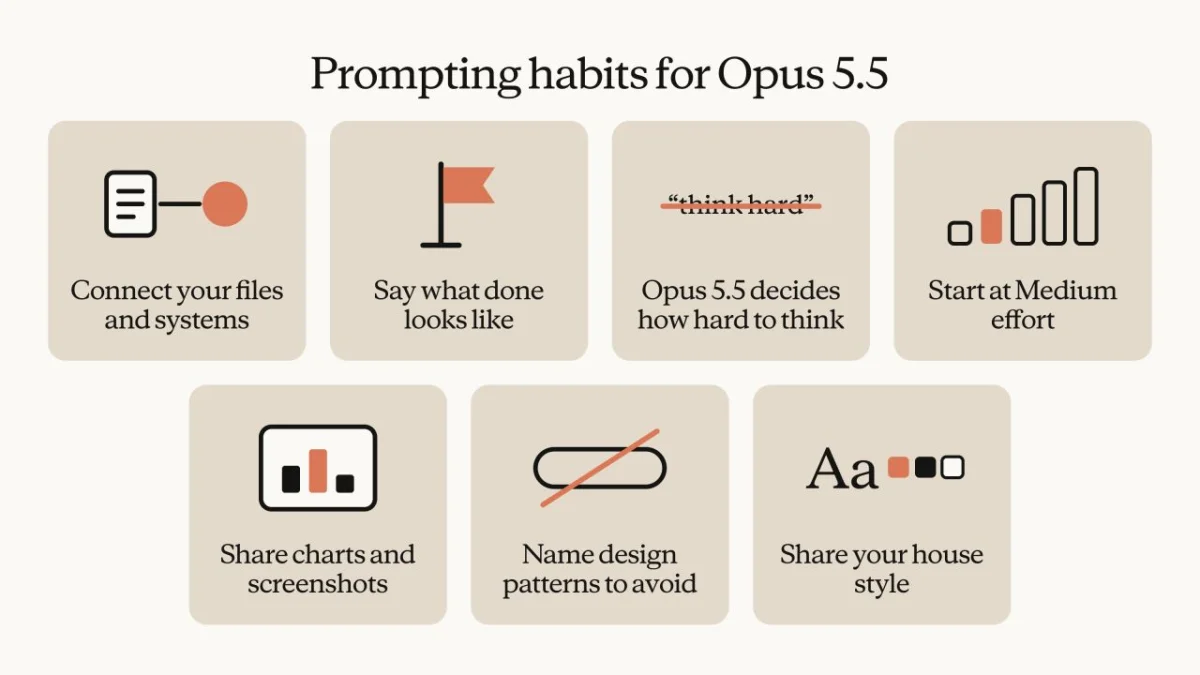
Anthropic's first recommendation is the simplest. Remove phrases like "think hard" or "think carefully" from your prompts. The company says Opus 5.5 always reasons before it answers, and it scales that reasoning to the task and the effort level you've selected. Telling it to think harder adds nothing the model isn't already doing.
The habit goes back to the early reasoning models, when these phrases could sometimes coax more performance out of a model or steer how it routed a request. Those tricks grew out of a period when reasoning was switched on by hand. Today's adaptive reasoning makes the decision itself, so the old incantations are closer to noise. In Anthropic's internal tests, responses written without these phrases started sooner, and the company reports no measurable drop in quality.
That's worth keeping in perspective. These are Anthropic's own tests, not independent benchmarks, and the company hasn't published figures for the size of the speedup. But the mechanism is plausible: a model that decides its own reasoning depth doesn't need the prompt to tell it to try.
Start at Medium and treat the effort setting as a cost lever
Anthropic also wants users to start at the "Medium" effort level, which is the Opus 5.5 default. According to the company, Opus 5.5 on Medium matched the performance of its predecessor, Opus 5, on "High" in internal testing. Higher settings cost more and don't reliably produce better answers. The advice is to move up to "High" only when Medium clearly falls short. The setting sits in the model menu next to the send button.
This matters most for teams that have built a routing habit. Many groups have used a cheaper model like Sonnet for routine work and reserved Opus for hard problems. Anthropic suggests that split deserves another look. Its argument is that a more capable model often finishes a task in fewer steps, which can partly offset its higher per-token price. The company also says that someone who regularly pushes Sonnet to "Extra High" or "Max" effort ends up spending about what they would on Opus 5.5 at its default settings.
My read is that this is the more practical takeaway for anyone managing a budget. Token price is only part of the bill. Retries, follow-up turns, and reruns all add up, and a model that gets it right in one pass can be cheaper than a smaller model that needs three attempts. The catch is that this depends on your workload. Anthropic's numbers come from its own tests, so the right move is to measure the cost per finished task on your own jobs before you change your routing.
Stop running the conversation one message at a time
The biggest shift in Anthropic's guidance is about how to structure a request. Instead of feeding instructions in one step at a time, describe the whole job in a single message. Cover the goal, the output format, and the conditions under which Claude should stop and ask you questions.
That's a change in posture. Older chat workflows assumed the human would steer every turn. Anthropic says Opus 5.5 is better at carrying multi-part tasks through to the end, and that it can increasingly handle the back-and-forth that users used to manage themselves. In the company's framing, the model can effectively prompt itself from one well-specified opening message.
Two related habits follow from this. First, ask for the finished document or spreadsheet directly rather than requesting a draft and then iterating. Anthropic says Opus 5.5 often goes from request to finished product in one pass. Second, stop transcribing your inputs by hand. Anthropic recommends attaching diagrams and tables as images or files. It says workarounds older models needed, like manually copying chart values into the prompt, are no longer necessary. The company also reports that Opus 5.5 reads dense charts more accurately even at its lowest effort level than Opus 5 does at its highest.
Name the style you don't want
For design work, Anthropic's advice is to be specific about what to avoid. Telling the model to skip "generic design" doesn't give it much to work with. Naming the concrete choices you don't want, such as a cream-colored background or pill-shaped buttons, works better. The company's reasoning is that vague bans tend to swap one default style for another. The model still needs a direction, and a negative instruction that's too broad leaves it guessing what counts as generic.
This is a familiar problem in creative prompting, and it applies beyond design. Constraints work best when they're concrete enough to check the output against. Anthropic also recommends sharing your own house style when you have one, which gives the model a positive target rather than a list of prohibitions.
The last point concerns data access. Users who connect Claude to their own files and systems through connectors, according to Anthropic, get noticeably more tailored results. The model can pull the information it needs without the user pasting it in. For teams, that shifts effort from writing longer prompts to setting up the integrations that supply context. The payoff depends on how well those connections are wired into your actual workflow, and Anthropic's guidance doesn't quantify it.
What to watch next
The useful thing about this guidance is what it implies about where prompt engineering is heading. For the last few years, much of the craft was compensating for model weaknesses: forcing step-by-step reasoning, hand-feeding context, and iterating through drafts. If Anthropic is right that Opus 5.5 handles those on its own, the skill shifts toward specifying goals clearly, choosing effort and model tiers deliberately, and building good data connections.
Two things would make this more useful to evaluate. One is independent testing of the Medium-versus-High claim across a range of tasks, since the current figures come from Anthropic. The other is a clear cost comparison that includes retries and follow-up turns. Until those exist, treat the guidance as a well-reasoned starting point and check it against your own workloads.