Ensuring Safety in Robotaxi Deployment with NVIDIA Halos System
- Gate
- Machine Learning
- Departs
- Crew
- Riccardo Mariani
- Passengers
- 446
NVIDIA's Halos system provides a comprehensive safety framework for robotaxis, addressing critical challenges in deployment and operation scalability.

A new wave of mobility is upon us: robotaxis are no longer just a concept but are gradually becoming part of urban transport ecosystems in cities worldwide. With companies like Uber and Autobrains leading initiatives in Munich, alongside partnerships in Taiwan and Saudi Arabia, the robotaxi industry is shifting from experimental prototypes to fully operational fleets. Key to this transition is the underlining technology that not only enables these systems to function but ensures their safety and reliability.

As robotaxi services expand, safety mechanisms must inherently integrate with the vehicle operations rather than being affixed as afterthoughts. The transition to commercial viability necessitates rigorous adherence to safety protocols as regulatory bodies pay closer attention. This attention is reflected in the collective efforts of developers and manufacturers who are putting stringent systems in place to meet these safety standards.
Addressing Safety Challenges in Robotaxi Technology
For both developers and regulatory entities, safety encompasses more than just immediate operational capabilities such as visual perception and decision-making processes of the vehicle. There are significant requirements that need to be addressed to ensure the overall reliability of the system.
Regulatory authorities seek assurance that autonomous systems can operate dependably, promptly isolate any faults, and adhere to predetermined operational parameters. This requirement leads to four distinct challenges that must be addressed simultaneously to foster a safe robotaxi environment:
- Developing a safety-certifiable operating system.
- Creating consistent hardware and software interfaces that support safe operations.
- Implementing AI systems that operate within verifiable limits.
- Conducting thorough validation at scale before vehicles engage the public roadways.
NVIDIA Halos: A Multilayered Safety Framework
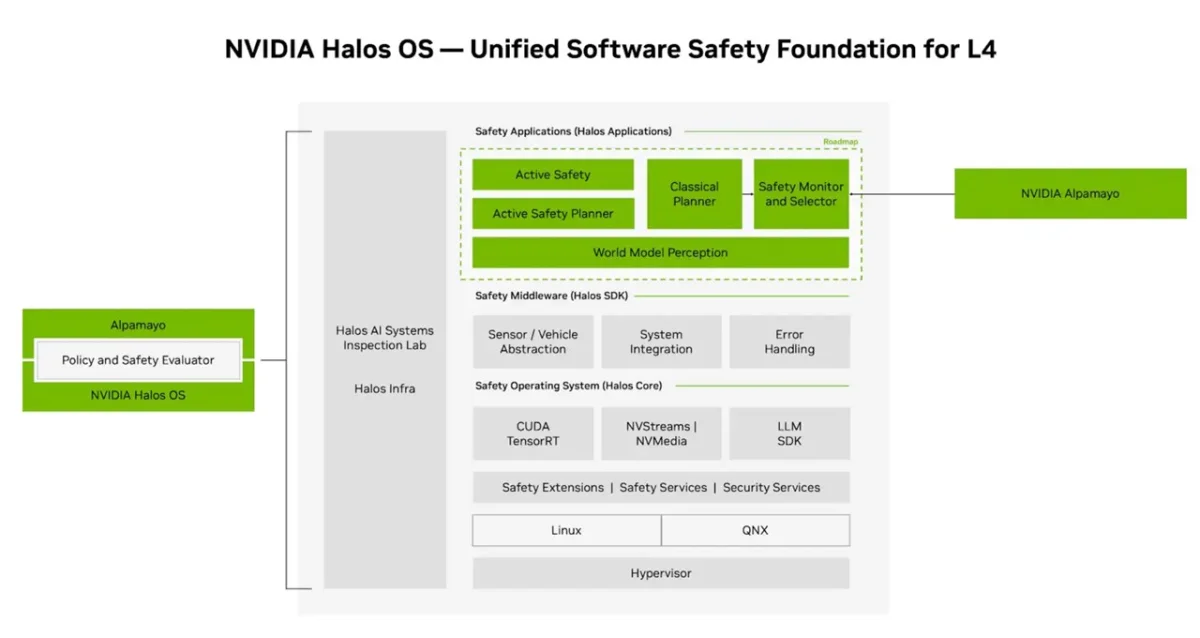
The recently introduced Halos Operating System (OS) has emerged as a key component in addressing these challenges, providing a cohesive, production-ready safety foundation specifically tailored for AI-driven vehicles based on the NVIDIA Hyperion platform.
Halos Core: Certified OS for Automotive Safety
At the crux of NVIDIA’s Halos OS is Halos Core, a next-generation operating system that meets stringent automotive safety standards. Halos Core has been audited and designed to deliver predictable behavior even under fault conditions, thanks largely to its hypervisor—a specialized software layer that isolates critical functions and prevents failures from affecting critical vehicle control systems. It complies with the ISO 26262 standard at ASIL D level, ensuring high safety integrity. Halos Core also supports NVIDIA CUDA and TensorRT, providing the infrastructure for high-performance AI inference.
Halos SDK: Standardizing Interfaces for Reliability
Robotaxis must integrate multiple sensor types—ranging from cameras to radar and lidar—each producing data at different rates and formats. This diversity creates significant integration challenges. The Halos SDK addresses this by introducing a standardized middleware layer that abstracts sensor interfaces, allowing developers to easily interchange sensors without necessitating extensive code modifications. This adaptability is crucial for maintaining operational versatility with minimal disruption.
Additionally, Halos SDK provides a deterministic application-level scheduler to ensure reliable timing in processing, as well as zero-copy inter-process communication to minimize latency. These features lay the groundwork for robust and efficient automotive applications.
Halos Applications: Establishing Safety Guardrails
While the AI models powering robotaxis can replicate human driving behavior, they must also adhere to regulatory standards that emphasize safety. The application layer of Halos includes a suite of deterministic, rule-based functions designed to operate within set limits. This includes perception models that account for the surrounding environment and the highly-regarded NVIDIA DRIVE active safety features like automatic emergency braking and lane supervision.
This layer also facilitates the integration of explainable AI models, such as those from the NVIDIA Alpamayo model family, which enables continuous assessment of driving conditions and decision-making frameworks. These capabilities are vital in ensuring compliance with safety regulations while enhancing operational reliability.
The Halos Safety Evaluation Framework
The Halos Infra serves as a cloud-side development platform streamlining vehicle training, simulation, and validation processes at scale, forming the backbone of the newly released NVIDIA Halos Safety Evaluation Framework. This framework equips developers with the essential tools and guidelines for constructing a credible safety case that spans from Level 2 driver assistance to Level 4 autonomous operations.
Backed by extensive research, including over 330 papers and 1,000 patents developed within the Halos OS ecosystem, Halos Infra connects to NVIDIA's advanced computing systems for training AI in actual environments and simulations, ensuring the broad capabilities needed for real-world performance.
In conclusion, as the robotaxi sector surges towards mainstream adoption, establishing a solid safety foundation will be critical. By focusing on comprehensive safety features, the NVIDIA Halos framework not only addresses the immediate operational safety concerns but also prepares the industry for sustainable growth in autonomous transportation.


