Egypt’s AI Ecosystem: From Development to Deployment and the Growth of African AI Infrastructure
- Gate
- Machine Learning
- Departs
- Crew
- Fatima Tambajang
- Passengers
- 960
Egypt's AI ecosystem is rapidly advancing with significant investments in infrastructure and innovation, showcasing a vibrant environment for startups and developers.
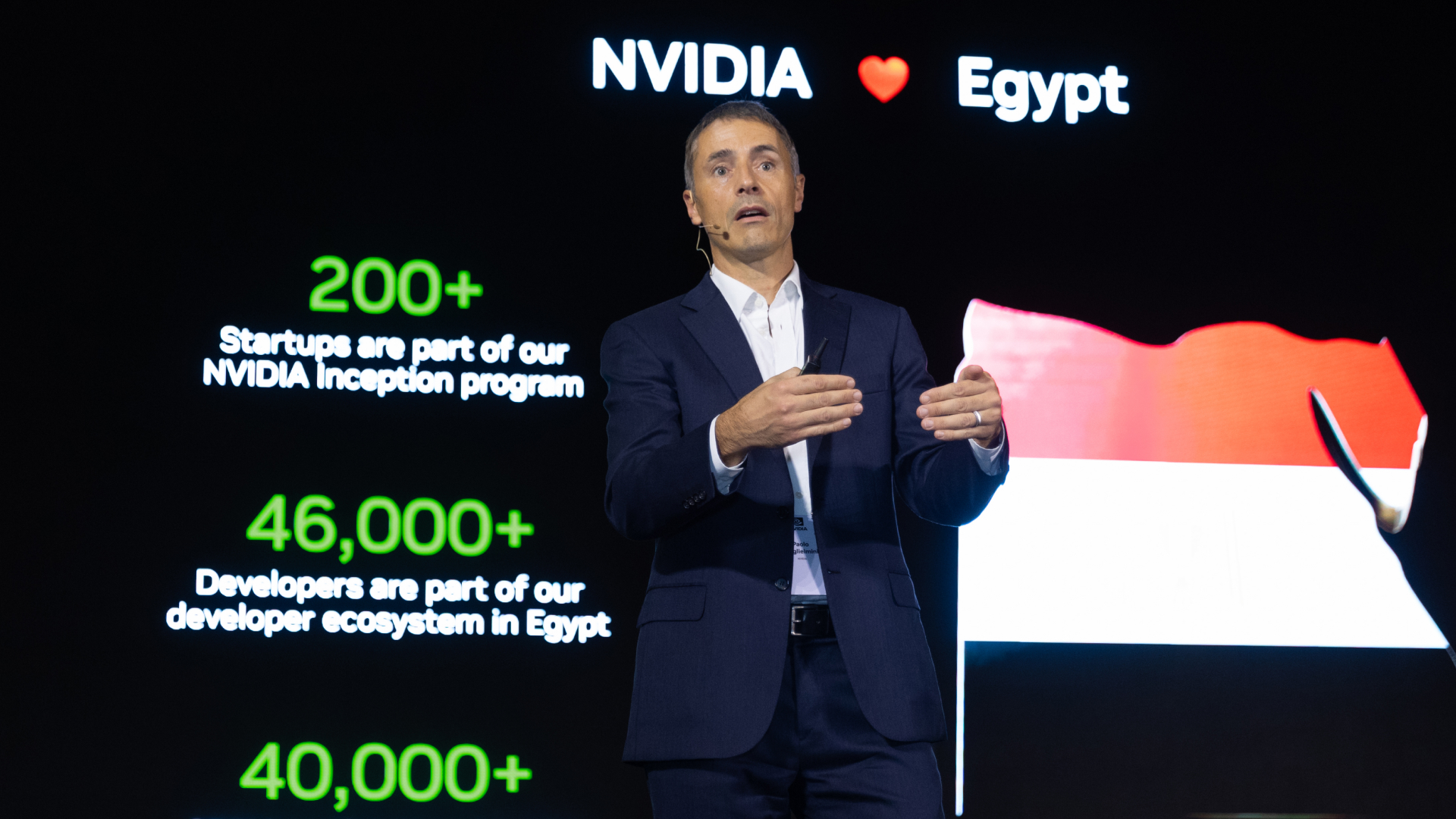
Egypt has witnessed a vibrant gathering of artificial intelligence (AI) professionals recently at the Grand Egyptian Museum. This event spotlighted the nation’s burgeoning AI ecosystem, encompassing native developers, researchers, startups, and established enterprises across various industries. The intent was to highlight ongoing efforts and achievements in AI development and production across the region.
The keynote address at the event was delivered by Paolo Guglielmini, the vice president of EMEA at NVIDIA, underscoring NVIDIA’s comprehensive approach to AI development and deployment. His colleague, Ahmed Mostafa, regional AI adoption lead for the Middle East and Africa at NVIDIA, elaborated on the necessity of accelerating every layer of AI to optimize deployment capabilities. The session emphasized a full-stack approach to harness AI technologies effectively.
A panel moderated by Basil Fateen, head of startups for the Middle East and Africa at NVIDIA, further showcased insights from various startups specializing in sectors such as smart spaces, healthcare, cybersecurity, and robotics. This discussion underlined the collaborative spirit within Egypt’s growing ecosystem.
Investment in AI Infrastructure
The development of infrastructure has a direct impact on AI growth, exemplified by the increase in the NVIDIA Deep Learning Institute learner base, which saw a more than tenfold rise within a year. In June, the National Telecommunications Regulatory Authority of Egypt issued a license to Hassan Allam Data Centers to construct and operate data centers, aiming to bolster local AI capacity. The partnership between Hassan Allam Utilities and A15 resulted in an anticipated $400 million investment into essential data infrastructure.
In tandem with NVIDIA, A15 hosted an event to connect emerging founders in Egypt with NVIDIA’s global startup ecosystem. This initiative aligns with various recent startup and investor events across Egypt, including those organized by Plug and Play and A15 at the Creativa Innovation Hub, situated at a historical site in Sultan Hussein Kamel Palace.
Startups participating in the NVIDIA Inception program exemplify the diverse applications of AI in Egypt. For instance, Aidera offers an enterprise intelligence system that integrates data systems and workflows, facilitating data-driven decisions and intelligent automation. Additional startups include:
- Intella: Marketing Arabic speech intelligence for sectors like financial services and telecommunications.
- Marses Robotics: Focused on developing autonomous robotics and advancing industrial automation technologies.
- Proteinea: This startup blends AI-driven protein design with lab experimentation to pioneer new medicinal solutions.
- Stakpak: Works on an open-source autonomous developer-operations AI agent.
- Paymob and Thndr: Aiming to enhance financial services through innovative AI technologies.
The NVIDIA VC Alliance's expansion within Egypt has been notable with new members, A15 and M Empire, enhancing connections between local investors and NVIDIA's wider startup network. Starting initiatives have involved collaborations with established platforms such as RiseUp, Plug and Play, Flat6Labs, and Algebra Ventures, all focusing on promoting startup innovation in the region.
AI Growth Across Africa
The gathering in Egypt also reflects a broader trend in Africa's expanding AI landscape. Historically, discussions surrounding Africa’s AI potential have concentrated on expected outcomes rather than existing developments. The continent, accounting for around 18% of the global population but less than 1% of worldwide data center capacity, has increasingly turned to cloud services located outside its boundaries for significant AI training.
This dynamic is shifting, with the announcement and launch of four AI factories across Africa within a year, which attributes an additional 656 megawatts of capacity in progress. These facilities are poised to provide accelerated computing resources necessary for local developers to train, refine, and deploy AI models closer to the data sources.
Cassava Technologies has emerged as a significant player, with initiatives to provide NVIDIA accelerated computing access through its AI factory in South Africa and planned expansions into Egypt, Kenya, Nigeria, and Morocco. Their total investment may reach an impressive $720 million. In collaboration with Vodafone Egypt, Cassava has launched an AI factory initiative aimed at supporting businesses and government entities with local AI infrastructure via GPU-as-a-service.
Stratos Lab, another notable initiative, collaborates with ECOBLOX and Digital Parks Africa to create an AI cloud supported by 50 NVIDIA HGX B300 systems, designed to deliver substantial local GPU compute power, optimizing model training and deployment costs.
At the GITEX Africa event in Marrakech, Nexus Core Systems disclosed plans for the Nexus AI factory, a landmark initiative requiring an initial $1.2 billion investment, signifying a commitment to advanced computing and renewable energy integration.
Ready for Deployment
The infrastructure developments in Africa reflect a growing confidence among local enterprises and developers available to apply innovative technologies effectively. NVIDIA aims to train 100,000 developers across Africa by 2024 through its Deep Learning Institute, which has trained approximately 85,000 developers to date, confirm its position as one of the fastest-growing regions globally.
Instadeep serves as a case study, having evolved from a small Tunisian team to a recognized figure following its acquisition by BioNTech for about $680 million. AI's potential in Africa is further exemplified by initiatives focused on local languages and cultural contexts, such as Lelapa AI’s development of language models tailored to African languages, enhancing their visibility among mainstream AI technologies.
As the demand for data centers continues to rise, projections estimate Africa's data center needs will surge from current levels of around 0.4 gigawatts to between 1.5 and 2.2 gigawatts by 2030. Meeting this demand will require significant investments between $10 to $20 billion, indicating an accelerating trajectory for AI development and application throughout the continent.
Through ongoing advancements and infrastructure development, Egypt and the broader African region are positioning themselves as vital players in the global AI landscape.


