NVIDIA Unveils Comprehensive Physical AI Framework for Advanced Autonomous Vehicles and Robotics
- Gate
- Machine Learning
- Departs
- Crew
- Pranjali Joshi
- Passengers
- 646
NVIDIA's new physical AI tools streamline workflows for autonomous vehicles, robotics, and vision AI, advancing development with innovative skills and frameworks.
At the Conference on Computer Vision and Pattern Recognition (CVPR), NVIDIA introduced significant advancements in physical AI agent skills aimed at expediting the development processes for autonomous vehicles (AVs), robotic systems, and vision AI applications. The company emphasizes that the primary challenges in physical AI research lie not just in enhancing model performance, but in constructing cohesive workflows that encompass scene reconstruction, edge-case scenario generation, policy training, behavioral evaluation, and rapid iteration. Traditionally, these workflows have been fragmented across various tools, hindering effective experimentation.
Central to NVIDIA's announcement is NVIDIA Cosmos 3, which represents a foundational model for physical AI, integrating vision reasoning along with action and world generation capabilities. This model leads the public leaderboards for physical AI applications and serves as a cornerstone for core physical AI development. It is designed to work in conjunction with NVIDIA libraries and simulation frameworks, enabling researchers to streamline their workflows, moving from model capabilities to fully integrated end-to-end processes quicker than ever before.
Enhancing Autonomous Vehicle Research
Autonomous vehicle researchers often face challenges related to the “long tail” of driving scenarios. These include rare interactions, complex road geometries, varying lighting conditions, and atypical behaviors that are tough to capture yet essential for training and validation. NVIDIA’s new suite of autonomous vehicle skills allows researchers to automate the scene reconstruction process using fleet data and generate synthetic driving scenarios that can be explored repeatedly under varying conditions.
The Neural Reconstruction skills enable AI agents to convert data captured from the fleet into editable 3D environments suitable for simulation and synthetic data generation. Other technologies, such as NVIDIA Omniverse NuRec and InstantNuRec, enhance this process, offering advanced scene realism and the ability to generate new views quickly.
Moreover, NVIDIA’s open-source reinforcement learning framework, NVIDIA AlpaGym, enhances this workflow by coupling policy rollouts with high-fidelity simulations, allowing for scaling across thousands of GPUs. The newly introduced NVIDIA Cosmos-Dreams model augments this by incorporating real-time photorealistic rendering, generating camera frames that react dynamically to model actions.
In terms of foundational models, NVIDIA also introduced NVIDIA Alpamayo 2 Super, a 32-billion parameter reasoning-language-action (VLA) model that is designed to enhance the safety and scalability of level 4 autonomous vehicle development and deployment.
Progressing Vision AI Systems
On the vision AI front, the challenge remains the creation of controlled examples that accurately reflect how models behave under fluctuating visual conditions, object states, or temporal changes. Current research often struggles with limitations in data availability for applications like zero-shot anomaly detection or synthetic anomaly generation.
NVIDIA Metropolis skills offer solutions by leveraging AI agents to create synthetic visual scenarios. These tools enable researchers to augment datasets, generate anomalies, and perform pseudo-labeling effectively, thereby overcoming the limitations of current data availability. Metropolis skills utilize Cosmos 3’s advanced mixture-of-transformers architecture to create physically grounded virtual environments systematically.
For high-accuracy visual inspection tasks, the Defect Image Generation skill allows researchers to generate multiple instances of various defects across different surfaces utilizing real image data. This combined workflow utilizes NVIDIA Isaac Sim for simulation and Cosmos 3 for orchestration, empowering researchers to generate rare visual examples and evaluate model responses.
NVIDIA also introduced the Metropolis Blueprint for Video Search and Summarization (VSS) to enhance insights derived from extensive video datasets. Coupled with NVIDIA TAO and other augmentation skills, this toolbox facilitates model fine-tuning and automates the process of model building and evaluation.
Advancing Robotics with Streamlined Simulation Workflows
When it comes to robotics, the primary challenge involves building diverse controlled environments and policy rollouts sufficient to train models across different tasks and settings. NVIDIA’s ecosystem allows for automation of development steps, providing a means to gather insights into how robot behavior evolves across various situations.
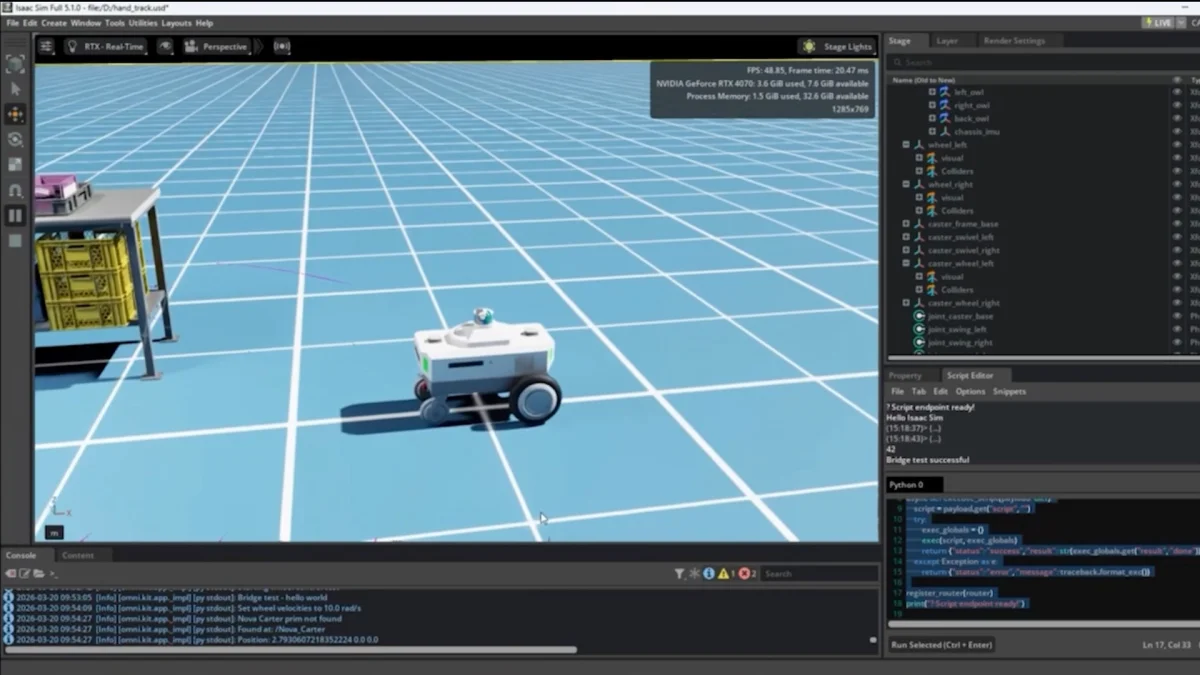
The Isaac Sim 6.0 now incorporates agent-friendly skills to facilitate these processes. By using NVIDIA Omniverse libraries and Isaac frameworks, researchers can automate scene creation, simulation control, data capture, and validation tasks. Specialized skills, such as Isaac mobility skills, enhance workflows for navigating through simulations, further accelerating the robot learning process.
For robotics in healthcare, the Cosmos-H-Surgical-Simulator model differentiates itself by generating realistic surgical data from actual surgical interactions. By moving away from artificially constructed physics models, it aims to bridge the gap between simulated and real-world performance for surgical robotic tasks.
Complementing these advancements, Cosmos 3 supports the generation of diverse synthetic data and scene variations for tasks ranging from simple manipulation to complex surgical procedures.
NVIDIA's Impact at CVPR 2026
NVIDIA technologies, including GPUs and CUDA-accelerated libraries, were heavily referenced at CVPR 2026, underscoring their widespread adoption by institutions such as Carnegie Mellon University, Stanford University, and others. The company’s contributions extend to numerous presentations on computer vision, robotics, and neural rendering.
In conjunction with their CVPR presence, NVIDIA is spearheading several open research challenges to benchmark advancements in physical AI, including:
- AI City Challenge — an ongoing competition aimed at smart city applications, now in its tenth year.
- PAI-AV Reasoning Challenge — focusing on evaluating VLA models based on causal reasoning in driving scenarios.
- AlpaSim Closed-Loop End-to-End Driving Challenge — a benchmark evaluating driving policies through closed-loop simulations.
NVIDIA aims to expand its research ecosystem around physical AI with new datasets—including over 15 million downloads of the NVIDIA Physical AI Dataset—to facilitate training and evaluation processes.
Availability of Resources
NVIDIA’s physical AI agent tools and skills are now available on GitHub. Researchers can access preconfigured environments and tools like Neural Reconstruction, Video Augmentation, and Defect Image Generation on NVIDIA Brev, which hosts these resources on H100 Tensor Core GPUs with trial credits for researchers.
For more insights into NVIDIA’s efforts at CVPR and its ongoing research work, you can explore additional resources on NVIDIA’s CVPR page or delve into their broader research portfolio at NVIDIA Research.


