Understanding LLM Fine-Tuning: Benefits, Techniques, and Frameworks for 2025
- Gate
- Machine Learning
- Departs
- Crew
- Michael Williams
- Passengers
- 592
Explore how fine-tuning large language models enhances task performance, reduces costs, and discover leading frameworks for implementation.

What is LLM Fine-Tuning?
Fine-tuning is a crucial step in optimizing pretrained large language models (LLMs) to align them better with specific tasks or domains. By making targeted adjustments to model weights, fine-tuning enables users to achieve higher quality outputs than standard prompt engineering, while also being more cost-efficient and faster. This article provides an overview of LLM fine-tuning, its benefits, and how to initiate the process using state-of-the-art techniques, particularly on Modal.
Benefits of Fine-Tuning LLMs
Cost Efficiency
Fine-tuning presents significant advantages over traditional prompting methods, mainly due to its ability to effectively steer an LLM's behavior. By training the model on a tailored dataset, users can reduce the length of prompts, thereby conserving input tokens without degrading response quality. Additionally, fine-tuned models often require less computational power, translating into reduced latency and inference costs. For example, a fine-tuned Llama 7B model can be around 50 times more cost-effective on a per-token basis compared to a baseline model like GPT-3.5, while still delivering comparable performance.
Common Use Cases
LLM fine-tuning excels in various scenarios, including the following:
- Structured Output: Generating formats like JSON or HTML.
- Style Adherence: Producing text that matches specific stylistic guidelines, such as those from The New Yorker or a company's branding voice.
- Domain-Specific Instruction: Enhancing tasks such as classifying corporate documents.
In tasks that necessitate integrating extra context into the model, such as referencing corporate documents, techniques like Retrieval Augmented Generation (RAG) may be more appropriate. Fine-tuning can even complement RAG by saving prompt tokens, which can then be utilized for incorporating additional input context.
Best Platforms for Fine-Tuning LLMs in 2025
In 2025, several platforms will facilitate LLM fine-tuning, varying between low-code solutions and more configurable, open-source approaches:
Low-Code Solutions
-
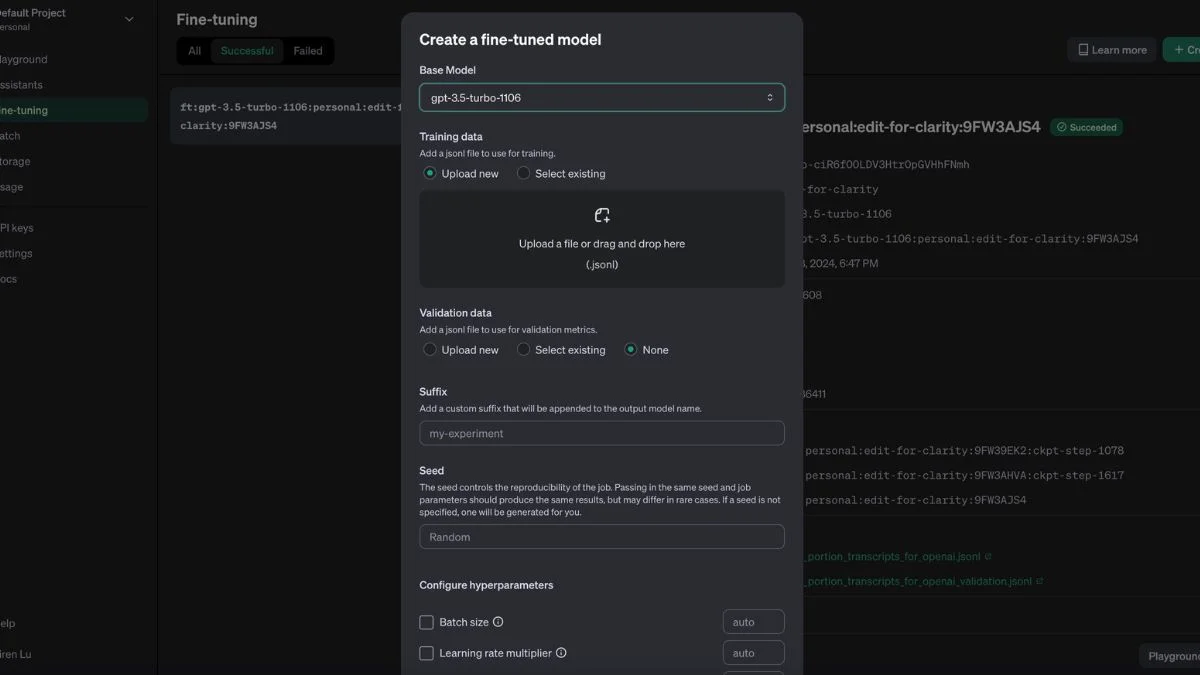
OpenAI: This platform offers an intuitive interface to fine-tune proprietary models with custom datasets.
- Pros: User-friendly interface and libraries that help validate data formats.
- Cons: Limited model availability, high costs, and lack of control over model weights.
-
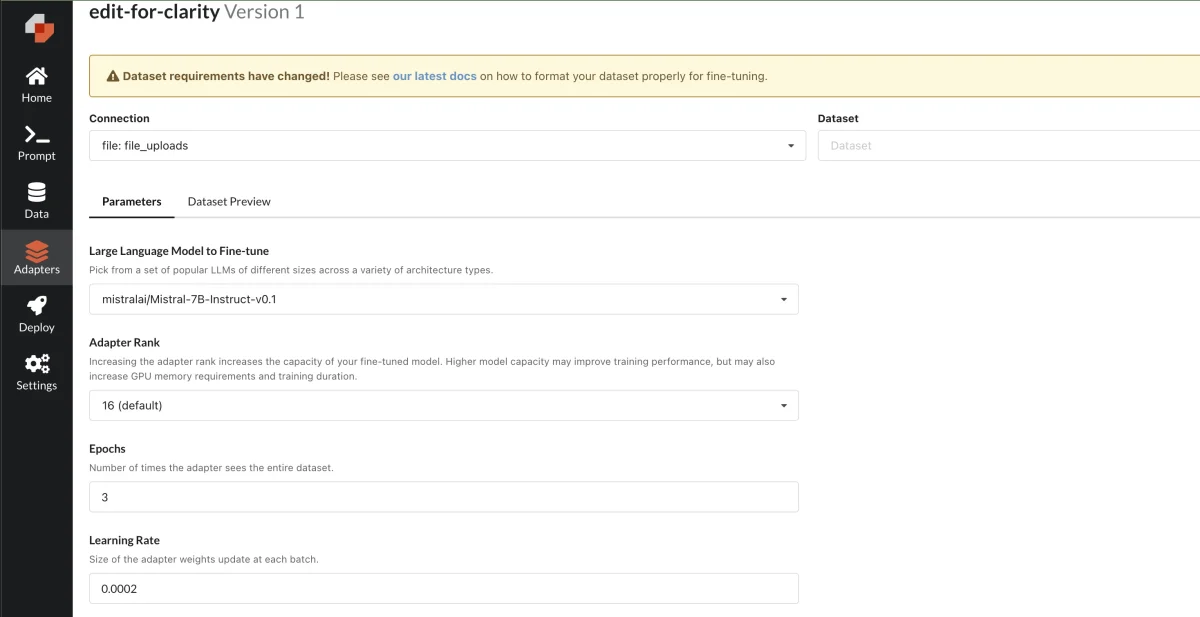
Predibase: A low-code framework designed for building AI models with excellent support for fine-tuning.
- Pros: Accessible UI, compatibility with various open-source models, and support for private deployments.
- Cons: Limited customization options.
Configurable Solutions
Alternatively, users can utilize open-source libraries and frameworks for fine-tuning, which offer greater control but require infrastructure to run the code. Notable options include:
-
Modal Labs: This serverless cloud computing platform simplifies the process of executing fine-tuning tasks by allowing on-demand GPU access through a few lines of code. Modal includes a template for fine-tuning open-source LLMs tailored to individual datasets, incorporating various training techniques.
-
Google Colab: This platform offers an upgraded Pro tier that allows users to access powerful GPUs for extended durations, making it suitable for smaller fine-tuning experiments.
-
AWS SageMaker: A fully-managed platform for building, training, deploying, and fine-tuning models at scale.
Top Frameworks for LLM Fine-Tuning in 2025
Several frameworks stand out for their capabilities in LLM fine-tuning:
-
Hugging Face Transformers: A popular open-source library for transformer-based models, featuring a high-level API for various tasks and training techniques like distributed training and mixed-precision training.
-
Hugging Face TRL: This library enables users to implement reinforcement learning models that assign rewards for generating desired outputs, such as polite interactions.
-
Axolotl: An open-source library offering a user-friendly interface for customizing fine-tuning configurations through YAML files or command-line overrides. It supports various fine-tuning techniques, including full fine-tuning, Low-Rank Adaptation (LoRA), and quantization methods.
Steps for Fine-Tuning LLMs
1. Choose a Base Model
Numerous open-source LLMs exist, each presenting distinctive strengths and weaknesses. Although various models claim superiority based on numerous benchmarks, experimentation is key to identifying the best option for your application. Models, such as Llama 2, Pythia, and Mistral, come in multiple sizes to align with specific use cases. Here’s a brief overview of selectable models:
| Model | Description |
|---|---|
| Llama 2 | Open-source model provided by Meta. |
| Pythia | Open-source model from EleutherAI. |
| Mistral | Open-source model from Mistral. |
| Falcon | Open-source model from TII. |
| T5 | Open-source model from Google. |
Additionally, models that have undergone further fine-tuning on specialized datasets can also be leveraged. Examples include Vicuna, Code Llama, and Dolly, each tailored to different tasks such as dialogue or sourcing code.
2. Prepare the Dataset
The success of fine-tuning heavily relies on the quality and relevance of the dataset. Depending on the chosen fine-tuning strategy, the dataset needs to be formatted correctly, often as JSONL or CSV files for easy access. Here’s an example structure:
| Input | Output |
|---|---|
| News Brief - Atlanta Airport Flight Statistics for June 2003: In June 2003, Hartsfield-Jackson Atlanta International Airport (Code: ATL) experienced a total of 30,060 flights. Out of these, 23,974 were on time, resulting in 79.7% of total flights. However, 5,843 flights faced delays, leading to 2,160 cancellations and 27 diversions. | { "Airport": {"Name": "Hartsfield-Jackson Atlanta International Airport","Code": "ATL"},"Time": {"Month": "June","Year": 2003},"Statistics": {"Total Flights": 30060,"On Time Flights": 23974,"Delayed Flights": 5843,"Cancelled Flights": 2160,"Diverted Flights": 27,"On Time Percentage": 79.7}} |
Create training and validation splits to evaluate your training runs effectively.
A. Create the Prompt
Each dataset sample typically needs conversion into a string prompt with clear instructions prior to model training. An instruction prepended to the prompt aids in directing the model to produce high-quality outputs. For instance:
### Instruction:
You are an advanced assistant that will transform this natural language text into a tripleset.
### Input:
News Brief - Atlanta Airport Flight Statistics for June 2003
...
### Response:
{
  "Airport": {
    "Name": "Hartsfield-Jackson Atlanta International Airport",
    "Code": "ATL"
  },
  ...
}
For optimal results, the prompt template during inference must match the format employed during training.
B. Add Special Tokens (Optional)
Incorporating special tokens into your prompt can be advantageous. These symbols serve defined purposes for the model during fine-tuning:
- Marking start and end points of responses.
- Separating multiple list items.
- Highlighting specific input or output elements.
Specify custom tokens as necessary, ensuring they do not overload the embedding space and compromise model performance:
from transformers import AutoTokenizer

tokenizer = AutoTokenizer.from_pretrained("meta-llama/Llama-2-7b-hf")
tokenizer.add_special_tokens(["### Instruction:", "### Input:"])
Following token addition, resizing the model's token embeddings is crucial:
model.resize_token_embeddings(len(tokenizer))C. Tokenize the Prompt
Having constructed the string prompt, the next phase is tokenization, which involves converting the text into tokens, ensuring that special tokens are preserved intact. Using a predefined tokenizer facilitates this:
from transformers import AutoTokenizer

tokenizer = AutoTokenizer.from_pretrained("meta-llama/Llama-2-7b-hf")
tokens = tokenizer.encode("ChatGPT is great!")
3. Train the Model
With the base model selected and the dataset prepared, commence the training by following these steps:
- Loading the pretrained base model.
- Providing the tokenized training data.
- Adjusting hyperparameters like learning rate, batch size, and epochs.
- Launching the training job and monitoring the validation dataset performance.
The training duration will vary based on factors including dataset size, GPU type, and model complexity.
4. Implement Advanced Fine-Tuning Strategies
Fine-tuning can be computationally intensive and lengthy. Employing efficiency strategies can enhance the training process:
Parameter-Efficient Fine-Tuning (PEFT)
PEFT techniques minimize memory demands while accelerating fine-tuning. For example, Low-Rank Adaptation (LoRA) updates a small matrix to capture necessary changes instead of adjusting all weights, expediting the process and reducing memory usage.
Quantization
Quantization transforms floating-point model weights into integers, significantly decreasing model size. For instance, 8-bit quantization can represent weights using 256 discrete integer values. QLoRA extends this concept for memory efficiency during fine-tuning.
Distributed Training
When single GPU training proves slow, distributed training can optimize resources by distributing the workload across multiple GPUs:
- DeepSpeed: Implements the ZeRO method for efficient memory usage and training of large models with multiple GPUs.
- Fully Sharded Data Parallelism (FSDP): Simplifies the training process by dividing model parameters across GPUs.
- Accelerate: Streamlines running models on multiple GPUs or CPUs, reducing complexity.
Conclusion
Fine-tuning LLMs enables the customization of general models for specialized applications. By employing techniques like LoRA or distributed training, users can optimize their fine-tuning endeavors. Modal provides resources that implement many of these advancements, facilitating efficient cloud-based trainings. By working with open-source models such as Llama 2 or Mistral through Modal, organizations can achieve tailored results at significantly lower costs and latencies compared to commercial API services.


