Meta Launches Muse Spark Open with Extensive Multimodal Capabilities on Modal
- Gate
- Machine Learning
- Departs
- Crew
- Richard Davis
- Passengers
- 695
Meta's Muse Spark Open now available on Modal features a 1M-token context window and excels in coding tasks, while offering scalable usage options.
Meta has officially launched Muse Spark Open, making it accessible via Modal Auto Endpoints. This model is designed for advanced programming tasks and long-duration projects, boasting a remarkable contextual capacity with a window of 1 million tokens. Such a feature allows developers to engage with complex coding and planning workflows, performing tasks such as writing, debugging code, multi-step planning, and utilizing various tools sequentially.
In practical terms, the core strength of Muse Spark Open lies in its native multimodal understanding, allowing it to interpret and generate both text and code effectively. This model is particularly well-suited for environments where programming demands a level of cognitive reasoning and task management that extends beyond typical interactions. For teams involved in software development or computational thinking, Muse Spark Open could serve as a transformative aid, enhancing productivity during intricate coding exercises and facilitating the recovery of procedural errors across lengthy workflows.
Benchmark Performance
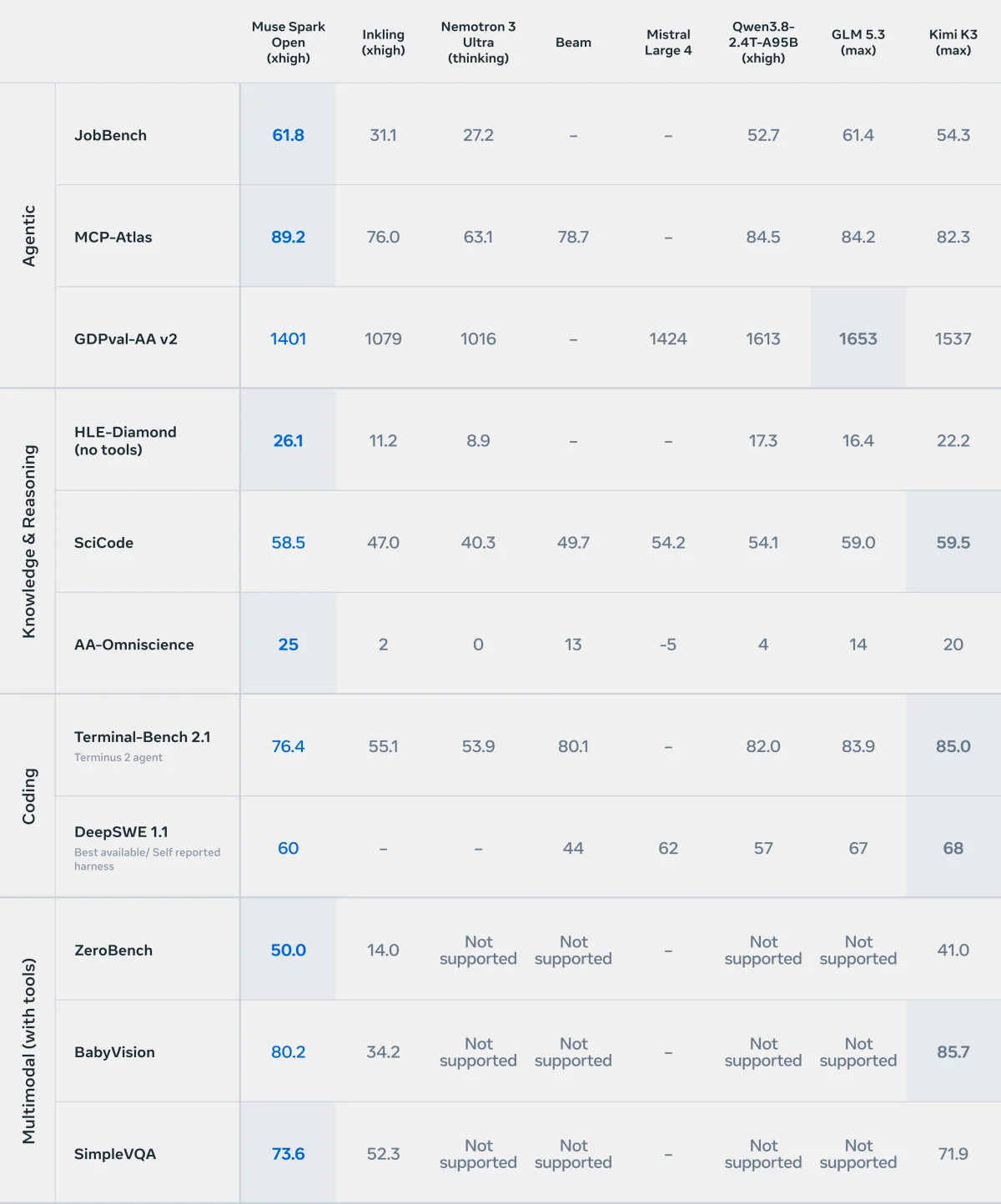
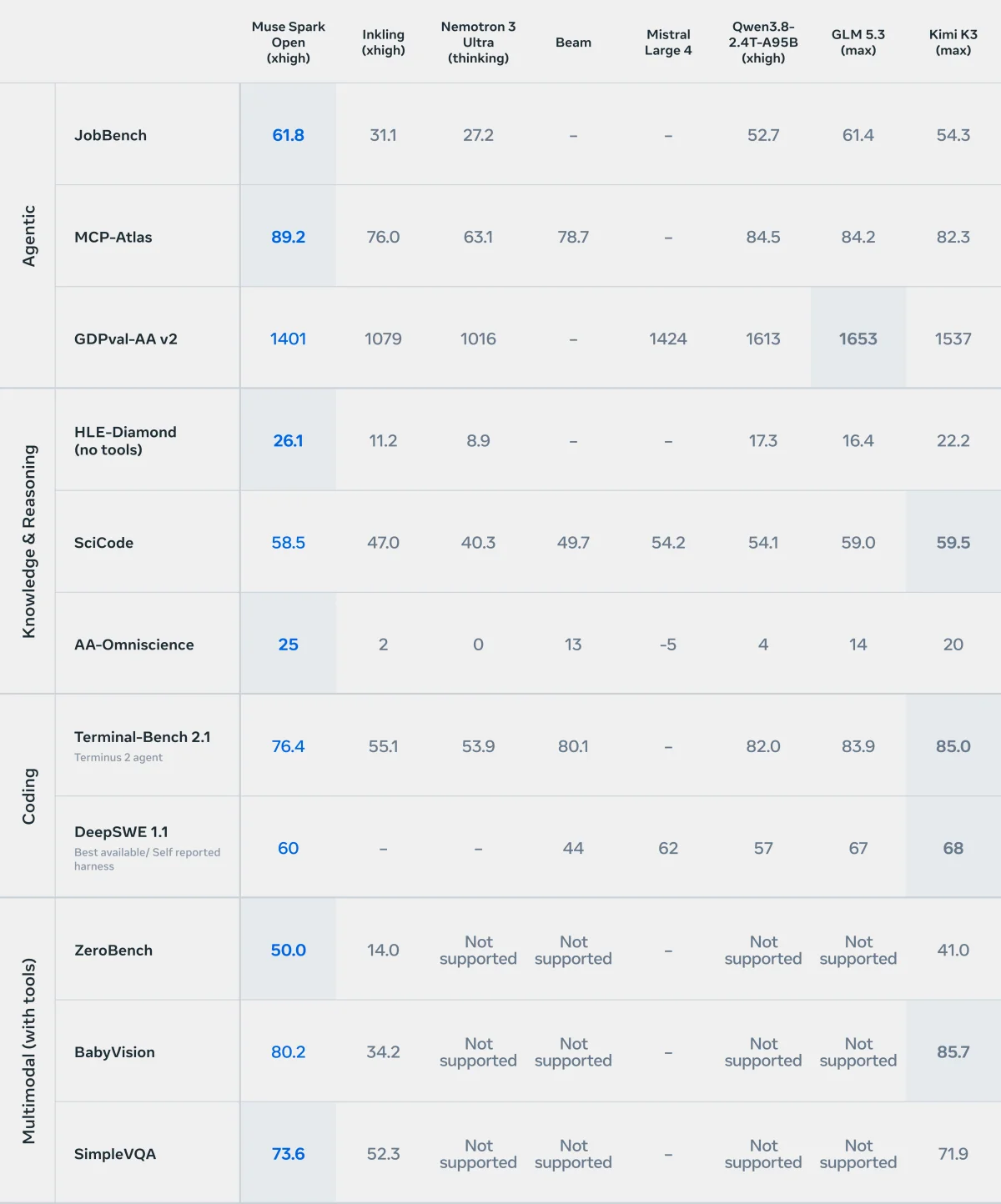
Performance assessments of Muse Spark Open have been conducted through various evaluation methods. In Meta's own benchmarks, Muse Spark Open achieved a score of 76.4 on Terminal-Bench 2.1 with the Terminus 2 agent, indicating a strong ability to manage terminal-based programming tasks. Additionally, it scored 60 on DeepSWE 1.1 while utilizing Meta’s preferred evaluation harness, which assesses models against rigorous coding standards using high reasoning effort. These scores reflect the model’s robust capabilities in reasoning and problem-solving compared to competing systems.
Benchmark details are publicly documented in the official model card, allowing users to assess its performance metrics and the specific conditions under which these evaluations were conducted. These scores become instrumental for developers aiming to choose a suitable AI tool tailored to their unique operational environments.
Practical Deployment on Modal
Muse Spark Open operates on Modal's infrastructure, providing a straightforward platform for integration into existing workflows. Users can access a shared endpoint for Muse Spark Open, which operates under a per-token billing system. This flexibility allows teams to budget their resource consumption dynamically based on actual usage, making it an appealing option for diverse project scales, from single developer tasks to collaborative coding projects across larger teams.
The per-token model streamlines deployment since teams pay only for what they utilize. This can lead to significant cost-efficiency, especially for organizations experimenting with the model or expecting variable workloads. It reflects a growing trend in cloud services where billing aligns closely with resource consumption, thus avoiding the pitfalls of fixed subscription costs that may not reflect actual usage levels.
Comparative Advantage and Challenges
When juxtaposed with prior approaches, Muse Spark Open's extensive context window stands out. Many traditional models restrict their context to a fraction of this depth, which can limit their effectiveness in comprehensive coding tasks. By contrast, Muse Spark Open supports a more nuanced dialogue with extended memory, which is critical for developers who need to maintain context over lengthy codebases or complex sequences of commands.
However, as with any sophisticated model, there are noteworthy considerations. The computational requirements to utilize Muse Spark Open effectively can demand substantial resources, particularly for high-volume tasks. Additionally, the inherent complexity in multimodal AI raises questions about error management and model failure during particularly intricate sequences. Evaluating when and how to best deploy Muse Spark Open effectively within a team's existing frameworks will be crucial for maximizing its potential.
In conclusion, Muse Spark Open presents a compelling option for developers and researchers involved in coding and software development. With its advanced capabilities and flexible deployment model through Modal, it represents a significant step forward in the ongoing evolution of AI models for programming applications. As users begin to integrate this tool into their workflows, observations regarding performance and practical efficiency will likely inform future enhancements and provide further insights into its operational effectiveness.


