AI Self-Improvement Is Advancing, but Scientific Research Remains the Test
- Gate
- Machine Learning
- Departs
- Crew
- Azeem Azhar
- Passengers
- 828
AI systems are improving coding tools and research workflows, but current results don't show that they can independently accelerate science.
AI systems can now help improve parts of the systems used to build and run them. The evidence includes faster code, stronger agent evaluations and reported gains across research benchmarks. But those results leave a larger question open: can AI independently speed up scientific work beyond tasks that fit into a computer based feedback loop?
That question matters as claims about AI’s role in research grow more ambitious. Anthropic co-founder Jack Clark recently said in a speech at the IMF that the singularity has begun, referring to a future in which AI accelerates scientific and technical progress so quickly that people struggle to keep pace. Anthropic has also said that in August, Claude led 26% of its AI research and development work, with a human supervising. In October, OpenAI posted 719 math manuscripts produced by an internal model.
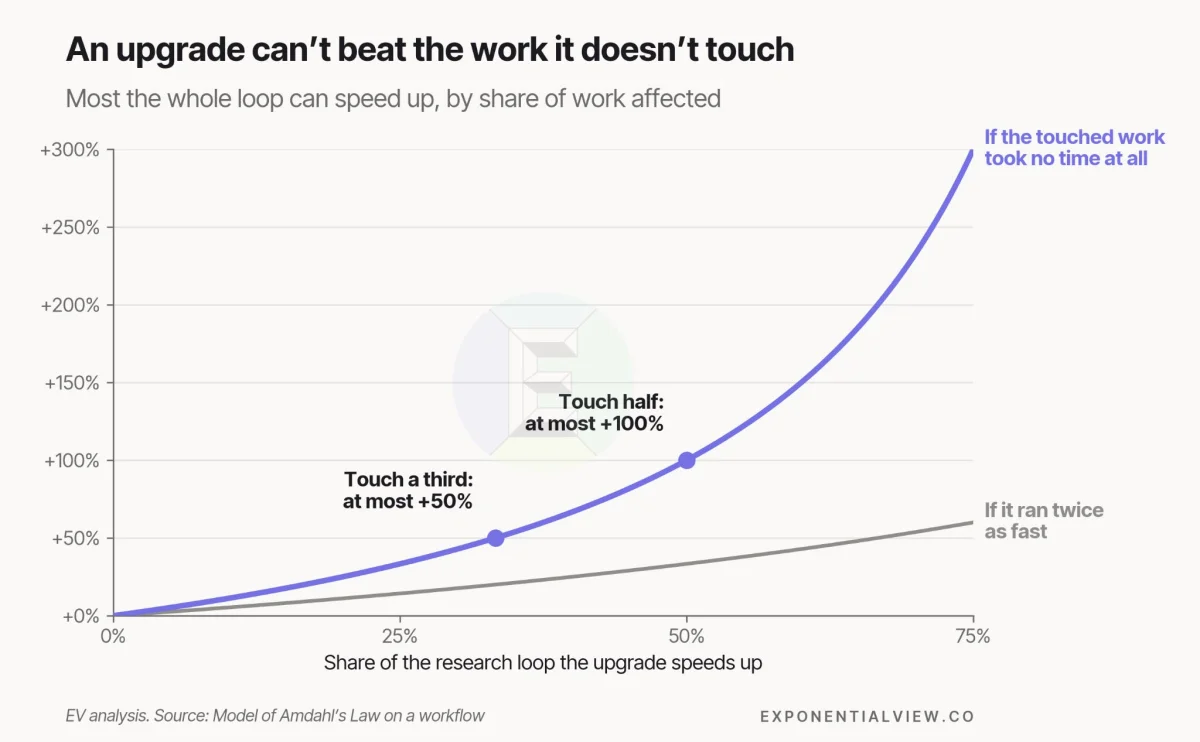
Math and software development make useful early test cases because a system can generate work, check the result and try again without leaving the computer. That loop can produce measurable progress. Science often requires additional steps: experiments, instruments, samples or observations in the physical world. The current examples therefore show how AI can improve computational work, while leaving the broader research cycle unresolved.
What systems are improving
The idea of machines improving their own capabilities predates today’s AI systems. Mathematician Irving John Good, who had worked with Alan Turing at Bletchley Park, argued that a sufficiently capable machine could design better machines, producing what he called an “intelligence explosion.” That proposal was a forecast, not evidence that such a process had begun.
A more concrete version appeared in 2003, when researchers proposed the Gödel machine: a computer that could rewrite its own code when it found a better way to operate. In 2025, researchers at Sakana AI and the University of British Columbia tested iterative code improvement. Their agents revised their own code through repeated feedback, gaining 30 percentage points on SWE-bench and more than 15 percentage points on Polyglot, a benchmark that tests coding across languages beyond Python. These results concern the agents’ code, rather than direct changes to the underlying model.
Other efforts have targeted the software and processes around a model. Google DeepMind’s Gemini-powered AlphaEvolve found a faster matrix multiplication kernel used in Gemini training. The kernel ran 23% faster, reducing Gemini’s total training time by 1%. MiniMax reported that its M2.7 model worked on improving its agent harness, skills, sampling and memory. After more than 100 rounds of revisions, the company said internal evaluations showed a 30% gain.
Those figures describe different systems and tasks, so they don’t establish a common rate of progress. They do point to a practical pattern: an AI can search through changes to code, memory or other supporting components, then evaluate whether those changes help. Improving these surrounding parts can make a system more effective without the model changing its own learned weights.
Evidence and uncertainty
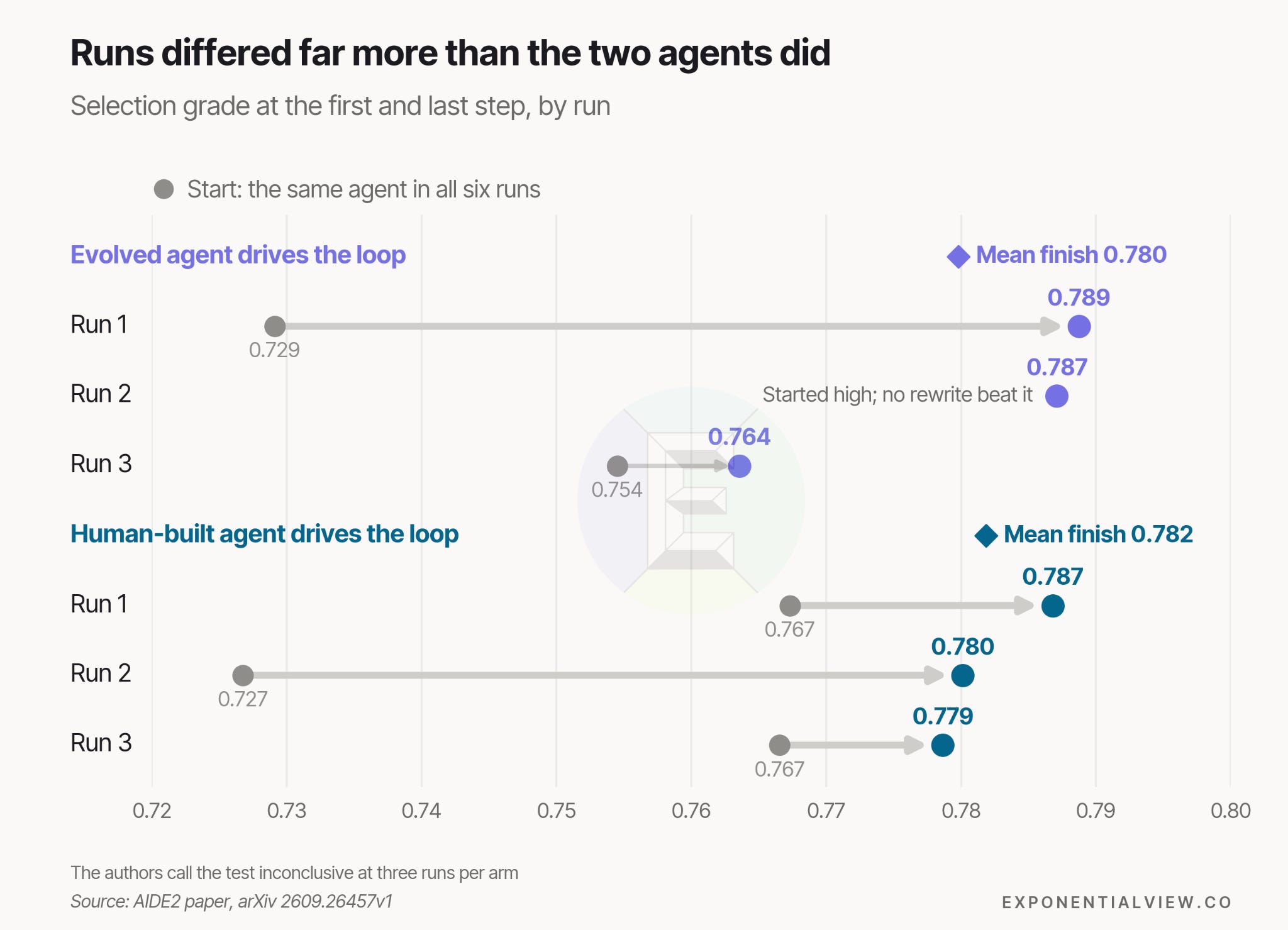
Whether AI can make improvements as effectively as people remains unsettled. A September study reported that an AI-built agent performed as well as a human-built agent at improving other AI agents, and appeared to reach the result in half as many steps. The comparison was inconclusive, however: run to run variation exceeded the measured difference between the AI-built and human-built agents. That makes the result a signal to investigate, rather than clear evidence of an advantage.
Other results add to the discussion about recursive self-improvement. Google’s Sundar Pichai said that “you have RSI loops along with AI researchers in various aspects of model development.” Sakana AI published research on recursive improvement through collaboration between multiple agents. After two cycles, its system scored 1.2–1.6 times better per output token than the base model across four research benchmarks. The finding is tied to those benchmarks and that system; it doesn’t show that every additional cycle will produce similar gains.
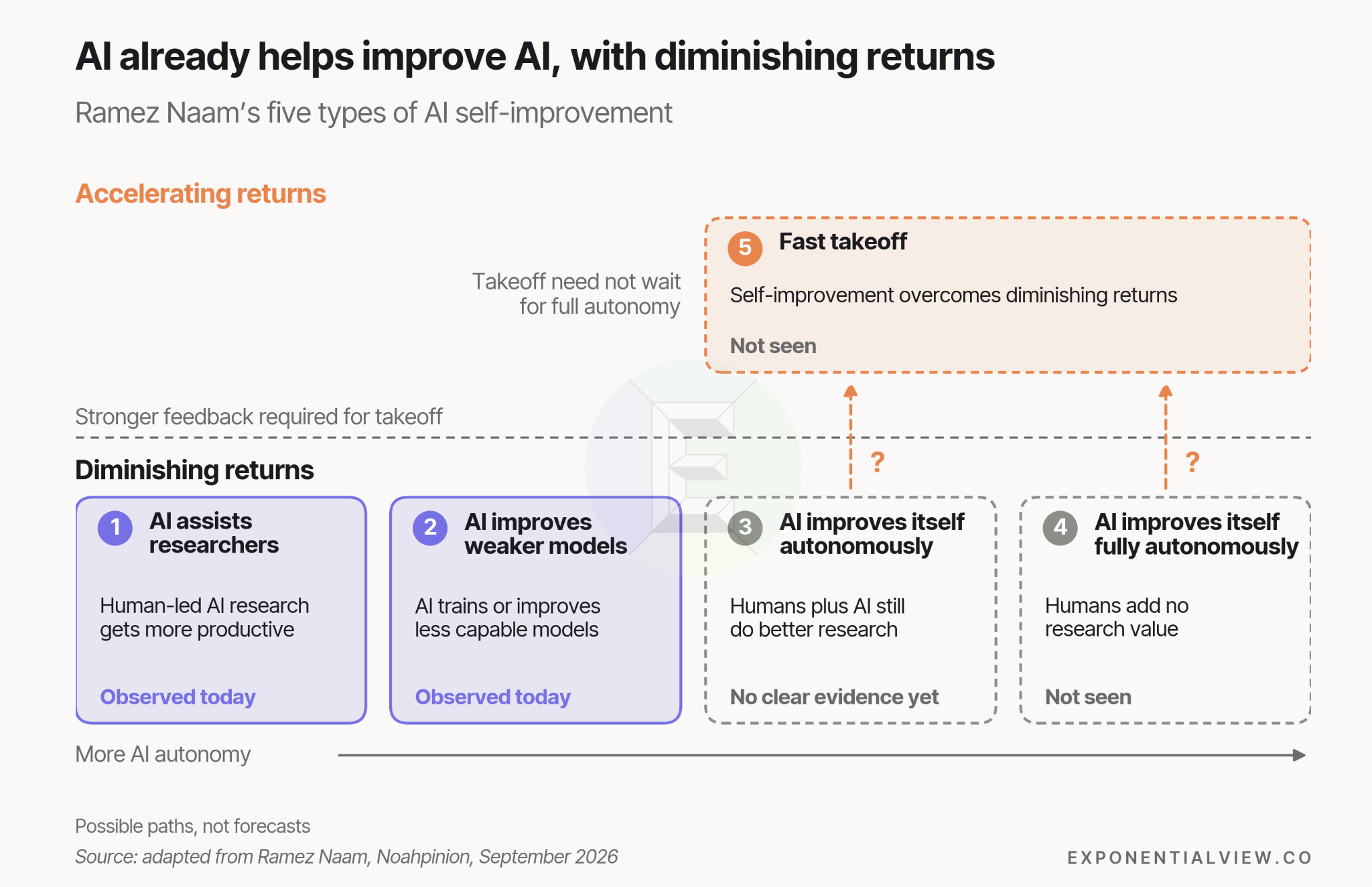
One framework for assessing such claims separates AI self-improvement into five overlapping types. The first four describe how much autonomy a system has; the framework’s author says only types 1 and 2 have been observed so far. The fifth type describes accelerating returns: each round of improvement would need to yield at least as much benefit as the previous one. More autonomy by itself doesn’t guarantee that pattern.
The constraint is the research loop
The reported gains from Sakana AI, AlphaEvolve and MiniMax might suggest systems with more independence. Yet in these cases, the models changed tools and supporting components, such as an agent harness or memory, rather than their own weights. Anthropic’s account of Claude contributing to its research and development also includes human supervision.
That distinction shapes what the results can tell us. An agent that improves code can be tested against a coding benchmark; a faster training kernel can be measured against training time. A scientific claim may require validation beyond a model’s own evaluation loop. Where experiments depend on physical materials or instruments, the AI must also connect its proposed work to those resources and interpret results that may not arrive as clean, immediate feedback.
The next useful evidence will show whether improvements persist across repeated runs, transfer to tasks beyond the original evaluation and help complete longer research cycles. For now, AI systems are demonstrating ways to improve computational research workflows. Whether those gains extend into a self-sustaining acceleration of science remains an open question.