NVIDIA's DSX Suite Enhances AI Factory Performance Through Intelligent Power Management
- Gate
- Machine Learning
- Departs
- Crew
- Vishal Ganeriwala
- Passengers
- 370
NVIDIA's DSX platform optimizes AI factories' energy efficiency, improving token throughput by 24% and enabling power conservation without service interruptions.
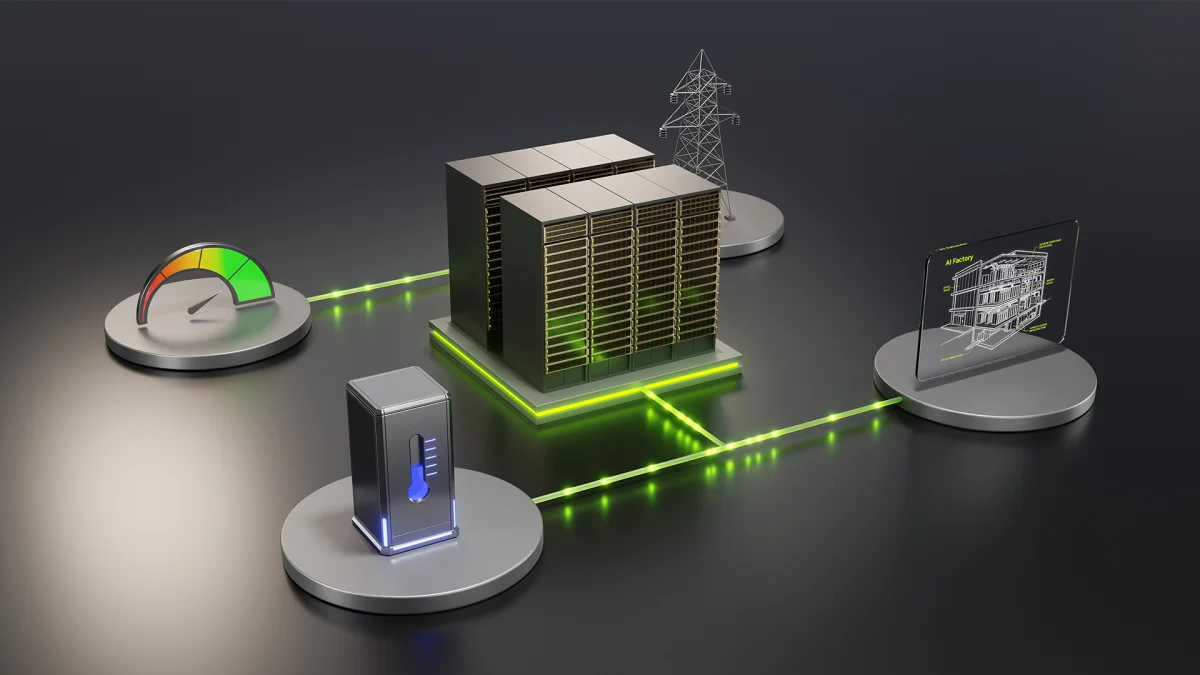
On a hot evening in August in Silicon Valley, Silicon Valley Power (SVP) prompted an AI factory to adjust its energy consumption—thus showcasing a new level of operational efficiency. Varun Sivaram, part of the Emerald AI team, monitored the response from the company’s Conductor platform along with colleagues, engineers, and utility representatives. This moment highlighted how a grid-orchestration system can adapt to fluctuating power demands without disrupting critical AI processes.
The Conductor platform acts as a bridge between grid conditions and the AI factory's workflow, effectively managing computing resources according to predefined priorities. Tasks deemed less urgent are postponed, allowing mission-critical operations to continue uninterrupted. This proactive response to power signals exemplifies a new approach to managing electricity consumption in AI facilities.

The achievement resonates beyond just one data center in Santa Clara; it's indicative of a larger movement aimed at optimizing energy usage in the rapidly growing AI sector. At the AI Infra Summit, NVIDIA's Ian Buck emphasized the importance of AI factory efficiency, underpinning that AI workloads' effective management can significantly enhance overall productivity.
Empirical Results from Lambda Validation
Lambda, a cloud provider recently reported findings that underline the significant advantages of the NVIDIA DSX MaxLPS technology. When Lambda deployed their solution in a test environment, they found that they could support 24% more token throughput within a fixed power budget. The figures revealed that operating 19 nodes at 85% power yield similar outputs to 16 nodes running at full capacity.
Dave Ward, president of cloud services at Lambda, noted, “With our proof of concept, we believe we’ve moved beyond the limitation of fixed power budgets.” This signifies a pivotal shift in how AI factories can leverage existing energy resources without necessitating extensive infrastructure changes.
Dynamic Power Management with DSX
The DSX platform includes multiple components designed to address and optimize various aspects of AI factory operations. Notably, the DSX Flex technology takes real-time utility signals such as load-shedding and demand-response, adapting workloads accordingly. This allows for a balance between energy consumption and operational necessities, ensuring that essential tasks receive the priority they deserve.
NVIDIA’s recent engagements demonstrate impressive performance metrics. Emerging from a pilot involving Emerald AI Conductor and SVP's Flexible Load Interconnect Program, the factory adjusts power usage typically within a minute upon receiving a utility signal. As SVP has sent over 200 successful demand alerts, this practicality underscores the operational viability of the program.
Gains Through Smart Infrastructure Design
Efficiency is paramount in the AI factory economy, with key performance indicators focusing on how much productive work is achieved per gigawatt consumed. NVIDIA’s extensive design suite, comprising DSX Reference Designs and DSX Sim, allows data center operators to preemptively identify potential bottlenecks. Thus, this proactive approach fuels operational excellence from the outset of design and throughout the factory's lifecycle.
The DSX MaxLPS optimizes power usage, particularly during different types of workloads like training and inference. As Lambda's findings suggested, by dynamically reallocating power where it’s needed most, the potential for stranded capacity diminishes, allowing for better performance across various tasks.
Emerging Power Delivery Solutions
As AI factories expand, power delivery becomes increasingly critical. NVIDIA’s introduction of an 800V DC power architecture aims to simplify conversion complexities and enhance delivery efficiencies. Integrating this system within the DSX ecosystem will support denser configurations of accelerated computing racks, ensuring that as workloads increase, energy constraints do not hinder performance.
Conclusion: The Future of AI Factory Operations
While no single element can optimize an AI factory in isolation, NVIDIA's integrated approach—uniting power management, workload prioritization, and infrastructure design—positions it as a leader in energy-efficient AI factory solutions. The benchmark set by the SVP and Lambda deployments illustrates a pathway for AI facilities to not only operate efficiently under current energy constraints but also to scale operations sustainably in the evolving tech landscape.
The next benchmark for AI factories is clear: how much productive capacity can be achieved per megawatt consumed? With the smart technologies introduced in the DSX suite, NVIDIA is poised to help infrastructure builders reach this goal and redefine AI factory operations.


