Salesforce's Koa: A New Era of AI-Driven CRM Built with NVIDIA Technology
- Gate
- Machine Learning
- Departs
- Crew
- Brian Caulfield
- Passengers
- 495
Salesforce has unveiled Koa, its first CRM reasoning model powered by NVIDIA's Nemotron 3 Super, promising advanced capabilities and enhanced safety measures.
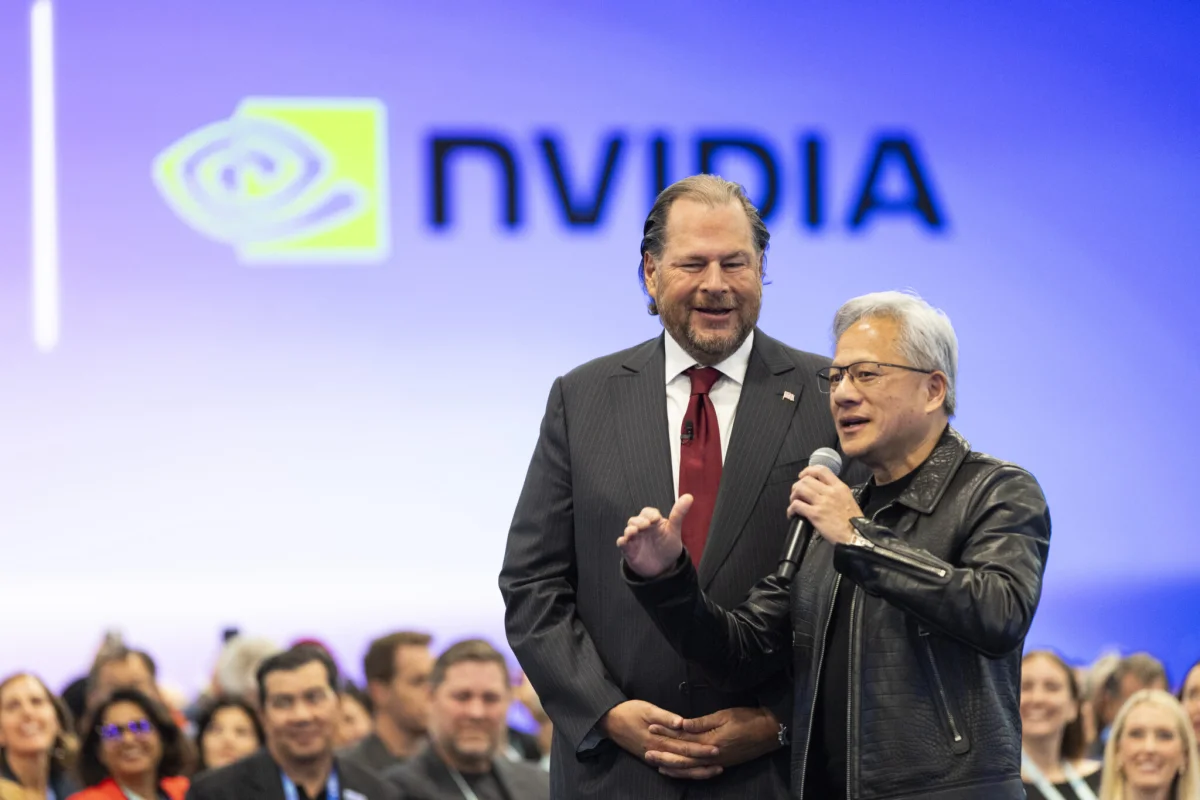
At Salesforce Dreamforce, NVIDIA's founder and CEO Jensen Huang showcased Koa, the company's inaugural CRM reasoning model developed on the NVIDIA Nemotron 3 Super platform. This launch aligns with Huang's bold assertion: with artificial intelligence as a fundamental infrastructure, “we can know everything and do anything.”
During his dynamic presentation, Huang engaged directly with attendees, emphasizing the transformative potential of both AI and Salesforce’s technology. This framework will leverage nearly three decades' worth of enterprise CRM data to enhance decision-making processes across organizations.
AI Safety as a Core Principle
Amidst discussions on AI's expanding role, Huang addressed AI safety when prompted by Salesforce CEO Marc Benioff. He articulated that ensuring safety should be a primary focus: “Safety is paramount in a lot of ways. It’s job one.” This perspective underscores the importance of confidence in a product’s design before release. Huang advised companies to pause development if there are doubts about the safety or functionality of their offerings, thus framing safety as an integral aspect of innovation rather than a competing priority.
Notably, Huang also countered fears surrounding AI and job displacement, advocating for the additional productivity that AI brings to the workforce. He remarked, “The sky’s the limit” for companies willing to embrace AI technology, encouraging businesses to integrate AI into their operations instead of resisting it.
In this iteration, Huang stressed the idea that every organization—even those traditionally not classified as tech companies—will inevitably evolve into an "agentic enterprise," driven by AI capabilities.
Technological Foundations of Koa
Koa's foundation is robust, employing supervised fine-tuning alongside reinforcement learning using NVIDIA’s NeMo RL, NeMo Gym, and NeMo AutoModel. This training method positions Koa to handle diverse enterprise scenarios, tailored specifically for over 14 industry sectors, including manufacturing, healthcare, and financial services.
The model's training incorporated a proprietary synthetic dataset designed to ensure that “not a single byte of customer data was used,” as highlighted by Rohan Kumar, Salesforce president of platform and engineering. This data handling approach means that customer privacy is preserved while still pushing the boundaries of model performance and application.
Benchmarks for Koa indicate it already matches or exceeds the performance of competitors in the CRM realm, achieving three times fewer errors in a suite of real-world tasks such as opportunity updates, case routing, and follow-up scheduling. This performance leap positions Koa as a serious player among CRM solutions, with implications for better accuracy and efficiency in CRM activities.
Deployment Plans and Future Directions
Koa is set to influence various operational efficiencies as it powers an employee agent integrated into Slack. Moreover, starting in October, Salesforce will expand Koa's utility through customer pilots in its Agentforce system, engaging diverse participants such as Formula 1, UChicago Medicine, and 1-800Accountant. General availability is anticipated for winter 2026 across U.S. regions, aligning with Salesforce's strategy to make AI a cornerstone of its product offering.
This strategic move follows Huang’s observation of the growing trend of organizations building their own custom AI models, which he notes has shifted from 30% to around 70% of the industry employing open models. The resultant landscape shows both an uptick in adopting closed models and a diversification of companies creating tailored AI solutions.
As Koa integrates into Salesforce's ecosystem, its impact is expected to resonate throughout various sectors, reinforcing Huang's conviction: “Every company, every enterprise, every country would become an AI company.” The implications are vast, not only for operational efficiencies but also for redefining customer engagement through tailored interactions powered by AI technologies.
Ultimately, Salesforce’s Koa represents more than just a new tool; it embodies a broader vision of the future where AI-driven insights transform how enterprises approach customer relationships, paving the way for continuous innovation and growth in an increasingly competitive landscape.


