NVIDIA DGX Spark 64GB Enhances Local AI Development with Scalable Supercomputing Power
- Gate
- Generative AI
- Departs
- Crew
- Allen Bourgoyne
- Passengers
- 548
The NVIDIA DGX Spark 64GB offers developers flexible and powerful local AI capabilities, enabling easy scalability and efficient computation without cloud reliance.
In the evolving landscape of artificial intelligence, local AI is gaining traction for its ability to handle complex tasks without dependence on cloud services. NVIDIA’s upcoming DGX Spark, equipped with 64GB of unified memory, is set to expand the capabilities for developers, researchers, and enthusiasts looking to harness AI's potential directly at the device level.
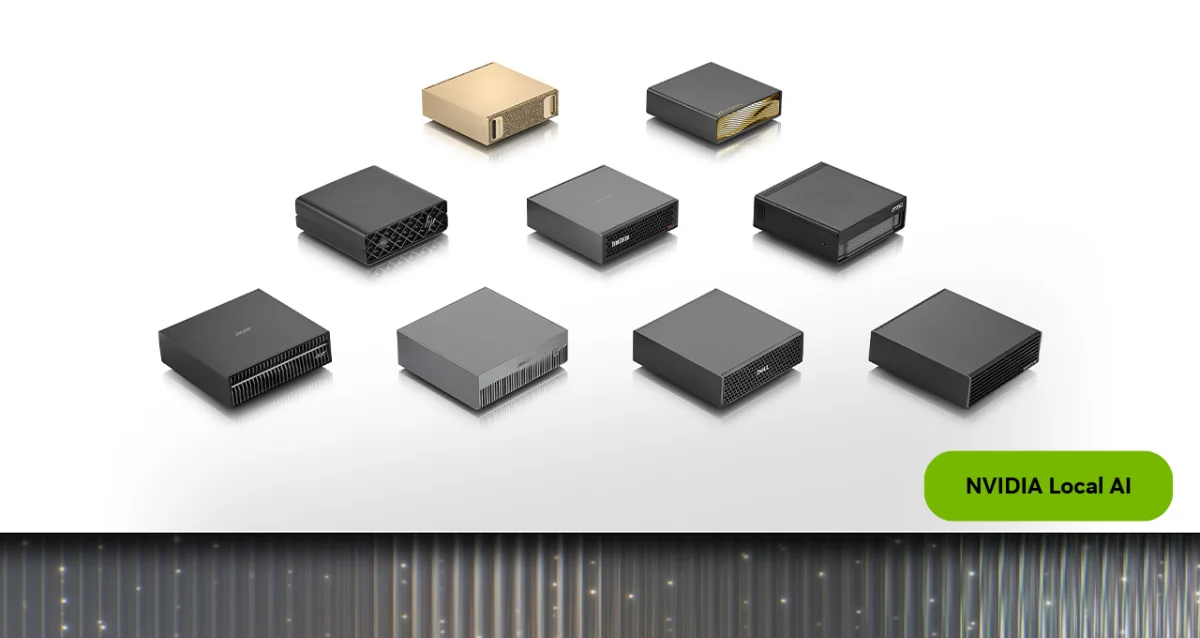
Set to launch later this month, the NVIDIA DGX Spark will be offered from major manufacturers including Acer, ASUS, Dell, Gigabyte, HP, and MSI. This new configuration arrives with DGX OS and the complete NVIDIA AI software stack pre-installed, enabling immediate use upon setup.
A New Starting Point for Personal AI Supercomputing
The DGX Spark combines the NVIDIA Grace Blackwell compute architecture, unified memory, NVIDIA ConnectX-7 networking, and a NVIDIA CUDA-accelerated software stack. This integration creates a potent local AI platform tailored for agents, inference tasks, data science, and edge development.
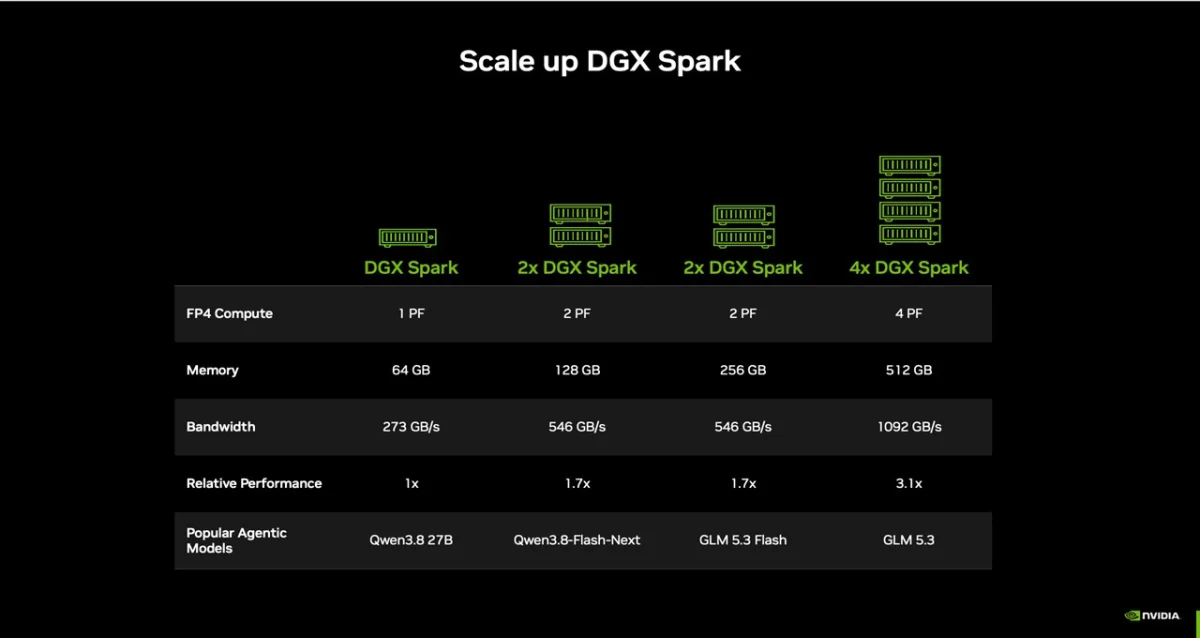
Developers now have access to a compact yet powerful supercomputer capable of running AI models using their data without needing to engage cloud solutions for every computational task. The 64GB configuration maintains a competitive price point while sustaining the same performance features found in the more robust 128GB model. It can support up to 100 billion-parameter models, catering to complex AI applications directly on the device.
A notable advantage of this system is the clustering capability: two 64GB units can be linked to significantly boost performance. During NVIDIA’s testing with the Qwen 3.8 27B model, a pair of clustered systems achieved up to 1.7 times the performance of a single unit, indicating that as demand grows, so does the system's scalability without major reconfigurations.
Ready for immediate use in agent development, the DGX Spark ships with necessary tools such as the NVIDIA Agent Toolkit, CUDA-X AI libraries, Nemotron open models, and support for popular frameworks like Ollama and vLLM, ensuring developers can get started with minimal delay.
Scale Up With NVIDIA Sync Cluster Assistant
As needs evolve, the DGX Spark enables developers to start small and scale efficiently. Every unit comes standard with an NVIDIA ConnectX-7 network interface card. When two units are connected using a QSFP cable, they can pool memory, enabling support for models requiring up to 200 billion parameters while effectively doubling the memory bandwidth.
The NVIDIA Sync application allows configuration of these multi-node clusters without technical hassle. Automated detection of connected units streamlines setup, so developers can shift their focus back to immediate development tasks. This means that all nodes operate using the same NVIDIA software stack, facilitating seamless scaling from one unit to multiple units without extra configuration.
Moreover, by the end of this month, NVIDIA will introduce the Sync Model Launcher, a user-friendly tool for deploying local AI. It will allow developers to download and operate models like Qwen3.8 27B across either a single DGX Spark or multiple clustered systems. The launcher simplifies the process, enabling easy usage for projects within a browser interface.
Practical Use Cases on DGX Spark
The DGX Spark 64GB is designed to support practical workflows from the outset. With capabilities to run up to 100 billion-parameter models entirely on device, users can either leverage a single system for tasks fitting within its memory or combine multiple units to manage extensive workloads.
Here are three illustrative workflow scenarios:
- Continuous AI Agent Operation: Implement a coding or research agent on DGX Spark that remains operational round-the-clock, able to perform tasks like code reviews or document analysis. Clustering enriches capacity for larger models or simultaneous agent operations.
- AI Applications on Standard PCs: Employ the power of DGX Spark to execute language or image generation processes, freeing up personal computers to engage in other tasks.
- Effortless Scaling: When a single task requires more resources, linking two DGX Spark 64GB systems can expand memory to 128GB, allowing the same software environment to support larger models without significant changes.
Getting Started With DGX Spark
The DGX Spark 64GB will be available from manufacturers such as Acer, ASUS, Dell, Gigabyte, HP, and MSI, starting at $4,999 on October 23.
To begin, users should:
- Choose an appropriate inference framework such as llama.cpp, Ollama, vLLM, or LM Studio.
- Select a recommended local model suited for their specific workflow.
- If scaling to two units, connect them using the NVIDIA ConnectX-7 ports and launch the NVIDIA Sync Cluster Assistant for automated network setup.
For additional resources focused on agentic AI on DGX Spark, visit the NemoClaw, OpenClaw, Hermes Agent, and OpenShell pages.
#ICYMI: More from NVIDIA Local AI
Explore further at build.nvidia.com/spark for playbooks related to DGX Spark, including upcoming tutorials for:
- Serving LLMs using vLLM
- Executing OpenClaw with a Local LLM
- Connecting Multiple DGX Sparks for Distributed Workloads
Exciting new PCs powered by NVIDIA RTX Spark will also be rolled out this month by leading manufacturers. To keep informed on developments, sign up for the RTX Spark newsletter.
With cutting-edge models like Alibaba's Qwen-Image-2.1, which integrates image generation with local execution capabilities, NVIDIA continues to empower creators with tools that enhance their hardware's functionality.


