Enhancing Language Model Inference through Multi-Token Residual Prediction
- Gate
- Machine Learning
- Departs
- Crew
- Robert Miller
- Passengers
- 343
The innovative Multi-Token Residual Prediction framework boosts language model efficiency, enhancing throughput and accuracy across various decoding regimes.
Introduction to Multi-Token Residual Prediction (MRP)
Multi-Token Residual Prediction (MRP) emerges from a collaborative research initiative that aims to address the inefficiencies in autoregressive models by leveraging a new decoding strategy. The intuition behind MRP lies in the ability to predict multiple tokens in a single forward pass, fundamentally shifting how language models operate during inference.
This method is particularly relevant to Diffusion Language Models (DLMs), which already incorporate inherent parallelism. However, existing challenges in balancing speed and quality during the decoding process can limit effectiveness. By utilizing residual predictions instead of direct outputs, MRP not only speeds up the process but also maintains accuracy, with significant implications for practical applications.
Key Mechanics of MRP
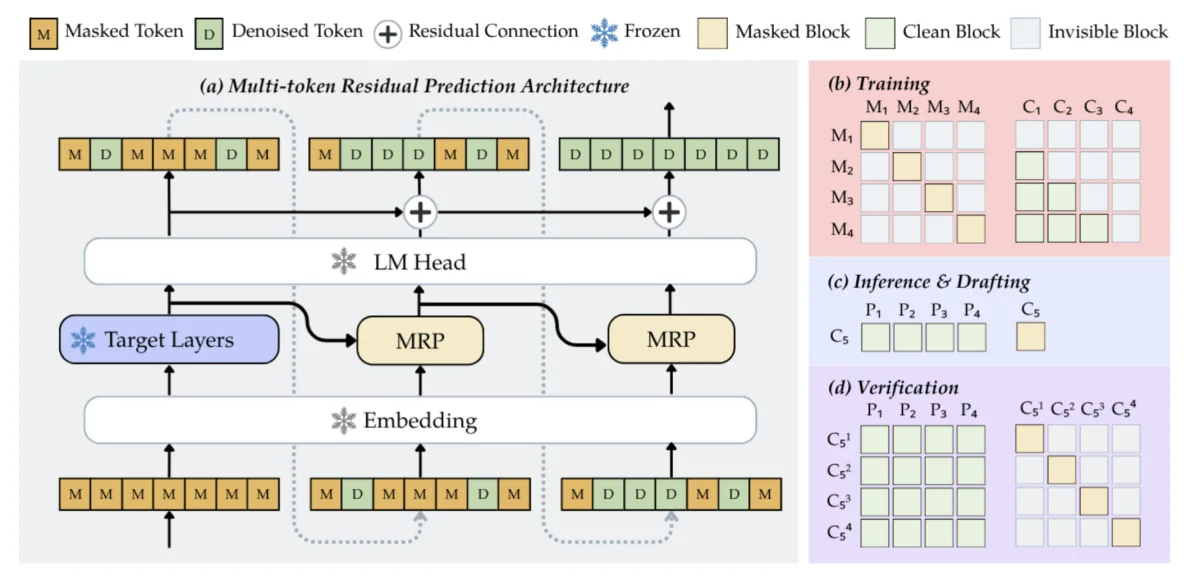
MRP operates by attaching a small transformer module to a frozen DLM backbone. This module focuses on predicting the logit residual—the difference between predicted logits from successive denoising steps. By training the MRP on this target, rather than the complete distribution of the next step, the framework simplifies the prediction problem, allowing for accurate adjustments across multiple tokens simultaneously.
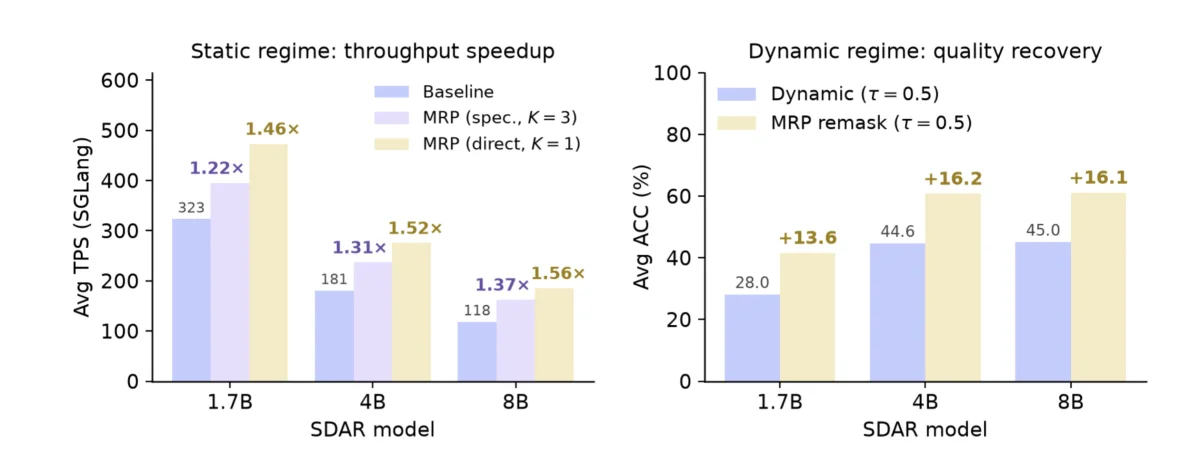
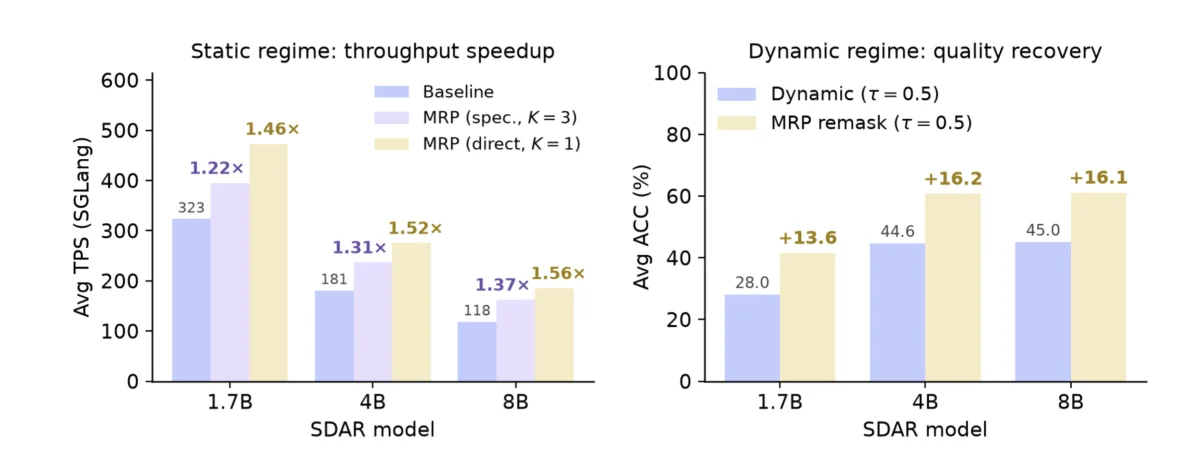
The structure comprises a three-layer transformer which effectively reads the backbone's hidden states, enhancing the decoding process's overall throughput in static and dynamic regimes. Notably, the dynamic regime allows the model to compensate for aggressive decoding thresholds, recovering quality while maintaining high acceleration.
Performance Benchmarks
In testing scenarios, MRP demonstrated impressive performance across several benchmarks, including GSM8K, MATH500, HumanEval, and MBPP. The results indicate that MRP achieves up to a 1.56× speed increase in throughput without significant quality loss in static conditions. In dynamic conditions, it recovers an average of 16 accuracy points that would otherwise be lost due to aggressive token unmasking.
The accuracy improvements brought by MRP are substantiated by clear benchmark data:
| Method | K=1 | K=2 | K=3 | K=4 |
|---|---|---|---|---|
| Naïve MTP | 84.8 | 16.9 | 5.9 | 1.9 |
| MRP | 88.6 | 84.9 | 70.9 | 57.2 |
This shift in accuracy, especially at higher prediction steps using MRP, highlights its effectiveness in facilitating a more accurate and efficient decoding process compared to conventional techniques.
Comparative Analysis of Approaches
The groundwork for MRP draws from the concept of Multi-Token Prediction (MTP) that exists within autoregressive frameworks. However, MRP distinguishes itself by employing a different target. Rather than articulating predictions over the broad distribution at each step—which proved to be a complex endeavor—MRP streamlines the task by focusing on the residuals. It eliminates the compounded errors associated with the need to predict high-dynamic-range outputs by operating instead within a low-complexity domain.
For example, typical MTP approaches struggled significantly as the number of prediction steps increased, leading to degraded performance past the initial step, as seen when tested on the SDAR-4B backbone model. Conversely, MRP maintained its predictive reliability even across multiple steps, providing a more stable, quality output.
Applications of MRP in DLM Inference
MRP's utility extends across various inference settings, particularly within the two primary decoding regimes of DLMs: static and dynamic. In static denoising, MRP allows for a highly precise mode of operation, where the model can adjust the speed versus quality trade-off according to the specific needs of the application. Here, it can propose exact outputs close to those generated by the backbone, enabling a reliable fallback when quality is essential.
In dynamic scenarios, where higher latency is a concern, MRP takes a turn. After an aggressive reveal of tokens, it reassesses and predicts residuals based on previously unmasked positions, thus remasking those whose confidence has weakened. This dual role allows MRP to counteract the potential negative impacts of hastily unmasking many tokens within a single step.
Implementation and Training Methodology
The MRP module is uniquely trained using a residual loss approach. This training involves running the frozen backbone model twice—once before and once after token reveals—to derive KL divergence losses over the remaining masked positions. The simplification in the learning task afforded by focusing on residuals not only aids in accuracy but also ensures that the model remains lightweight.
As training progressed, it became apparent that certain configurations yielded better results. Specifically, a module depth of around two to three layers proved optimal, balancing accuracy and computational efficiency. Beyond this, the returns on added layers diminished, highlighting an important consideration in module design.
Insights from MRP Development
Several conclusions emerged during the development of MRP, notably its adaptability across different modes of operation. For instance, while deeper models tended to improve performance in direct decoding modes, they did not significantly enhance speculative formulations where verification could correct MRP's predictions, emphasizing the need for strategic design based on operational context.
Additionally, MRP's design offers a clean compositional strategy that not only empowers DLMs but also serves as a versatile module adaptable for future enhancements and methods, enriching the broader ecosystem rather than competing with existing structures.
Conclusion
Multi-Token Residual Prediction represents a significant advance in the realm of language model inference, providing an adaptable and highly effective mechanism to balance speed and quality during decoding. By addressing the common pitfalls associated with previous methodologies, MRP opens avenues for more efficient language processing systems. The flexibility afforded by controlling the inference stack is invaluable in a landscape increasingly reliant on rapid linguistic and computational models.
As the research community continues to explore avenues for leveraging MRP, its implications promise to scale across applications, further pushing the boundaries of what can be achieved in fast language model inference.
Further Research and Implementation
Future explorations will likely build on the framework set forth by MRP, investigating optimal configurations, integration strategies into broader systems, and potential adaptations for various types of language models. The innovative utilization of residuals not only marks a new chapter in language processing but sets the stage for more rapid advancements in the speed and efficacy of inference techniques.


