Elevating AI Training: Applied Compute's Focus on Specific Intelligence through Reinforcement Learning
- Gate
- Machine Learning
- Departs
- Crew
- Christopher Brown
- Passengers
- 624
Applied Compute leverages reinforcement learning to develop tailored AI agents. This approach emphasizes adaptability, heavy reliance on proprietary data, and continual improvement, setting a new standard for enterprise AI.
Specific Intelligence in Enterprise AI
Applied Compute specializes in creating custom AI agents for notable clients such as DoorDash, Cognition, and Mercor. The founding team, which includes expertise from OpenAI's Codex and o1, identified a pivotal trend: as generative models become commonplace, the real competitive edge lies in the post-training phase. Their thesis centers around the idea that organizations that control their own reward functions and continual learning processes will outpace those that do not.
Reinforcement Learning as the Core Mechanism
Applied Compute's primary method for developing these specialized AI agents is through Reinforcement Learning (RL). This involves training models by executing tasks repeatedly in a controlled, replayable environment, where each attempt is scored against a defined reward function. The model's weights are then updated based on the feedback received, steering its behavior toward those that yield higher rewards.
For instance, in collaboration with DoorDash, they engineered a sophisticated model for merchant onboarding. This model can analyze photographed restaurant menus and generate structured storefront representations utilized in real-world applications. For Cognition, they developed a bespoke bug-catching agent that identifies issues in a matter of seconds after a developer makes a commit. This showcases the adaptability of Applied Compute’s solutions across varied industry challenges.
“Frontier models set the floor, specialized models and custom post-training raise the ceiling.”
Infrastructure for Reinforcement Learning
A typical reinforcement training loop encompasses three main components necessary for seamless interoperation:
- Rollouts: Agents attempt tasks within a replayable environment.
- Evals: Agents are scored for each performance against a reward function.
- Inference: The trained model is deployed in a production setting while simultaneously capturing new data.
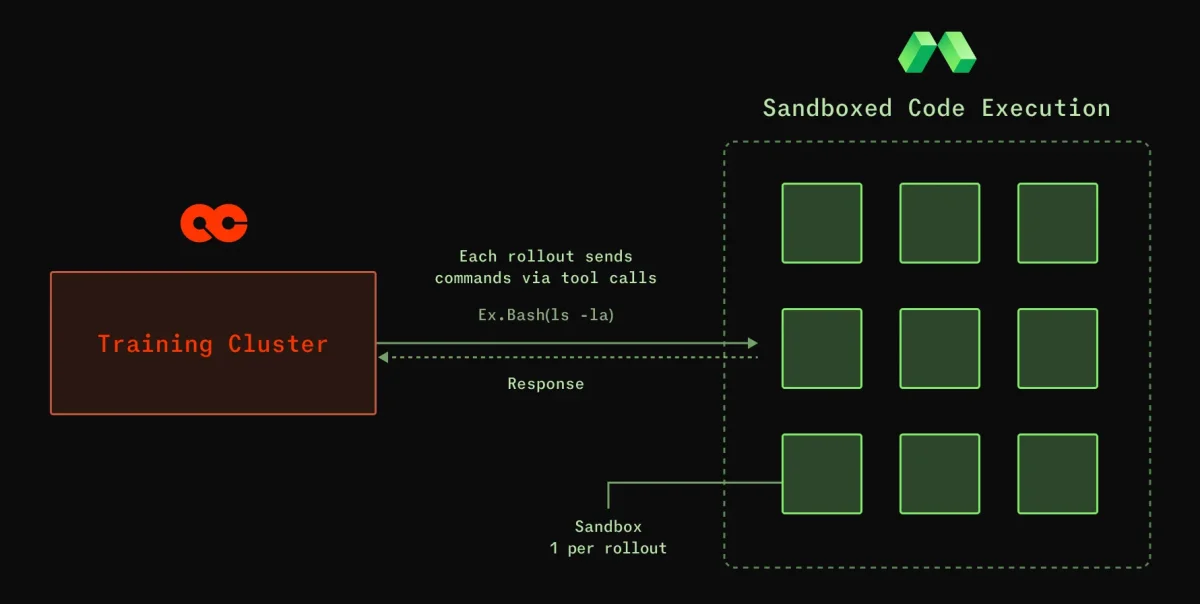
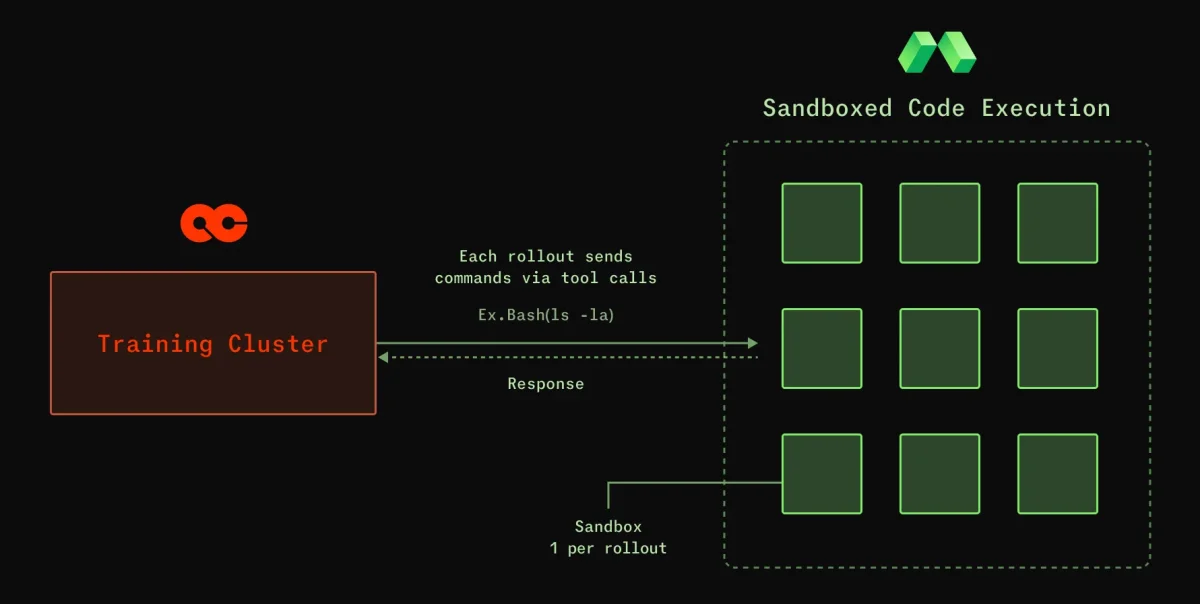
Each of these components has unique infrastructure needs. For instance, rollouts demand considerable CPU resources due to their bursty nature, evaluations necessitate massive parallel processing, while inference requires highly optimized access to GPUs for efficient deployment. Modal provides the underlying platform to facilitate these operations effectively, ensuring they can be conducted in a way that minimizes latency while maximizing throughput.
Choosing Modal for Optimal Performance
Before selecting a suitable platform, Applied Compute assessed a wide range of sandbox and execution environments in the market. Modal emerged as the top choice due to its ability to provide essential primitives required at each stage of the RL training loop while maintaining affordable operational boundaries.
“Modal was clearly very flexible, structured in a way where we could build these complex environments, and really focused on performance and reliability.”
Training Environments and Their Importance
In application development through RL, each instance involves the model executing tasks in parallel across distinct environments designed to closely resemble real production systems. For example, these environments might simulate internal APIs, or platforms like Salesforce and Slack, providing a level of fidelity that prevents the agents from recognizing any difference between training scenarios and actual operational contexts. Patil insists that ensuring the training environment mirrors real operational settings is vital to avoid the "train-test mismatch," a common pitfall in RL deployments.
To achieve this, Modal Sandboxes provide fast-starting containers with comprehensive network and filesystem isolation. They allow Applied Compute to create complex mocks of production systems while maintaining the determinism crucial for the training loop.
Performance Considerations in Training
As rollouts require simultaneous execution of inference and several sandboxes, performance latency becomes critical. During extensive training sessions, particularly when many tasks are handled concurrently, even minor startup latencies can lead to significant costs due to underutilized GPU resources. Since GPU time is often the most substantial expense in the training loop, maximizing GPU usage through rapid sandbox initialization is essential.
According to Patil, the efficiency of CPU tasks influences overall system performance. Modal's pre-built, fast-caching container images allow for sub-second cold starts, maintaining a GPU-bound training loop, which is crucial for the operational demands of reinforcement learning workloads.
Reliable Infrastructure Under Concurrent Loads
With thousands of tasks being simultaneously processed, the likelihood of operational failures increases. However, the effectiveness of the system lies in its recovery speed. Modal’s architecture features automated retries and isolated per-invocation processing, maintaining stability in the grading layer even during heavy concurrent execution.
The Future of Specific Intelligence
Yash Patil anticipates that every company will eventually create its own intelligent systems, mirroring the evolution of their software infrastructure. He asserts that, while frontier models will remain relevant, the focus will shift towards organizations taking ownership of their post-training functionalities and bespoke data pipelines. Applied Compute’s strategic approach is directed toward embedding researchers with customers, translating their contextual insights into that crucial feedback loop, which results in AI models seamlessly integrating into their operational ecosystems.
In this evolving landscape, Modal stands as the enabling backbone, facilitating rapid adaptation to meet the demands of future AI training processes. Its architecture not only ensures high-speed execution but also provides the flexibility required to construct diverse mock environments and the reliability to keep systems operational under the pressures of concurrent executions.


