Enhancing Security with Role-Based Access Control for Agents and Developers
- Gate
- Machine Learning
- Departs
- Crew
- Christopher Davis
- Passengers
- 975
New Role-Based Access Control (RBAC) features on Modal provide a secure framework for managing agent and human access to resources within environments.
As agents increasingly take on responsibilities beyond coding—handling deployments and managing infrastructure autonomously—teams need effective ways to regulate access while keeping security tight. Modal addresses this need with the introduction of Role-Based Access Control (RBAC), now available for users on Team and Enterprise plans. This initiative is part of a broader effort to refine access management for both agents and human developers within the Modal ecosystem.
Environments as Secure Access Boundaries
The RBAC system integrates with categorized environments within Modal Workspaces, defining specific access controls for each subdivision. Environments can consist of dedicated storage, secrets, applications, and other essential resources, tailored to the developmental workflow of teams. Modal's architecture supports flexible setups, allowing environments to represent varying stages like development, testing, and production, or even to tailor to individual developers and ongoing changes.
These environments create practical boundaries, making it easier to enforce security protocols that fit the particular needs of each project. For example, teams may utilize a classic approach of separating development, staging, and production environments, but many are now opting for more granular setups, like a dedicated environment for every developer or even specific pull requests.
With RBAC, the separation of environments becomes a foundational security measure. This allows teams to build enforceable access restrictions that align closely with their operational processes. By tightening these boundaries, organizations can better manage how various actors interact with their workflows and data.
| Actor | Recommended Identity | Environment Access | Intended Use |
|---|---|---|---|
| Human Developer | Workspace User | Dev Contributor, Prod Viewer or Contributor | Interactive work |
| AI Agent | Service User | Agent Environment Contributor | Autonomous iteration |
| CI Deployer | Service User | Prod Contributor | Controlled deployments |
| External Caller | Proxy Auth Token | Associated Web Function Environment only | Invoke endpoint |
This structure emphasizes a clear alignment with agent-driven workflows, dedicating individual environments to specific developers, client requests, experimental projects, or agent instances. Such a configuration ensures precise permissions for every actor involved, streamlining operations while maintaining strong access controls.
Understanding Restricted Environments
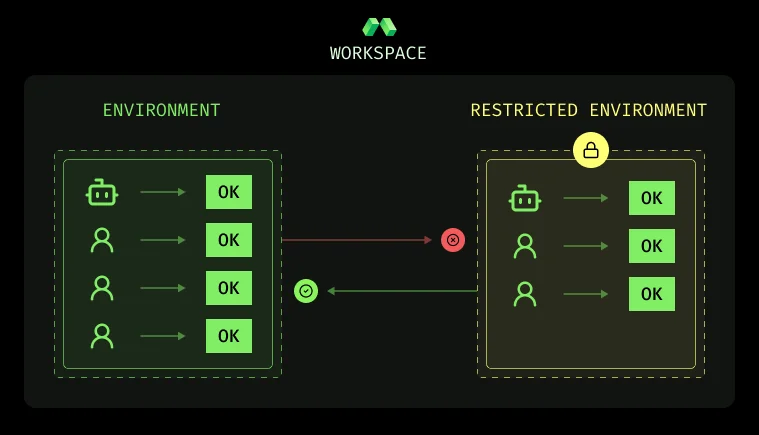
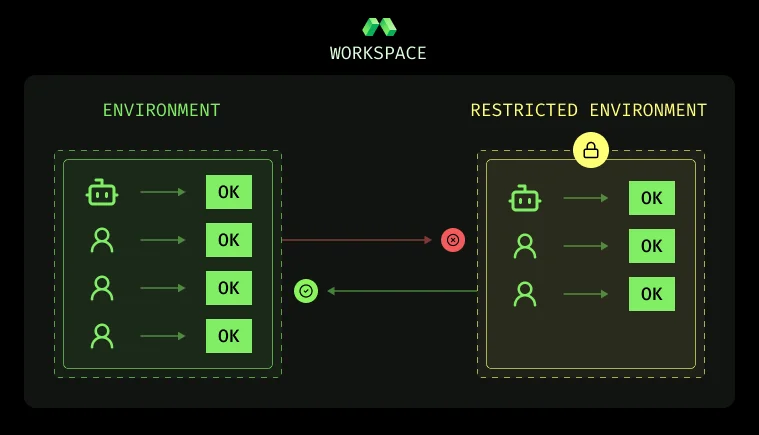
One of the significant advancements in Modal’s RBAC framework is the concept of Restricted Environments. Rather than deciding simply whether an agent has access, teams can strategically configure environments to design customizable permission landscapes. Restricted Environments limit access to only those users or service accounts specifically granted permission to deploy, manage, or create resources.
Within a Restricted Environment:
- Workspace members are granted read-only access by default to ensure security.
- Only expressly assigned users or agents can create, deploy, or manipulate applications.
- Access to logs and secrets is exclusively reserved for users and agents defined within the environment.
- Cross-environment operations, such as accessing resources from outside the Restricted Environment, are restricted to prevent unauthorized actions.
This containment strategy not only enhances security but also establishes definite control over operational processes. Should any issues arise, the RBAC functionality allows teams to track activities, correlating actions and timelines through comprehensive audit logs to maintain transparency and accountability.
What’s Next
RBAC’s new permissions architecture has been in production for several months, laying the groundwork for future enhancements that will refine agent-based development on Modal. Upcoming features include setting spending and time-based limits for agents, introducing programmatic access to permission settings, and enhancing resource-based permissions.
One of the exciting potential directions is shifting toward allowing Restricted Environments to become the standard configuration within teams. For users on Team or Enterprise plans, RBAC is available to try out today. To activate it, navigate to the Environments tab in the Workspace Management section of Settings.
For professionals looking to bolster their access management practices while ensuring a secure infrastructure for agents within Modal, this development is a significant step forward. The team at Modal is also inviting contributors to help fine-tune this evolving framework, aligning it with the complex needs presented by modern development practices.


