Modal Launches General Availability for Cloud Function Execution
- Gate
- Machine Learning
- Departs
- Crew
- Thomas Martinez
- Passengers
- 935
Modal is now generally available, offering teams a streamlined platform to run code in the cloud with minimal setup and extensive scaling capabilities.

Modal, a cloud function platform, is now generally available, enabling data teams to execute code in the cloud swiftly and efficiently. Launched after over two years of development, Modal promises a more straightforward experience for developers struggling with existing cloud infrastructure.

Origins of Modal
The inception of Modal dates back to 2021, driven by the observation that existing infrastructure solutions often failed to address the specific needs of data, machine learning, and analytics teams. Founders recognized that teams often spent excessive time managing configuration files instead of focusing on their core programming tasks. The goal was to create an easy-to-use platform that would provide fast feedback loops, allowing developers to run code in the cloud within seconds.
In pursuit of this vision, Modal developers chose to build much of the necessary infrastructure from the ground up, including a proprietary file system. Despite skepticism regarding their approach, the team believed this effort was essential to delivering a superior developer experience.
Following a phased rollout that began with a limited user base in 2022, Modal is now fully accessible, allowing users to sign up and start utilizing the platform immediately.
Key Features of Modal
Modal provides a range of functionalities designed to enhance the productivity and efficiency of developers:
- Quick Code Execution: Users can write and execute Python code in the cloud within seconds.
- Autoscaling Inference Endpoints: Users can deploy inference endpoints powered by various GPUs including A100s, T4s, and H100s.
- Large-Scale Job Execution: The platform supports running batch jobs on thousands of containers simultaneously.
- Ease of Integration: Simple declarations in Python enable users to turn functions into cron jobs or web endpoints with minimal code.
- No YAML Configuration: Users appreciate an entirely code-driven environment that eliminates complex configurations.
Modal's pricing model follows a serverless structure, charging users based on actual usage—a significant benefit for teams managing cloud costs effectively.
Getting Started with Modal
To begin using Modal, developers only need to install the Python client library and create an account:
pip install modalpython3 -m modal setup
With these straightforward steps completed, developers can explore practical applications of Modal, including projects like:
- Building Slack Bots that emulate user behavior.
- Creating a Discord Bot for generating music.
- Implementing Parallelized Podcast Transcriptions using Whisper technology.
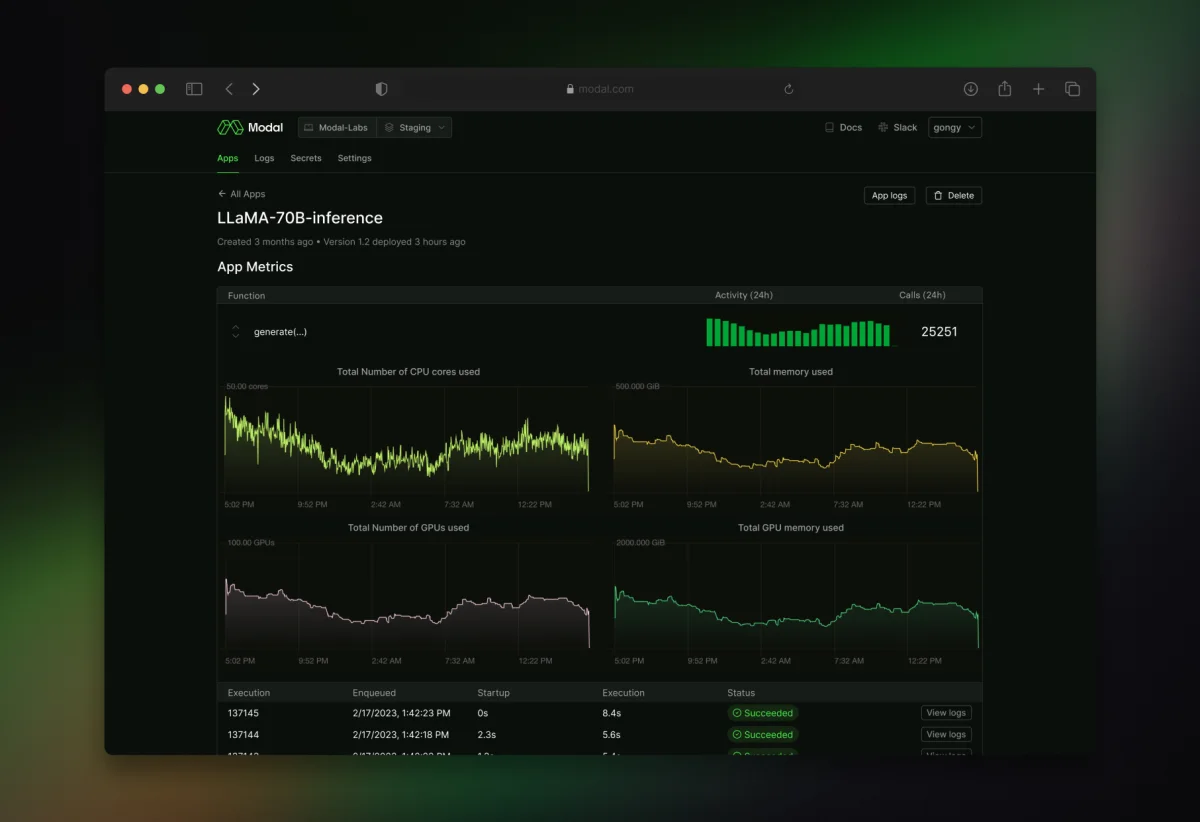
Current Use Cases and Adoption
Modal has quickly gained traction among an eclectic mix of users. Organizations leverage it for diverse applications ranging from generative AI to computational biology. Notable users include:
Ramp: A prominent player in expense management, stated, "Our team loves the developer experience because it allows them to be more productive and move faster. Without Modal, these projects would have been impossible for us to launch."
Substack: The platform harnessed Modal for AI-powered audio transcription, facilitating high-efficiency processing on hundreds of GPUs simultaneously.
Suno: This AI music and speech generation firm expressed its reliance on Modal for scalable model inference, emphasizing the developer-friendly aspect of the platform.
Sphinx Bio: Operating in the life sciences sector, Sphinx noted how Modal allowed them to run complex protein folding models efficiently.
These varied use cases illustrate Modal’s flexibility and capability to cater to different industry requirements.
Future Plans and Funding
Modal's team is energized by their recent funding round, having raised $16 million in Series A financing led by Redpoint Ventures. The financing will enable the team to accelerate product development and explore adding features like multi-language support and enhanced capabilities across the data stack.
As they work on these enhancements, Modal aims to address the evolving challenges in data infrastructure, positioning itself as a vital player in the market.
Interested developers can stay updated by following Modal on Twitter or LinkedIn. To start using the platform, sign up at Modal's website or simply install the Modal Python package.
With its emphasis on user experience and capability to handle complex tasks efficiently, Modal seems poised to transform how developers manage and deploy data operations in the cloud.


