Meta's Muse: A New Era for Personal AI Agents?
- Gate
- Machine Learning
- Departs
- Crew
- Azeem Azhar
- Passengers
- 726
Meta's Muse app, recently launched and now top of the charts, aims to enhance user experience through AI-driven personal assistance—yet it raises questions about effectiveness and intent.

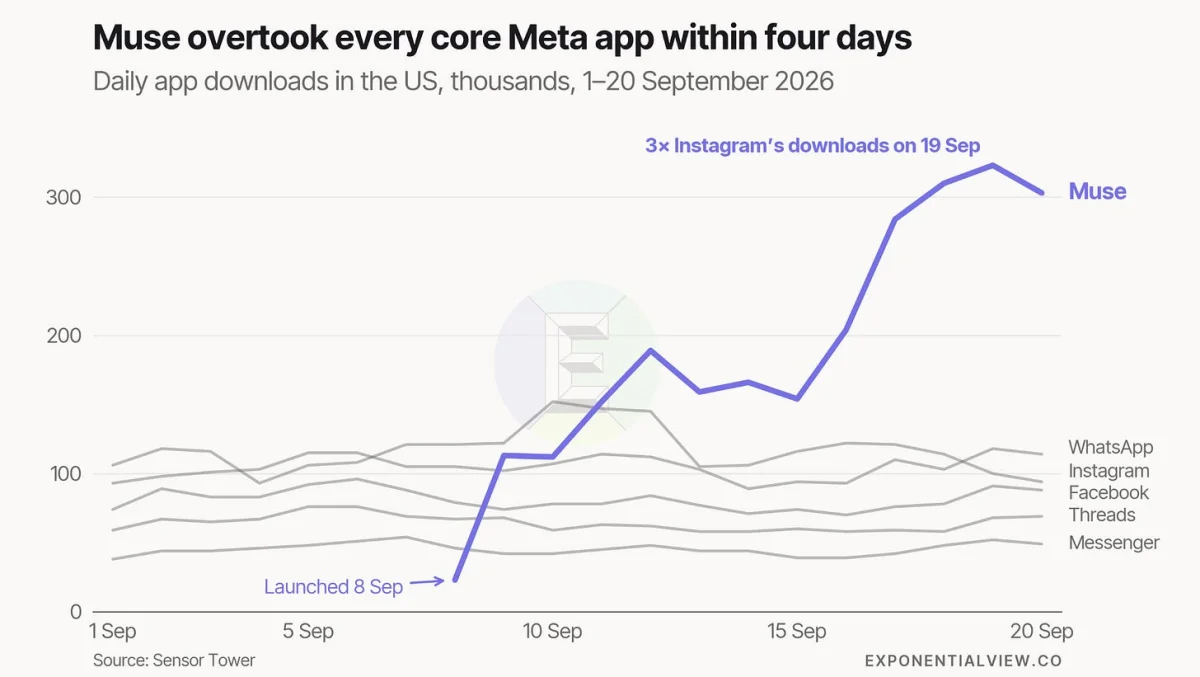
Meta introduced its latest AI application, Muse, which quickly ascended to the top of the free iPhone apps in the U.S. shortly after its launch. Muse is positioned as a personal AI agent, akin to the invite-only assistant Instinct, and features a more approachable avatar named Jolly. This playful design may make Muse more user-friendly compared to other agents like R Mini Arnold, which has been utilized effectively for various personal tasks.


The historical concept of AI agents dates back to Pattie Maes’ 1994 vision, which framed these agents as personal assistants capable of learning from user interactions and other agents. This aim remains relevant today. Users generally expect these digital assistants to streamline tasks and facilitate quicker problem-solving efforts, making them more attractive alternatives to traditional web interactions.
Jolly, Muse’s avatar, mirrors this ethos of facilitating communication. Users of Muse reported positive early outcomes, such as one individual receiving $250 in compensation for a delayed flight mere five minutes after requesting it through the app. This aligns with a growing trend demonstrating that users seek AI agents that can efficiently manage their needs.
Assessing Muse’s Effectiveness
While Muse has generated substantial interest, the app's long-term viability remains uncertain. Out of nearly three million downloads, over 95% of the users are already Facebook users, which raises concerns about whether this figure represents genuine new engagement or just existing user migration. The platform has a shaky history with new ventures, having seen mixed results with features like Facebook Marketplace, the Metaverse, and more. Initial estimates suggest that about half a million individuals are actively using Muse, but further insights—such as data on daily active users and the diversity of tasks completed—are needed to assess its true impact.

From a business perspective, Muse offers Meta a potential revenue stream through transaction fees from partner companies, including major retailers like Walmart and Expedia. This model inherently complicates user loyalty, as the app may prioritize partners that generate revenue for Meta over the user's specific preferences.
Ultimately, the relationship between user guidance and subscription services may cause friction; users may find that their individual purchasing habits are influenced by commercial relationships inherent to Muse's design.
Interestingly, Shopify stands out as a partner for Muse due to its focus on smaller, quirky brands and creators—an area where traditional search engines like Google typically underperform. Meanwhile, Amazon has actively restricted Muse’s use of its platform, illustrating concerns that AI agents could disrupt traditional advertising revenue models. If agents like Muse encourage users to shop directly through alternative platforms, Amazon's substantial ad revenue could face significant challenges.
Structural Insights and Future Implications
The architecture of Muse suggests a forward-thinking approach to consumer AI interactions. Each user is granted a dedicated virtual machine in Meta’s cloud, enabling each agent to operate independently and efficiently. The ability for Muse to run multiple sub-agents in parallel can optimize performance while also addressing latency, a common drawback in many current agents.
However, the privacy aspect—where Meta claims that even employees like Zuckerberg won’t have access to user data—will be pivotal in building trust. Apple’s established focus on privacy and user autonomy presents a competitive challenge that Meta must contend with. If users perceive the AI as merely a gateway for Meta to collect data and charge fees, it could suffer from a lack of loyalty akin to other tech alternatives.
Discussions around AI are not just about technology, but also about user intent. While Muse seeks to be a personal assistant, it also engages in a relationship that profits Meta—a tension that could influence how users perceive its effectiveness and reliability. The agent may find itself at a crossroads between fulfilling user needs and fulfilling its monetary obligations to its corporate backers.
So, to sum up, while Muse has the potential to redefine how personal assistance is managed in consumer interaction, there are significant hurdles ahead. It's crucial to address how well these agents can genuinely serve their users’ interests versus those of the companies that own them. As newer apps enter the market, user preference will likely center around those that foster trust, transparency, and responsibility over mere functionality.
As the landscape develops, the question remains: will consumers find Muse to be a competent butler, or merely a means for Meta to influence their purchasing behavior? The clarity of purpose and loyalty exhibited by the AI agent could be what ultimately decides its success or failure.


