NVIDIA Vera Rubin Posts MLPerf Training and Agentic Inference Results
- Gate
- Machine Learning
- Departs
- Crew
- Shruti Koparkar
- Passengers
- 617
Vera Rubin leads NVIDIA’s MLPerf Training v6.1 submissions and reports over 10× throughput per watt on an agentic inference comparison still under review.
NVIDIA’s Vera Rubin platform is making its benchmark debut with strong results in both model training and agentic inference. The figures point to gains across different workloads, though the inference comparison is provisional and the training results don’t by themselves show how every deployment will perform.
In MLPerf Training v6.1, NVIDIA was the only participant to submit results across every benchmark. NVIDIA also reports that Vera Rubin NVL72 delivered up to twice the performance per GPU of its GB300 NVL72 system. In MLPerf Endpoints, its provisional Kimi K3 result reports more than 10 times the throughput per watt of GB300 NVL72 at a comparable minimum response speed per user. Those figures make the platform worth watching; understanding their scope and measurement conditions matters just as much.
Training results cover a broad set of workloads
MLPerf Training measures how long a system takes to train a model to a specified accuracy target. This round included large language models, image generation, recommender systems and reinforcement learning post-training. NVIDIA’s complete set of submissions makes its results broad within this benchmark round, while the reported per-GPU comparison offers an early view of Vera Rubin against the previous GB300 generation.
Training speed has practical consequences when teams need to update models as data or requirements change. Shorter runs can help teams iterate more quickly, but benchmark time is only one part of training cost. The result also depends on the workload, the system configuration and how efficiently the software keeps accelerators busy.
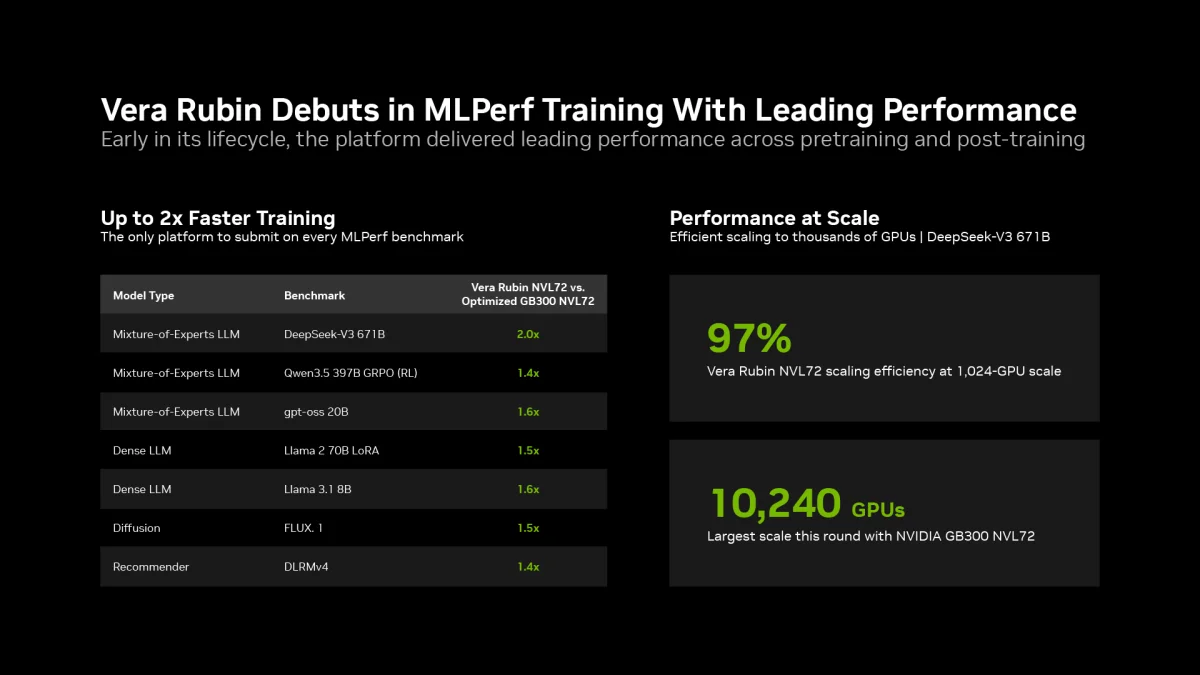
NVIDIA also reported scaling results for DeepSeek-V3. Vera Rubin NVL72 reached about 97% scaling efficiency when the system grew from 256 to 1,024 GPUs: the GPU count quadrupled while training time fell from 16 minutes to about four. This is a useful measure of how much work the additional hardware contributed in that specific run. It doesn’t establish that every workload or cluster will scale at the same rate.
At the largest scale reported in this round, NVIDIA ran the benchmark on 10,240 GPUs using GB300 systems. Microsoft Azure submitted a run at the same GPU count using GB200 systems. NVIDIA attributes its scaling approach to links between GPUs within a system through NVLink, and connections between systems using Quantum-X800 InfiniBand and Spectrum-X Ethernet, alongside software optimization. At these sizes, communication and coordination between accelerators can affect how much useful work each added GPU contributes.
Agentic inference puts power and response time in view
Agent workloads can involve repeated reasoning, tool calls and checks before a task is complete. That means one user request may require many rounds of model generation. MLPerf Endpoints evaluates systems on agentic coding and enterprise workflows and checks whether tasks are completed correctly, making it relevant to workloads where raw generation speed alone would miss part of the task.
NVIDIA says Vera Rubin leads across the agentic benchmarks in its MLPerf Endpoints submission. Its example is Kimi K3, an open model for agentic workflows. For the comparison, NVIDIA reports more than 10 times the throughput per watt for Vera Rubin NVL72 over GB300 NVL72 at a shared minimum end-to-end average interactivity of 50 tokens per second per user.
The detailed run conditions show why the headline needs context. Vera Rubin’s listed run used 32 accelerators at concurrency of 1,024 queries, with 41,414.2 system tokens per second and operating power of 100.89 kW. GB300’s listed run used 48 accelerators at concurrency of 48 queries, producing 2,210.4 system tokens per second at 60 kW. Average per-user interactivity was 50.4 tokens per second for Vera Rubin and 56.2 for GB300. The reported comparison uses throughput per kilowatt at the shared minimum interactivity threshold, rather than matching the two runs on accelerator count or concurrency.
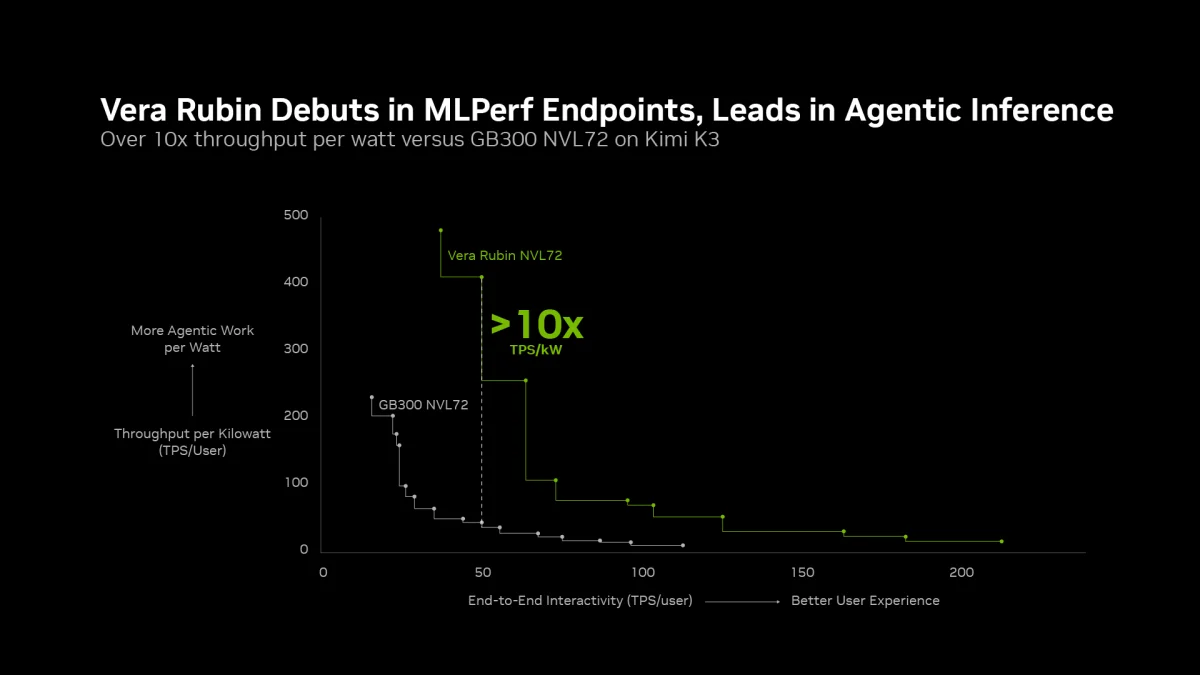
That distinction is useful for capacity planning: throughput per watt estimates how much system output a given power budget can support, while response speed and concurrency affect the experience and number of users served. The published comparison suggests Vera Rubin can sustain substantially more aggregate output under the stated interactivity condition. The provisional status means the result could change after review.
Partner submissions and remaining questions
Twenty organizations submitted MLPerf Training results, including ASUS, Azure, Cisco, CoreWeave, Crusoe, Dell Technologies, Google Cloud, HPE, Lambda, Oracle, Supermicro and the University of Florida. The participation shows that NVIDIA hardware is being tested across a range of partner systems. It does not mean every listed organization submitted on every benchmark or that results transfer unchanged to customer deployments.
NVIDIA also points to results on SemiAnalysis AgentX and Artificial Analysis AgentPerf, as well as high-performance computing workloads. Those references indicate interest beyond the MLPerf suites, but no scores or test conditions for those comparisons are included here, so they can’t be assessed on the same basis.
The near-term question is how Vera Rubin’s measured gains hold up across more workloads and production configurations. NVIDIA says continued optimization of its CUDA software stack will improve performance over time. For teams evaluating the platform, the reported training efficiency and agentic throughput are promising starting points; the benchmark details, power requirements and provisional status should guide comparisons with their own serving and training needs.