Slurm Adds Reusable Scheduling Support for Quantum Processors in Supercomputing Centers
- Gate
- Machine Learning
- Departs
- Crew
- Sam Stanwyck
- Passengers
- 765
Slurm’s new quantum interfaces aim to simplify QPU integration, while CUDA-Q updates extend NVIDIA’s tools for hybrid computing and research.
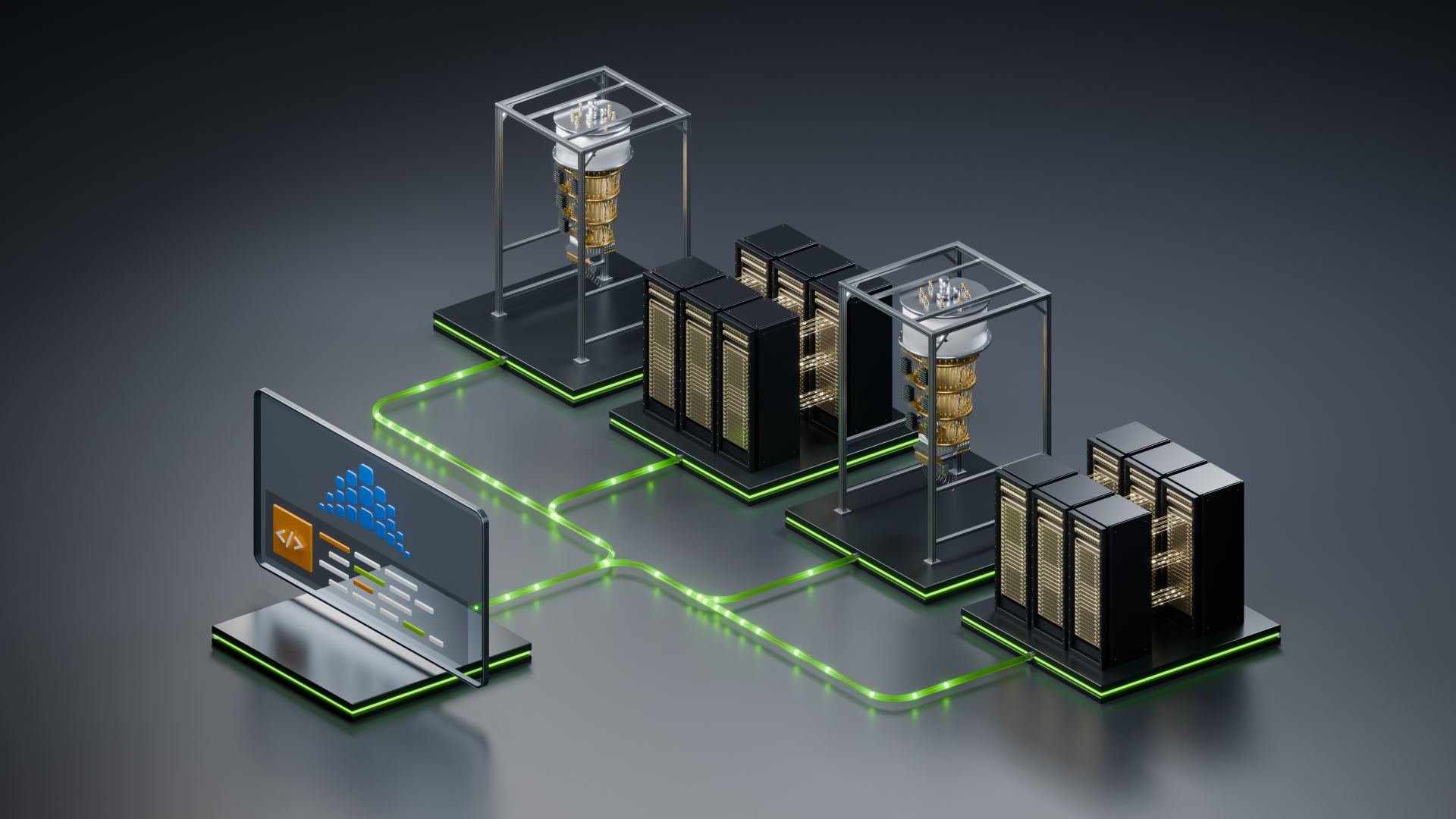
Adding a quantum processor to a supercomputing center has often meant building a new software integration for each pairing of hardware and center. NVIDIA’s Slurm expansion is designed to reduce that work: quantum processor builders can describe their hardware through a file-based interface, while centers can connect quantum resources to familiar scheduling and resource-management workflows.
The change targets a growing infrastructure footprint. Nearly 30 supercomputing centers worldwide are in the process of deploying more than 50 quantum processors, and deployments at these centers have grown nearly sevenfold over the past five years. Many already use Slurm to schedule scientific workloads, giving the new support a route into existing high-performance computing operations.
A shared path for quantum hardware
Previously, integrating a quantum processing unit (QPU) could require a separate software effort for each combination of processor and computing center. The expanded Slurm support builds on quantum and high-performance computing interfaces called QRMI and QDMI. The goal is for QPU builders to reuse an integration across their deployments, and for computing centers to add processors without creating a separate, hardware-specific scheduling solution each time.
That approach could make operational integration less repetitive, though it doesn’t remove the technical differences among quantum systems. Hardware still needs an interface that exposes the resources a center must manage. The practical value will depend on how well builders’ implementations fit their processors and how consistently centers can configure and operate them.
Alice & Bob, IBM, IQM, Pasqal, Quantinuum and MQSC are adopting the expansion. The release builds on earlier work with IBM, Pasqal and the broader quantum computing community. Slurm 26.11 is scheduled to become available later this month, according to the release information.
For researchers, the intended benefit is access through workflows they already use for shared computing resources. Applications that combine quantum and classical processing, including those developed with NVIDIA’s CUDA-Q platform, can use Slurm to coordinate access to the processing they need. That coordination matters when a research job spans different kinds of hardware: scheduling access becomes part of running the application, alongside the software that expresses the computation.
More components for hybrid quantum computing
The Slurm work sits within NVIDIA’s open quantum-GPU platform, which centers on CUDA-Q for hybrid quantum-classical computing. At SC26, the company also described updates across error correction, application development, algorithms and hardware control. Together, these tools address different stages of quantum research, from testing error-correction ideas to controlling qubits and running applications on classical accelerators.
CUDA-Q QEC is aimed at researchers prototyping and testing quantum error-correction methods. Its new decoder server is intended to support that work. NVIDIA reports that a TCBP-JOBS decoder is 13,000 times faster than what it calls the industry standard. The release does not specify the comparison’s test conditions or workload in the supplied details, so the figure should be read as a reported result rather than a general performance guarantee.
CUDA-Q is also gaining fault-tolerant primitives that application developers can use to compile ideas with more realistic assumptions. Fermilab used the platform for studies completed in three weeks that would normally have taken five months, according to the release. That example indicates a possible reduction in research turnaround time, though it does not identify the studies’ full computational setup.
CUDA-Q Algorithms adds reusable components for quantum application developers. The new capabilities include help with designing how data is loaded into quantum circuits, as well as tools for chemistry and materials research. Data loading is a consequential step in many quantum algorithms: the way classical inputs are encoded can affect the circuit a researcher must build and the resources the computation requires.
For hardware teams, CUDA-Q Pulse provides tools to shape the control pulses used to operate qubits, including GPU acceleration for generating them. This extends the platform beyond application code into a part of the hardware-control workflow where pulse design and processor behavior meet.
Examples span chemistry, control and simulation
Several projects show how the platform’s pieces are being used. Quantum Motion integrated its QUICHE chemistry framework with CUDA-Q. Altera and Oxford Quantum Circuits designed an FPGA-based controller that connects qubit control and readout to GPUs through NVQLink.
For large-scale simulation, QunaSys used cuQuantum and 1,024 NVIDIA Hopper GPUs on ABCI-Q to simulate more than 300 million quantum operations. The work reached chemical accuracy for a model containing four hydrogen atoms. Separately, NVIDIA researchers used JUPITER to simulate 104 qubits under realistic noise, testing fault-tolerant designs before building them.
These demonstrations cover distinct tasks and shouldn’t be treated as a single measure of processor capability. The four-atom result concerns a chemistry simulation on classical GPU hardware; the 104-qubit work concerns simulation under noise. Their relevance is in showing how classical supercomputers can support quantum research while physical processors and their control systems are integrated into shared computing environments.
Slurm’s expansion addresses a concrete adoption hurdle: the repeated work of connecting quantum processors to supercomputing operations. Whether it makes deployments easier in practice will depend on implementation details across hardware builders and centers. The next useful evidence will be how broadly the shared interfaces are adopted and how researchers use scheduled quantum and classical resources in real workloads.