GPT-6.2 Astra and Sol Cut API Prices, but Coding Results Remain Mixed
- Gate
- Machine Learning
- Departs
- Crew
- Michael Johnson
- Passengers
- 614
Astra lowers flagship API rates by 20%, while Sol keeps its lower price. Early coding tests show tradeoffs in output quality and agent communication.

GPT-6.2 Astra makes OpenAI’s higher-capability model cheaper to run, while GPT-6.2 Sol holds its existing lower price. Early examples point to a familiar tradeoff: lower API costs can make extended work more affordable, but they don’t guarantee stronger results or smoother interaction.
Both models are available through the API as gpt-6.2-astra and gpt-6.2-sol. LLM 0.38 also adds support for them. For teams choosing between the two, the clearest distinction in the available details is price: Astra is positioned for demanding projects, while Sol is priced for everyday work.
Astra’s lower rates change the cost of long sessions
GPT-6.2 Astra costs $8 per million input tokens and $40 per million output tokens. That’s 80% of the rates for GPT-6 Astra, which cost $10 and $50 respectively. The newer model’s cached input rate falls to $0.40 per million tokens, compared with $1 for the older Astra.
That cache discount could matter when an agent repeatedly uses the same context across a long session. Cached input is cheaper because repeated material doesn’t incur the standard input rate. The practical savings will depend on how much context a workload can reuse, how much output it generates, and how often the cache applies. The listed prices alone don’t show the total cost of a task.
GPT-6.2 Sol costs $2 per million input tokens and $10 per million output tokens, matching GPT-6.1 Sol and GPT-6 Sol. Those rates are half the $4 and $20 prices for GPT-5.6 Sol. For routine tasks, Sol therefore remains the lower-cost option in this lineup; Astra’s reduced price narrows the gap for workloads that need the higher-tier model.
Illustrations offer a small, visual comparison
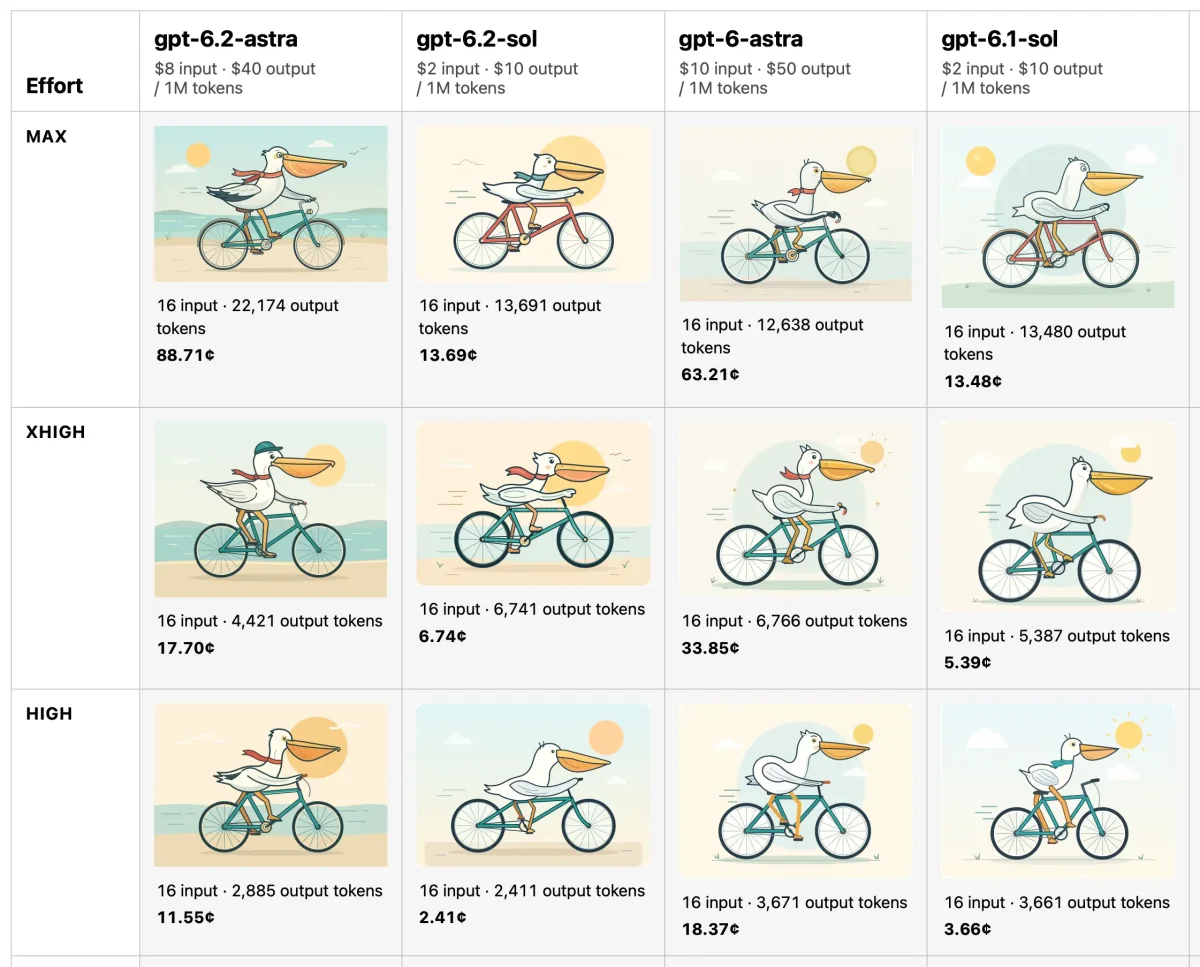
A pelican riding a bicycle serves as one test of how the models handle a visual prompt. In the Astra example, the bird’s pose is clearly defined: a wing rests on the handlebars, its feet sit on the pedals, and the image includes a pouch and a hooked bill. The accompanying comparison grid varies the model and effort level, making it possible to inspect changes in detail and pose alongside the listed cost for each image.
The examples suggest that effort settings affect both the output and its price. In the grid, GPT-6.2 Astra’s Max image is listed at 88.71 cents, while its High image is 11.55 cents. GPT-6.2 Sol’s corresponding examples cost 13.69 cents and 2.41 cents. Those figures describe the illustrated runs, not a general price guarantee for every image task.
The comparison also records differences among releases. Astra’s Max image has layered feathers and a scarf; its High image simplifies the feather detail while retaining the riding pose. Sol’s Max and Xhigh images show a clearer pedaling stance than its High image. These are useful visual checks, but they don’t establish how either model will perform across other image prompts.
GPT-6.2 Sol pelican and GPT-6.2 Astra pelican examples can be viewed separately. The full comparison grid includes earlier Astra and Sol releases.

A complex coding task exposes limits
A separate test used Codex CLI at the Ultra effort setting to request a Three.js animation of Yonkers transforming into a large mech and stomping around Manhattan, Queens, and Brooklyn, using OpenStreetMap data. Neither Astra nor Sol produced a convincing transformation. The results were judged weaker on that point than examples made with Claude Fable 5.2 and Gemini 4 Carbon. This is one prompt rather than a broad benchmark, but it shows why a lower rate or a more detailed illustration should not be treated as evidence of stronger performance on complex coding work.
View the Sol animation and the Astra animation. A side-by-side video places Astra in the top half and Sol in the bottom half:
The comparison video was assembled with Astra in the Codex desktop app. The prompts asked it to combine the two animations, label each half, make the video square at 2000 by 2000 pixels, and then extend it to 20 seconds. The exported transcript documents that editing sequence. That task shows Astra handling a follow-up media edit, though it doesn’t erase the shortcomings in the original animation request.
Agent coordination can create friction
Early feedback on Astra has also raised concerns about its communication during long tasks. One report describes the model coordinating multiple subagents effectively, then stopping to ask the user about a low-level implementation choice. In the example, a project to make a new Outer Wilds level stalled over which of two filenames a reviewer should use for video clips.
“When this model is working on long tasks, it can pull in a lot of subagents and manage them pretty well. It will then proceed to randomly ask you some weird internal implementation detail bullshit that you could not under any earthly circumstance understand, much less have input on.”
“I sent ‘/goal make a new level for Outer Wilds’. 2 hours in, it's ‘blocked’ because it wanted to ask me ‘does r24's reviewer write it's clips to 24_g521.mp4 or 24_p11.mp4?’”
The complaint points to a practical issue for agent workflows: delegation is useful only if the model knows which decisions require user input. A system that pauses for details the user can’t assess may consume time even when its subagents are making progress. The reported concern that Astra trails Fable 5.2 on some benchmarks adds another reason to evaluate the model on a team’s own tasks before shifting workloads.
For developers, the release presents two concrete reasons to test the models: Astra’s lower input and cached-input rates, and Sol’s unchanged low-cost pricing. The key evaluation should include task completion, output quality, total token use, and how often an agent interrupts for clarification. Those results will show whether the price reduction translates into cheaper work in practice.


