Understanding and Mitigating Host Overhead in AI Inference Workloads
- Gate
- Machine Learning
- Departs
- Crew
- Charles Frye
- Passengers
- 901
Host overhead significantly impacts AI inference efficiency, causing wasted GPU potential and increased costs. Strategies to minimize this inefficiency are discussed.
Introduction to Host Overhead in AI Inference
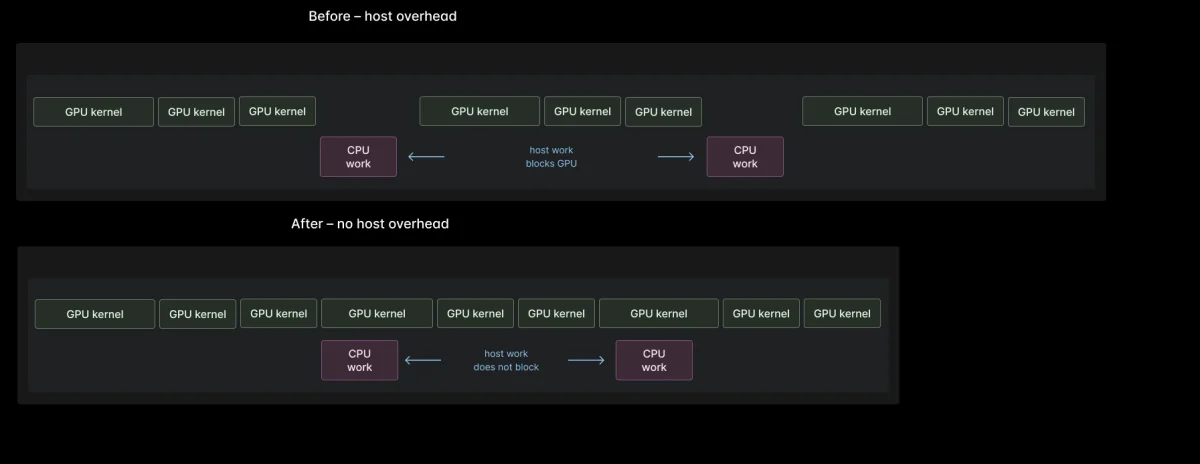
In asynchronous systems such as React and the Linux kernel, the core principle is to avoid blocking the event loop. This concept mirrors the requirements for AI inference workloads: avoiding GPU blocking is essential for efficiency. Occurrences of host overhead arise when the GPU is blocked, leading to inefficiencies during inference tasks. This article explores the identification of host overhead, its detrimental effects on efficiency, and effective strategies to minimize it, including improvements in production-grade open source inference engines.
Identifying Host Overhead Through GPU Utilization
Current AI inference systems often suffer from inadequate responsiveness, hindering user expectations where any delay beyond a few hundred milliseconds may deem a system "slow." To address these issues, software engineers must maximize available hardware resource utilization while awaiting anticipated improvements in silicon design.
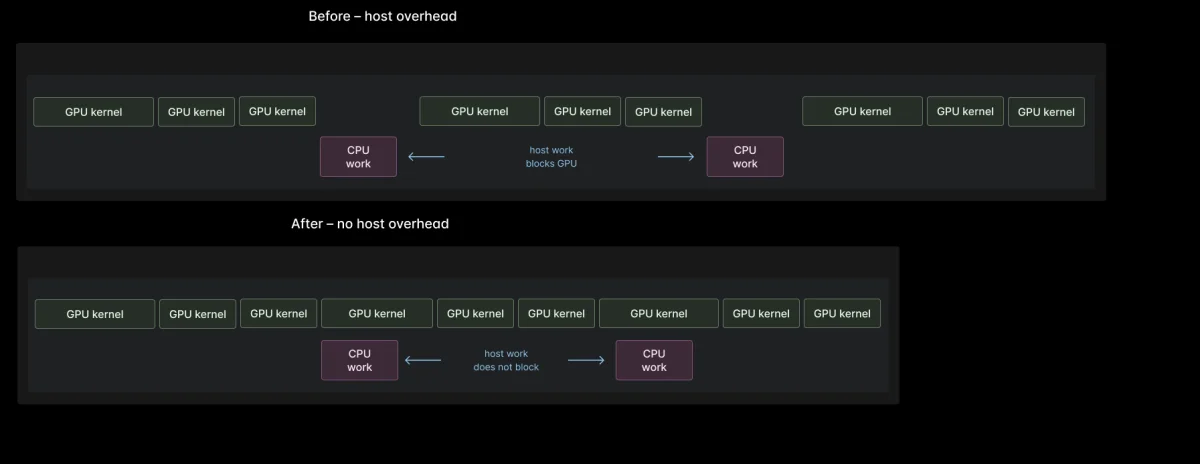
Host overhead is evident through low GPU kernel utilization. GPU utilization is typically reported by tools like nvidia-smi, but a more precise term is GPU Kernel Utilization, which quantifies the fraction of the GPU's capacity being utilized for executing CUDA kernels. Effective usage implies that a CUDA kernel must be active on the GPU continuously without interruption.
To expose instances of host overhead, it's beneficial to utilize profiling tools, such as the PyTorch Profiler or Nsight Systems. Analyzing the traced outputs visually can highlight execution "gaps" within the CUDA streams. These signify prime opportunities for rectifying host overhead.
Consequences of Inefficient Host Management
With modern data center GPUs capable of executing approximately one million floating point operations per nanosecond, periods when the GPU is idle—due to CPU delays in managing tasks—translate to significant computational losses. An inference process with 50% host overhead, for instance, incurs double the GPU costs, which typically dominate overall inference expenditures.
To illustrate, consider the role of a ship's navigator during an expedition. If the navigator is slow to issue new directions, the ship remains idle, incurring “navigator overhead.” This analogy aptly reflects GPU operations where the CPU hosts act similarly, deciding necessary computations, and a delay in direction may lead to inefficiencies in processing.
Minimizing Host Overhead Through Efficient Data Management
One prevalent cause of host overhead stems from unnecessary synchronization with the CPU, which can slow overall performance. For example, consider a scenario where the CPU assembles a tensor of position embeddings before sending it to the GPU. It can be more efficient to assemble specific tensors directly on the GPU, especially when patterns can be anticipated, such as always creating tensors with specific properties during decoding.
In other instances, unnecessary data transfers between the CPU and GPU have been identified as key efficiency bottlenecks. By constructing data on the GPU instead of transferring it post-creation, systems can avoid synchronous data transfer delays—this strategic decision can lead directly to improved inference speed and reduced overhead. Further details can be found in our pull request.
Kernel Launches and Host Overhead
Every CUDA kernel launch inherently risks additional host overhead. For instance, if a ship performs a series of short directional changes, it temporarily idles after each command—cumulatively leading to significant downtime. In rapid execution environments, every microsecond counts, and with latency capable of executing a billion operations in the rendered time frame, the effects aggregate swiftly.
For example, an 8 GB B200 GPU with HBM3e memory can stream a sizable model from RAM to registers within a mere millisecond. However, large models composed of numerous layers can indeed demand hundreds of kernel launches, collectively adding to the time spent idle. Simplifying this spectator model with consolidated kernel execution serves to mitigate launch overhead while increasing efficiency.
Strategies for Reducing Kernel Launch Overload
Kernel fusion is a pivotal technique for minimizing overhead by merging kernel launches into singular executions. This can be achieved either manually or through optimization frameworks such as the Torch compiler. In a significant implementation, kernel launch numbers were reduced from around 20 to just 3, eliminating roughly 30 microseconds of host overhead and yielding a notable 20% reduction in average end-to-end latency. More specifics are available in our pull request.
Utilizing CUDA Graphs for Enhanced Performance
For achieving further reduction in kernel launch overhead, merging kernel launches through an advanced technique like CUDA Graphs can be beneficial. This straightforward amalgamation of multiple directed kernel launches can be accomplished in production environments, enabling a single launch of extensive inference tasks. The integration of CUDA Graphs into production inference engines, such as SGLang and vLLM, is expected to become a standard practice as models and systems continue to develop.
Conclusion: The Path Forward in AI Inference
At Modal, we recognize that every nanosecond is significant, particularly in the context of high-stakes AI workloads where host overhead leads to unacceptable performance losses. Through our contributions to open-source inference engines, we aim to enhance operational efficiencies and push forward the boundaries of effective inference with open models. If you’re working in AI inference and share these priorities, we’re here to assist. Reach out about our highly optimized AI infrastructure designed to meet your needs.
Join our efforts: If you’re interested in contributing to the development of open-source inference engines, explore opportunities with us as we’re hiring. Be prepared to engage in optimizing code paths for significant performance enhancements.


