Lambda Uses NVIDIA Photonics Switches to Connect AI Clusters With More Than 10,000 GPUs
- Gate
- Machine Learning
- Departs
- Crew
- Brian Sparks
- Passengers
- 328
Lambda reports lower network latency and cooler optics in a deployment of NVIDIA Photonics switches, while retaining throughput across cluster configurations.
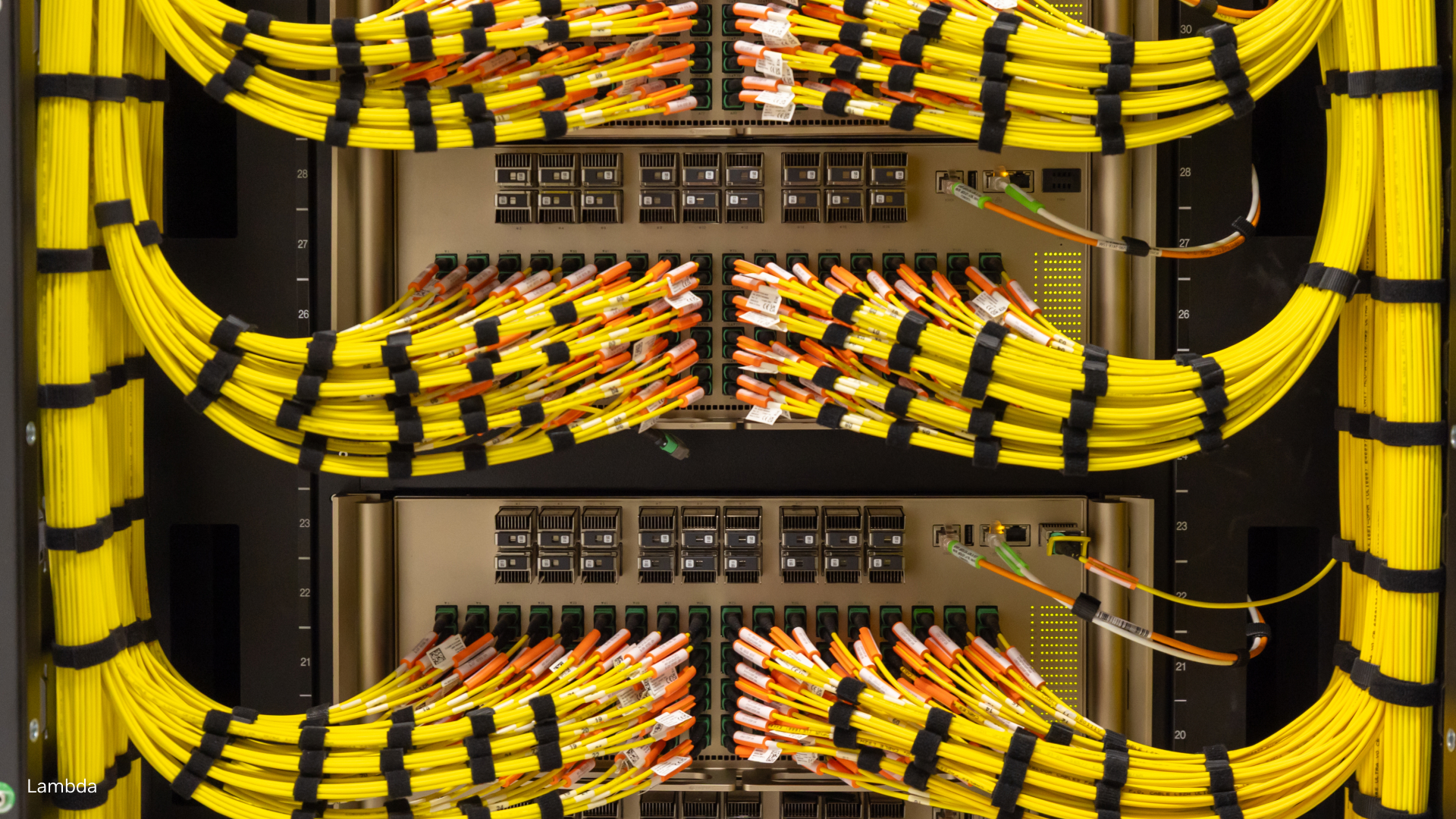
Networking can limit the pace of large AI workloads even when thousands of GPUs are available. Lambda is using NVIDIA Photonics switches with co-packaged optics to connect NVIDIA GB300 NVL72 racks in a system with more than 10,000 GPUs. The deployment puts optical components closer to the switch chip, with the aim of reducing power use and improving network reliability at cluster scale.
Lambda reports that its tests found network latency about 4% lower at rack scale and up to about 10% lower at pod scale. Throughput stayed the same as with conventional pluggable optics across rack, scalable unit and pod configurations. Those results point to a potential efficiency improvement without a reported loss in data-carrying capacity, though the figures are specific to the company’s tests and configurations.
Why network interruptions matter
Large training jobs depend on GPUs exchanging data across the cluster. If a network link fails or becomes unstable, the effects can extend beyond the devices directly attached to it: work across a much larger portion of the job may have to wait. That makes link reliability a practical factor in how much useful compute a cluster delivers.
Network performance also matters for agentic inference, where multiple agents may communicate as they carry out a task. A disruption can add latency across connected steps. In both cases, network interruptions can consume time that would otherwise go toward computation. Power has a similar tradeoff: electricity used by networking equipment is unavailable for other parts of the data center’s workload.
Lambda president of cloud services Dave Ward said that network infrastructure needs to keep up with larger AI clusters. He described deploying co-packaged optics at this scale as a step toward infrastructure for future AI systems. The deployment provides a practical example of that approach in a large GPU environment, although the reported results do not establish how it will perform across other cluster designs or operating conditions.
Optics integrated with the switch package
Conventional pluggable optics use separate transceiver modules to convert electrical signals from a switch into optical signals for transmission over fiber. NVIDIA Photonics instead places optical engines on the same package as the switch chip. That brings the electrical-to-optical conversion closer to the chip and shortens the electrical path from inches to millimeters.
Shorter paths reduce signal loss, according to the product description, and remove the need for retimer chips in the signal path. That can reduce both power consumption and the number of components involved in transmitting data. NVIDIA says Photonics offers up to five times better power efficiency and up to 15 times higher reliability than conventional pluggable optics. These are maximum comparisons reported by the company; Lambda’s supplied test results do not give a separate measured power reduction or reliability rate for its specific deployment.
The design also uses four times fewer lasers, which reduces the number of light sources that could fail. Each Lambda switch has 18 removable external light sources. Those modules provide light to the optical engines, which turn electrical signals into light for transmission between parts of the cluster. Technicians can replace a failed light-source module in the field. With traditional pluggable optics, a laser failure requires replacement of the entire module.
Cooling and reported operating results
Lambda’s switches have 144 ports, each running at 800Gb/s. Liquid cooling removes heat from the switch chip and optical engines. In the company’s measurements, the median optics temperature was 36°C, compared with 51°C for conventional pluggable optics. Lambda also reports more stable signal integrity in its tests.
Temperature and signal stability are relevant to sustained operation, but the reported figures alone don’t show how often failures occur over time or how maintenance needs change in production. The claim of longer mean time between interruptions likewise describes a goal of the design; the article does not provide a measured duration for that metric.
For operators, the main tradeoff to assess is whether the integrated optics, cooling setup and serviceable light sources deliver the expected benefits in their own workloads and facilities. The reported latency improvements vary by deployment scale, while throughput remains comparable in the tested configurations. That makes broader operational data—especially power use, interruption frequency and maintenance experience—useful evidence to watch as co-packaged optics move into more large-scale systems.
More information is available from NVIDIA Photonics and Lambda’s deployment details.